


[2022 Unmanned Vehicle Industry Exhibition] MBC: "Terrestrial broadcasting networks will become UAM communication channels."
 Published2022.08.19 14:38
Terrestrial broadcasting networks are gaining value as UAM communication tools.
Experts have argued that 'RTK (Real Time Kinematics)' must be applied to establish commercial services utilizing unmanned vehicles, and that terrestrial broadcasting networks must be utilized as a means of UAM communication for this purpose.
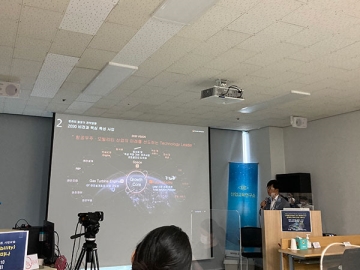
At the “2022 Urban Air Transport Tech Day,” held as a side event of the “2022 Unmanned World Congress (UWC)” held at COEX in Seoul from the 17th to the 19th, MBC Technology Information Business Division Deputy Manager Shin Hong-ki gave a presentation on the topic of “RTK Technology Trends for Unmanned Vehicles and Exploration of UAM Skyways.”
In his presentation, Vice President Shin Hong-ki discussed trends in broadcasting technology and RTK, the need for RTK in unmanned vehicles, and related UAM communication methods.
RTK (Real-Time Kinematic) technology is an advanced GPS system required to maintain centimeter error in real-time location information while moving.
Information obtained through observation of how patterns that cause errors in GPS signals appear is called error information (correction information). This is created at the ground station and sent to the RTK receiver, which compensates for errors at the terminal (if it is in close proximity) and increases accuracy.
RTK is a technology that improves the accuracy of GPS positioning, but it requires a high level of understanding and complexity. Recently, the commercial RTK correction information service market has been growing rapidly, and cooperation and competition between terrestrial broadcasters and mobile carriers are at the center of this growth.
Domestic RTK application cases include Sejong Domino's Pizza, Forty Two Dot acquired by Hyundai Motor Company, and various fields such as smart agriculture, smart marine, driver's license scoring system, metaverse, and digital twin. Forty Two Dot is currently providing a call-based taxi service in the Sangam area.
The RTK project being promoted by MBC utilizes broadcast frequencies to provide convenient high-precision location information services in industrial fields such as smart agriculture and smart construction, and can be applied to cutting-edge technologies such as self-driving cars, drones, and IoT.
In his presentation, Vice President Shin stated that satellite navigation-based RTK technology has high usability and market potential in various advanced industries after the Fourth Industrial Revolution, and added, “Ultimately, due to the error problem of GPS, the application of RTK technology to unmanned vehicles will be necessary.”
In addition, he claimed that “terrestrial broadcasting networks are the main medium for transmitting RTK correction information and various key information in low and medium altitudes,” and that “they are an appropriate means of communication for UAMs that must fly in medium altitudes (300-600 m).”
Vice Minister Shin explained, “While it is true that UAM is designed as a mobile communications-based system, it is an infrastructure built primarily for mobile phone users on the ground. Broadcasting networks will be able to be utilized in high-altitude areas, that is, between 300 and 600 meters above sea level where UAM will operate.”
In the latter half of the lecture, Vice President Shin stated that the North American market has a higher utilization value of terrestrial broadcasting networks than Korea, and that this characteristic presents opportunities for exporting solutions for building ATSC 3.0-based RTK correction information services overseas.
He presented the advantages of advancing into North America from an economic and commercial perspective, saying, “The data characteristics of the correction information are also suitable for broadcasting, and the broadcasting technology standards in Korea and the United States are the same. He added, “In the United States, mobile communication only covers about 70% of the country, but if we now utilize the cellular network in areas where mobile communication is not available, we will be able to cover up to 95%.”
Comments
Related news
[2022 Busan International Motor Show] SKT UAM Team Leader Lee Seok-geon – “We will lead commercialization by 2025 as an integrated UAM service provider”
UAM (Urban Air Mobility) is an overall transportation system based on eVTOL (electric vertical takeoff and landing aircraft) powered by electricity, and is drawing attention as a next-generation eco-friendly transportation mode. We met with Lee Seok-gun, team leader of SKT's UAM Business Promotion Team, to hear about SKT's vision and aspirations for UAM services aimed at commercialization by 2030.
2022.07.20by 김예지 기자
"National-led research and development is essential to pioneer new UAM markets."
A forum has been established to examine the current state of the domestic UAM industry and discuss policy development and business directions from various perspectives, including development technology, certification, and business models. UAM industry is anticipated as a massive market with potential stemming from linkages across diverse sectors, and experts have reached consensus that national leadership and joint research and development participation from industry, academia, and research institutions are essential for pioneering the new UAM market.
2022.07.27by 김예지 기자
SKT, K-UAM demonstration project 5G commercial network construction
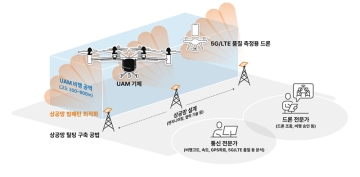
SK Telecom operated a communication quality measurement drone in a trial test related to 5G aerial network near the Goheung National Aviation Testing Center, verifying service quality based on communication altitude and distance.
2022.08.08by 김예지 기자
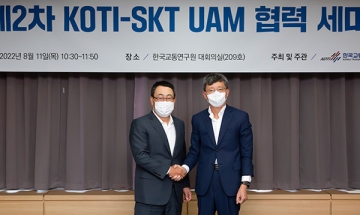
SKT-Korea Transportation Institute Hold UAM Cooperation Seminar
SK Telecom held a seminar with the Korea Transportation Institute on AI and big data-based UAM cooperation on the 11th. SKT and the Transportation Institute have been conducting joint research for UAM commercialization following a cooperation seminar led by representatives from both sides in early this year to lead the UAM industry.
2022.08.16by 김예지 기자
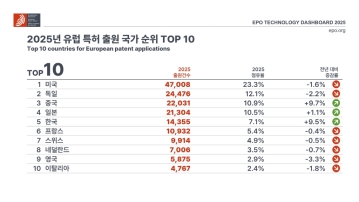
European Patent Applications Surpass 200,000 for the First Time… South Korea Maintains 5th Place, Led by Batteries and Telecommunications
According to the European Patent Office (EPO)'s 'Technology Dashboard 2025', European patent applications last year reached 201,974, surpassing 200,000 for the first time. Korean companies and inventors filed 14,355 applications, representing a 9.5% increase from the previous year and maintaining 5th place by country. Battery, digital communication, and semiconductor technologies led the growth, with Samsung ranking as the top EPO applicant for the second consecutive year and LG reaching 3rd place. The presence of major domestic cities such as Seoul, Suwon, and Yongin was also confirmed. It was also revealed that Korea's European patent strategy is expanding beyond individual technologies to span the entire industry.
2026.03.24by 명세환 기자











