



The announcement of the "Mobility Innovation Roadmap" provides momentum for autonomous driving development.
 Published2022.09.20 08:55
Expanding and Building Detailed Maps of Major National Roads by 2030
The Ministry of Land, Infrastructure and Transport announced on the 19th the 'Mobility Innovation Roadmap,' a preemptive response strategy to leap forward as a global leader in the mobility era and to implement innovative services in the daily lives of citizens.
It contains a lot of content related to autonomous driving.
The goal is to commercialize Level 4 autonomous driving, making it a daily routine to rest or work in a vehicle, and to prevent traffic accidents.
To this end, the current passenger transport system will be re-examined to ensure it is compatible with autonomous driving by 2024, and a plan to reform the passenger transport system will be preemptively prepared.
△Support for the private sector will also be expanded to develop and expand new services utilizing autonomous driving, such as support for the transportation disadvantaged and priority passage for emergency vehicles.
Regulations, which have been discussed continuously, also appear likely to be innovated.
To proactively resolve the uncertainty faced by the private sector as it strives to commercialize fully autonomous driving, we plan to proactively establish a system for Level 4 by 2024.
Establish automobile safety standards (manufacturing standards) such as Level 4 vehicle systems (response to defects, etc.) and driving safety (ensuring safety in the event of a collision, etc.), and operate a separate performance recognition system even before establishing standards to support unrestricted operation of autonomous vehicles.
Originally issued a temporary operating permit The system that allowed vehicles to operate for 5 years has been improved so that vehicles with separate performance certification can operate regardless of the temporary operating permit period.
To enable free autonomous driving technology and service verification, we will designate at least one autonomous vehicle pilot operation zone per city and province nationwide by 2025 through the introduction of a system under which the Ministry of Land, Infrastructure and Transport designates autonomous vehicle pilot operation zones. After that, we will significantly expand regulatory exemptions by introducing a negative system in which regulatory exemptions are applied to all regions except for certain areas.
It also supports autonomous driving systems by overcoming the limitations of vehicle sensors through nationwide construction of real-time communication infrastructure between autonomous vehicles and between autonomous vehicles and infrastructure.
By 2030, real-time communication infrastructure will be built on roads nationwide (approximately 110,000 km). However, in congested areas such as urban centers where support for autonomous driving systems is particularly required, this will be preemptively built by 2027 through collaboration with local governments.
The communication method will be promoted based on direct communication (WAVE or C-V2X), but for non-congested areas, construction will be promoted in a hybrid manner, such as by utilizing existing mobile communication networks (V2N method) to build at high speed.
By 2030, we will expand the construction of high-precision road maps covering major roads and urban areas nationwide and establish a real-time update system.
In the first half of next year, the first mobility innovation highway will be selected to enable the demonstration of various autonomous driving services, such as autonomous truck platooning, by designating and operating autonomous driving-only lanes on existing highways.
The Ministry of Land, Infrastructure and Transport said, “As ICT and innovative technologies are being converged and integrated in the transportation sector, the emphasis is on maximizing mobility from the user’s perspective, and global competition to lead the mobility industry, a future growth engine, is also intensifying.” It added, “We will implement mobility innovation in daily life and launch the ‘full-scale opening of the mobility era,’ which is a key national task.”He said, “We will successfully implement the ‘Mak’.”
Meanwhile, this roadmap was prepared jointly by the public and private sectors through the 'Mobility Innovation Committee', co-chaired by Minister Won Hee-ryong and Professor Ha Heon-gu of Inha University, and comprised of 27 private industry experts.
Comments
Related news
.jpg)
GM Cruise to Develop Self-Driving Semiconductors
According to Reuters on the 13th, GM Cruise independently developed four types of autonomous driving semiconductor chips, citing cost and production volume reasons as semiconductor supply concerns for automotive applications persist.
2022.09.15by 성유창 기자
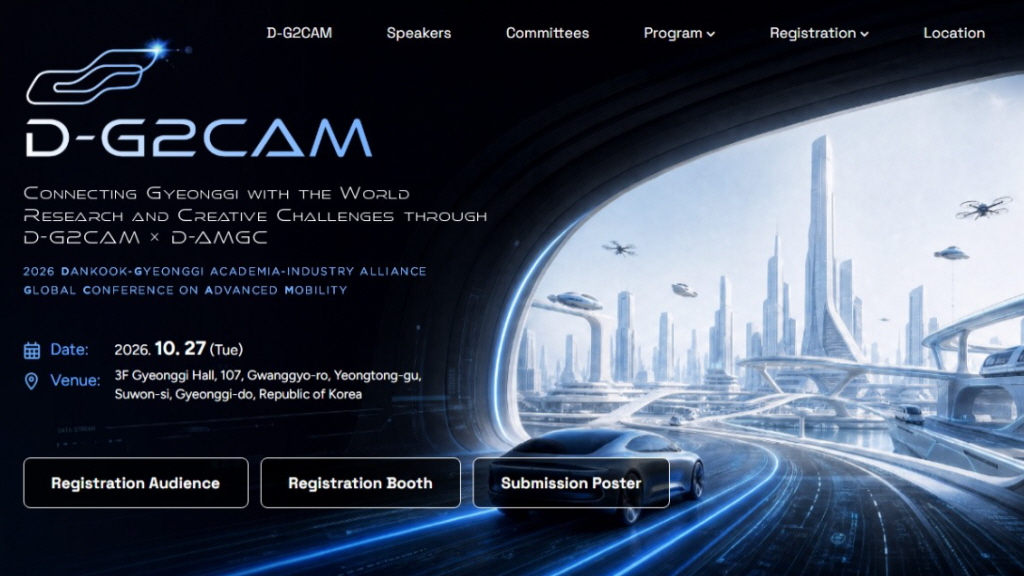
GAIA-Festa 2026, Autonomous Driving, AI, and Aerospace Experts Gather…Discussing Global Cooperation in the 'Silicon Intelligence Era'
GAIA-Festa 2026, which will be held in Suwon on October 27, is an industry-academia-research exchange event that explores the present and future of future mobility and AI technology through the global conference D-G2CAM 2026 and the international contest D-AMGC 2026. Domestic and international experts will share the latest research in autonomous driving, 5G/6G mobility, space technology, and data protection fields, while university students will showcase robots and physical AI prototypes that they have independently developed. Additionally, through poster presentations, corporate exhibitions, international cooperation meetings, and signing ceremonies, a platform will be established to connect the research capabilities and industrial needs of the Gyeonggi region with a global cooperation network.
2026.10.13by 배종인 기자
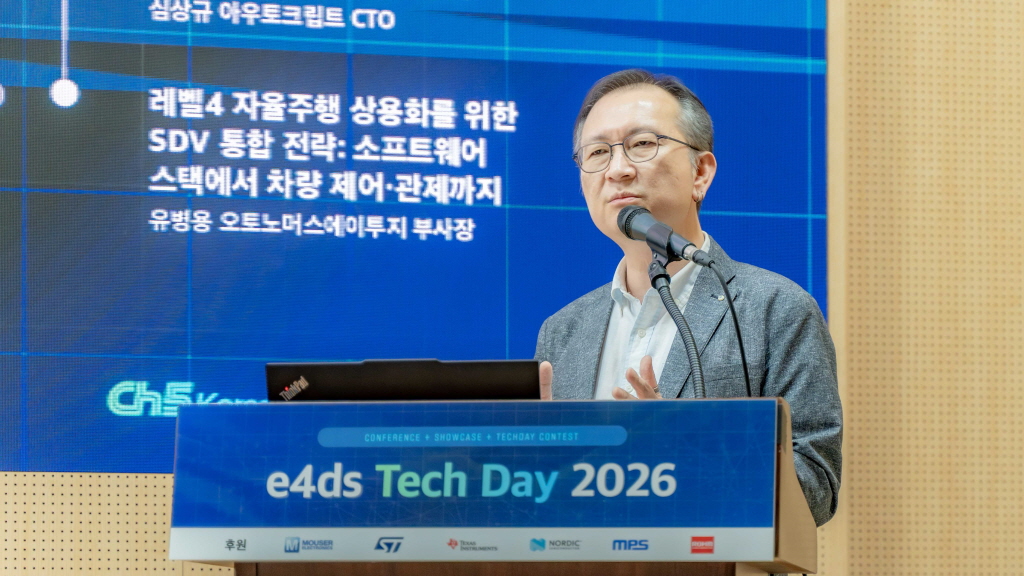
[e4ds Tech Day 2026 ⑨] Sim Sang-gyu, Autocrypt CTO: "In the Physical AI Era, Automotive Security Must Extend Beyond the Vehicle"
At e4ds Tech Day 2026, Sim Sang-gyu, CTO of Autocrypt, explained automotive cybersecurity strategies in the era of Physical AI and SDV (Software-Defined Vehicle). Automobiles are evolving as part of an ecosystem connected to AI, cloud, chargers, IoT, and robots, and he emphasized that the scope of security must expand beyond the vehicle interior to the entire connected environment. In particular, AI model tampering, adversarial attacks, OTA updates, and EV charger hacking were identified as major threats. He explained that response measures require zero trust, AI model integrity protection, intrusion detection, Security by Design and Default, and full lifecycle security management, and that proactive security system establishment beyond regulatory compliance is critical for securing future mobility competitiveness.
2026.10.12by 배종인 기자

Practical HIL Construction Strategy for Automotive and Off-Highway Controller Validation
As vehicle E/E architecture transitions to zonal structures and shifts to software-defined vehicles (SDV), the number of controllers (ECUs) requiring validation and software complexity are surging dramatically. Meanwhile, real vehicle testing cannot provide repeated verification under identical conditions and entails lead time and safety concerns. This white paper explains the principles of HIL (Hardware-in-the-Loop) validation and the structure of the NI platform composed of PXI, SLSC, and VeriStand, and through two actual implementation cases—Camera Record & Replay HIL for In-Cabin Monitoring Controller (ICMU) and Forklift Controller (VCU) HILS—describes how controller-level regression testing becomes possible. Additionally, it explicitly states application boundaries and limitations, such as lack of A2B support.
2026.10.12by 편집부
Korea Automotive Research Institute Signs MOU with Italy National Institute for Wireless Communications
The Korea Automotive Research Institute will sign an MOU with Italy's National Institute for Wireless Communications and launch joint research on next-generation mobility technologies based on 6G, V2X, and connected vehicles. The two organizations will conduct research to apply advanced wireless communication technologies to vehicles and discover international joint projects to advance next-generation connected vehicle technology development.
2026.10.12by 배종인 기자











