


5G is expanding into aviation, energy, and industrial safety sectors.
 Published2022.10.07 10:44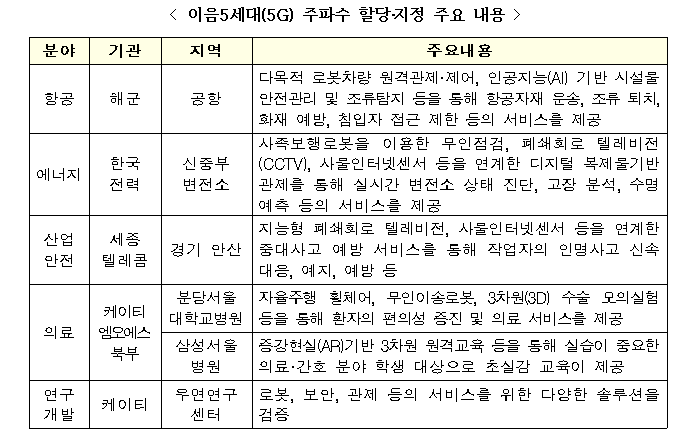
Additional allocations and designations completed for KTMOS North and Sejong Telecom.
As part of the Ministry of Science and ICT's plan to build an innovative network to implement the "Digital Strategy of the Republic of Korea," 5G is expanding into various fields, including the public sector (aviation, energy), and industrial safety.
The Ministry of Science and ICT announced on October 6 that it completed the allocation of 5G frequencies and registration of basic telecommunications business to KTMOS Book Co., Ltd. and Sejong Telecom, as well as the supply of 5G frequencies to the Navy, Korea Electric Power Corporation, and KT.
The Ministry of Science and ICT announced that through this 5G frequency supply, it will provide services such as AI-based airport control, substation management through digital copies, and prevention of major accidents in industrial sites.
5G is a communications network that utilizes 5G frequencies in specific areas so that desired businesses can directly build 5G networks. With this frequency supply, the number of operators allocated 5G frequencies for IEum has increased to seven, and for the first time, three organizations (Navy, Korea Electric Power Corporation, and KT) have been designated for IEum 5G frequencies.
'Frequency allocation' refers to the use of frequencies by telecommunications operators to provide services to others such as businesses or visitors, and these two companies have been added following Naver Cloud (December 2021), LG CNS (March and June 2022), SK Networks Service (May 2022), Naver Communications (August 2022), and CJ Olive Networks (August 2022).
'Frequency designation' refers to the use of frequencies by an organization to promote its own work, research and development, etc. through the use of wireless networks.
In terms of frequency bands, KTMOS North applied for 600 MHz of the 28 GHz band and 100 MHz of the 4.7 GHz band, while Sejong Telecom, the Navy, Korea Electric Power Corporation, and KT each applied for 100 MHz of the 4.7 GHz band.
The Ministry of Science and ICT announced that it has accepted the applicant's service plan and decided to supply the entire applied frequency band.
This frequency supply is significant in that it expands the scope of 5G utilization to new fields such as aviation, energy, public sector, and industrial safety, following the existing frequency supply for use in robotics, factories, medical, and media fields.
Park Yoon-gyu, Second Vice Minister of Science and ICT, said, “The government’s move to actively introduce 5G in areas that were previously unrelated to information and communication technology or relied on analog communication is in line with its direction to secure the world’s best digital competitiveness,” adding, “The government will continue to do more.” “We will actively support the establishment of a 5th generation (5G)-based network across the economy and society by introducing 5G in various fields,” he said.
Comments
Related news
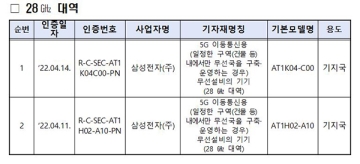
Radio Research Institute and Ieum 5G Base Station Launch in Full Scale
The National Radio Research Agency (Director Seo Sung-il) under the Ministry of Science and ICT has issued radio wave certification for dedicated equipment and modules for Unified 5G, establishing a full-fledged foundation for providing Unified 5G services.
2022.05.02by 김예지 기자
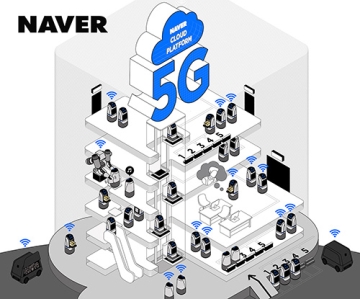
Samsung Electronics-Naver Cloud, Korea's first 'Eum 5G' commercialization
Samsung Electronics and Naver Cloud are collaborating to provide Korea's first 'Eum 5G (5G private network)' service at Naver's second headquarters building '1784' in Bundang-gu, Seongnam-si, Gyeonggi Province.
2022.06.02by 김예지 기자
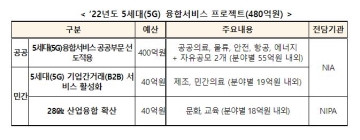
The Ministry of Science and ICT will invest 48 billion won in the Ieum 5G project.
The Ministry of Science and ICT, the Korea Intelligence Information Society Promotion Agency, and the Information and Communications Industry Promotion Agency announced on the 29th that they are launching a demonstration project for the '5G Mobile Communication Convergence Service Project'. This project comprises three demonstration businesses, and will invest a total of 48 billion won this year in the public and private sectors to demonstrate 11 tasks.
2022.07.01by 김예지 기자
Samsung Electronics Expands Public-Private 5G Equipment Supply
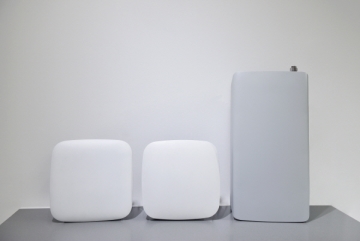
Samsung Electronics is expanding its supply of Open RAN 5G equipment for both public and private sectors, driving continued expansion of the Open RAN 5G ecosystem and promoting digital innovation.
2022.08.31by 배종인 기자
CJ OliveNetworks Eeum 5G Frequency Allocation
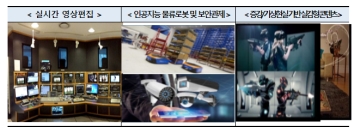
The Ministry of Science and ICT has completed the allocation of 5G frequencies for Eeum5G applied by CJ OliveNetworks Co., Ltd. and the change registration of telecommunications business on August 30th. Eeum5G is a 5G communication network that allows operators seeking to provide 5G convergence services in specific areas (land/buildings) to build and operate services using 5G frequencies.
2022.08.31by 김예지 기자











