


[ESG Management ②] Establishing a Practical Implementation Policy for RE100 is Essential
 Published2022.10.18 16:36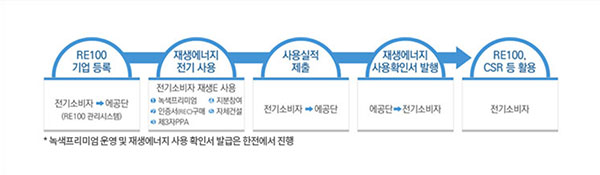
▲Korean RE100 Participation Procedure (Source: Korea Energy Agency)
"Korean RE100" establishes a foundation for RE100 implementation that reflects domestic realities.
Measures to reduce cost burden, such as minimizing additional costs for PPA and green premium systems.
As the global trend toward achieving Net Zero to address climate change continues, the importance of raising awareness of the 'Korean RE100 (K-RE100)' system to encourage genuine participation in the RE100 campaign by Korean companies is emerging.
Leading global companies have increasingly called on domestic companies to implement RE100 to increase the proportion of renewable energy in their supply chains. Companies such as Samsung Electronics, SK Group, and Hyundai Motors have already announced their participation in RE100 in response, and the government is also emphasizing the expansion of renewable energy supply.
Recently, it has been revealed that pressure to comply with RE100 has intensified not only on large corporations but also on small and medium-sized manufacturers. Therefore, it appears necessary to understand the current status of the government's RE100 demands and prepare countermeasures to meet them.
■ Differences between Global RE100 and K-RE100
The government has been establishing a foundation for full-scale participation by introducing the 'K-RE100' system tailored to the realities of our country to encourage many companies.
The Korean RE100 (K-RE100) is a system that allows electricity consumers to submit their renewable energy usage performance through the corporation's system and receive a renewable energy usage certificate, which can then be used for various purposes, such as participating in the RE100 campaign.
While the global RE100 is limited to influential companies such as companies that consume more than 100 GWh of electricity annually or Fortune 1000 companies, the Korean RE100 is open to anyone regardless of annual electricity consumption or company size, targeting industrial and general electricity consumers.
Meanwhile, the means of implementing Korea's RE100 include REC purchases, green premium systems, third-party PPAs, equity participation, and self-facilities.
The Green Premium System is a government reduction measure that is not recognized by the private sector, but it provides financial resources to the public corporation to be used for reinvestment in renewable energy. RECs are recognized as greenhouse gas reductions when electricity consumers directly purchase RECs (Renewable Energy Certificates) as a proof of their usage, and 'third-party PPAs' are also recognized as reduction achievements through agreements between power generation companies and electricity consumers mediated by KEPCO.
The Korean version of RE100 recommends setting a 100% implementation target by 2050, but allows for the voluntary setting of interim targets.
There are 105 companies that have joined the Korean RE100, including SK Group companies such as Kookmin Bank, Nonghyup, LG Display, SK Telecom, and SK Hynix, Hanwha Solutions, and Amorepacific.
■ Support tasks must be prepared to expand participation in RE100.
Meanwhile, in Korea, the three procurement methods are all 1.5 to 2 times the level of Europe, which was cited as the biggest challenge for domestic companies.
Accordingly, the government has proposed policy support tasks to expand domestic companies' participation in RE100.
First, by minimizing PPA additional costs, we will improve the structure that currently makes it difficult to conclude contracts at high unit prices. Additionally, when purchasing the green premium system, additional costs are exempted, so that duplicate charges are exempted, or costs at the level of climate and environment fees are excluded from the green rate system winning bid lower limit.
Expanding public-led large-scale projects to the private sector and simplifying administrative procedures for repowering aging renewable energy power plants will expand opportunities for direct investment by private companies.
It was announced that incentives will be provided for PPA resident participation projects, with incentives equivalent to the additional weight of REC.
The demand for a transition to renewable energy, which was previously centered on large manufacturing companies, is now expanding to include small and medium-sized manufacturers. The government will likely need to respond quickly to establish implementation policies tailored to the domestic situation.
Comments
Related news
[ESG Management ①] The Green Wave of Industry, RE100: Effectiveness Questioned
While an increasing number of companies are declaring RE100 commitments, concerns are being raised regarding the practical effectiveness of Korean companies' achievement of RE100 targets.
2022.10.14by 김예지 기자
.png)
September ICT exports reached $20.86 billion, recovering to $20 billion for the first time in three months.
The Ministry of Science and ICT announced that ICT exports in September 2022 decreased by 4.5% compared to the same month of the previous year, but reached $20.86 billion, and the trade balance achieved a surplus of $7.94 billion.
2022.10.18by 김예지 기자
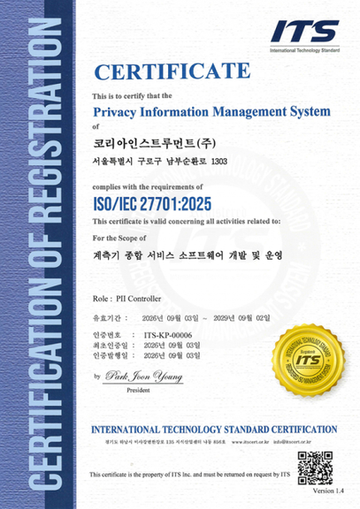
Korea Instrument, KOLAS Accredited Calibration Agency First to Simultaneously Acquire ISO/IEC 27,001·27,701
Korea Instrument has become the first among KOLAS accredited calibration agencies to simultaneously acquire ISO/IEC 27,001 and ISO/IEC 27,701 certifications. Through its proprietary platforms CWIZ Enterprise and CWIZ Partners, the company has embedded information security and personal data protection requirements across all business processes including customer information, equipment data, and calibration reports, with plans to continuously advance its management system through regular audits and security inspections.
2026.10.12by 배종인 기자
TeamViewer One, IT Incident Automation Workflow and Resolution Center Enhanced
TeamViewer has added IT incident automation capabilities and an advanced Resolution Center to its integrated digital workplace management platform 'TeamViewer ONE'. Recurrent service disruptions, configuration errors, and capacity shortages are automatically handled according to preset policies, and device status verification through script deployment can be managed in a unified interface, significantly reducing repetitive tasks for IT teams.
2026.10.12by 배종인 기자
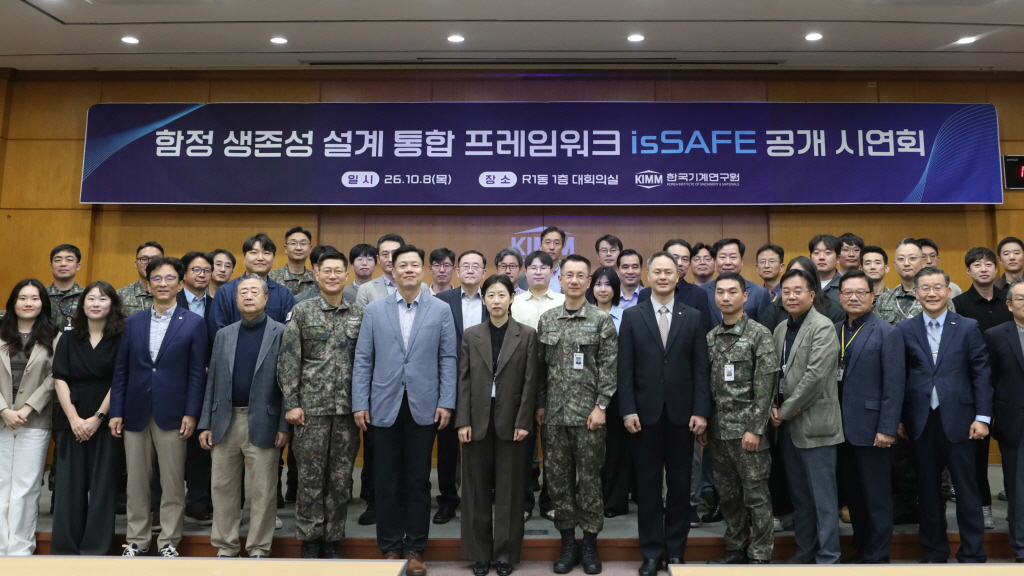
KAERI Develops Domestically-Produced SW 'isSAFE' for Integrated Warship Survivability Analysis
The Korea Institute of Machinery and Materials has developed domestically-produced software 'isSAFE' that comprehensively analyzes warship survivability. This design framework integrates the entire process—from warship modeling to hit scenario generation, vulnerability analysis, and results analysis—into a single platform, establishing an independent technology foundation in the defense technology sector that had previously relied on foreign software.
2026.10.08by 배종인 기자











