



“Manufacturing-Service Convergence, the Path to Advanced Manufacturing”
 Published2022.10.25 14:24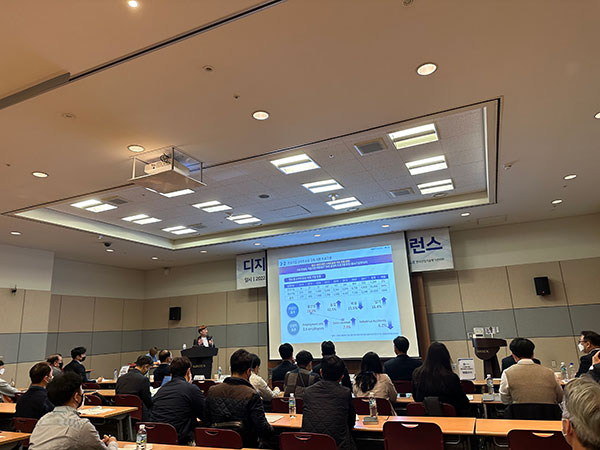
▲Song Byeong-hun, KETI Center Director
Participation by the Ministry of Trade, Industry and Energy, LS Electric, Doosan Energy, Hyundai Doosan Infracore, etc.
Smart factories, where the entire process is integrated, are significant in that they enable manufacturing companies to achieve the best QCD as a single factory with a standardized production process. One of the key issues is manufacturing services that focus on and approach customer utilization value.
A forum has been created for industry, government, academia, and research to discuss ways to strengthen future competitiveness through manufacturing-service convergence, with a view to the direction of future manufacturing service transformation. Experts have suggested that manufacturing-service convergence is the direction that manufacturing should take to advance its capabilities.
At the Korea Industry Fair held at COEX until the 21st, the 'Digital-based Manufacturing Service Conference' was held on the 20th (Thursday), where the Ministry of Trade, Industry and Energy's Machinery, Robotics and Aerospace Division, LS Electric, Doosan Energy, Hyundai Doosan Infracore, and the Electronic Technology Research Institute announced their respective strategies and held policy discussions.
■ Manufacturing service, manufacturing-based environment growth strategy
In his presentation, Song Byeong-hun, head of the KETI Smart Manufacturing Innovation Center, emphasized the promotion of net-zero in the manufacturing industry and the smartening of manufacturing services, and argued that a reversal strategy is needed to change the landscape for manufacturing companies by changing perceptions.
Smart factories were first introduced in 2014, but participation was difficult due to the lack of participation from mid-sized companies. To overcome this, discussions have emerged to gather individual companies and develop them into a single smart manufacturing platform centered on regional specialized industries.
Director Song said, “Our future goal is to operate an online platform that can provide services utilizing manufacturing data within the factory and to develop various applications.”
He also said, “We need to present ESG factors that take into account the domestic situation and present universal guidelines for the entire industry,” and ultimately, “It is important to increase the energy efficiency of machine tools and develop indicators of ESG management efficiency.”
In his presentation, Kwon Dae-hyun, team leader at LS Electric, argued that the beginning of smart manufacturing is to systematically collect standardized data, and that technological advancements must be achieved in stages.
Team Leader Kwon said, “We need to gradually improve system equipment to apply AAS, which is attracting attention as an international standard.”
.jpg)
▲Jang Se-young, Managing Director of Doosan Energy
In his presentation on industrial predictive maintenance solutions and services, Jang Se-young, Executive Director of Doosan Energy, argued that a professional service ecosystem that focuses on digital expert capabilities must be fostered.
Predictive maintenance is a different concept from preventive maintenance and post-maintenance maintenance. It is a maintenance method that checks in real time to predict future conditions. What it means to do predictive maintenance with a digital twin is to be able to look at equipment by maintenance component, examine components that are likely to have problems, and link them to component history data.
To revitalize the manufacturing service business, Executive Director Jang mentioned the following: △predictive maintenance organization, △process manual, △high accuracy requirements, △cloud service activation (ecosystem), and △creation of a remote service ecosystem.
Park Heung-geun, managing director of Hyundai Doosan Infracore, said that digital transformation is essential for smart construction and that convergence of various technologies is necessary to build a total solution.
The construction industry, which accounts for 13% of global GDP, is growing steadily every year, and smart construction is attracting attention as a market with unlimited business opportunities.
Director Park presented technologies such as future unmanned excavators through demonstrations of the future construction site solution technology implementation project 'Concept-X'.
The manufacturing service concept has been around for 20 years, but it is the most necessary field to align development with a business model based on customer utilization value. Manufacturing serviceization can strengthen the market competitiveness of existing products and create new customer-centered services, so it seems to be an appropriate growth strategy for the advancement of manufacturing.
Comments
Related news

Recruiting Trainees for Manufacturing Data Facilitator Training Course
The government is supporting the utilization of manufacturing data by training full-time employees of small and medium-sized manufacturing enterprises as manufacturing data facilitators, with plans to train a total of 100 facilitators this year.
2022.04.06by 김예지 기자
Asia's Largest Automation Exhibition… A Glimpse into the Future of Manufacturing
During the Corona era, as non-face-to-face work has become widespread and manufacturing companies are actively building advanced smart factories for the post-Corona period, an opportunity has been arranged to meet the technologies of domestic and international companies.
2022.04.07by 성유창 기자
Establishing a New Supply Chain, Digital Transformation is Important
Manufacturers are placing the highest priority on digital transformation when establishing new supply chain strategies.
2022.08.23by 배종인 기자
.jpg)
Demand for 30% Renewable Energy Use by Large Corporations: "Preemptive Policy Required"
According to a survey conducted by the Korea Chamber of Commerce and Industry targeting 300 domestic manufacturing enterprises, as RE100 has recently emerged as a key global supply chain issue, three out of every ten large domestic manufacturers in the manufacturing sector have been directly or indirectly required by global demand companies to use renewable energy in their product manufacturing processes. In response to the increasing demands for renewable energy use from global demand companies, it appears necessary to proactively address this matter in order to secure the supply chain.
2022.09.07by 김예지 기자

Mouser Electronics Adds 36 New Manufacturer Line Cards
Mouser Electronics, an authorized distributor supplying the latest semiconductors and electronic components worldwide, has added 36 new manufacturers to its line card, leading the way as a global authorized distributor in providing customers with cutting-edge technology.
2022.10.04by 배종인 기자











