



Full-scale acquisition of technological sovereignty for '12 major national strategic technologies'
 Published2022.10.28 11:47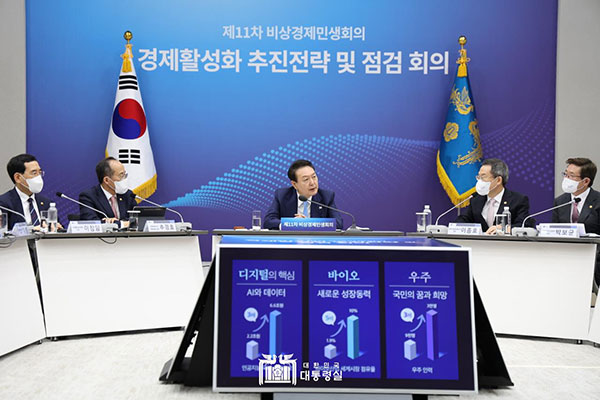
Semiconductor, display, mobility… Public-private joint topics
“Securing future growth and technological sovereignty by gathering public-private wisdom”
In an era of technological hegemony competition where cutting-edge technologies create future food, the Yoon administration has announced 12 national strategic technologies and set forth a vision to secure Korea's technological sovereignty.
The Ministry of Science and ICT announced on the 28th that it had announced the 'National Strategic Technology Promotion Plan' at the plenary meeting of the National Science and Technology Advisory Council held at the Presidential Office in Yongsan and chaired by President Yoon Seok-yeol.
This meeting, held after the launch of the government, was attended by President Yoon Seok-yeol, who is the chairman, newly appointed Vice Chairman Lee Woo-il, and 19 first-term civilian members, as well as the Prime Minister of the Ministry of Economy, the Ministry of Science and ICT, the Ministry of Trade, Industry and Energy, the Ministry of SMEs and Startups (minister), the head of the Science and Technology Innovation Headquarters, the Vice Minister of Education, the Senior Secretary to the President for Economic Affairs, and the Secretary to the President for Science and Technology.
The 'National Strategic Technology Development Plan' is a joint government-wide strategy and policy direction for developing nationally-led strategic technologies.
The fields selected as the 12 national strategic technologies are: △Semiconductors and displays △Secondary batteries △Advanced mobility △Next-generation nuclear power △Advanced bio △Aerospace and marine △Hydrogen △Cybersecurity △AI △Next-generation communications △Advanced robots and manufacturing △Quantum, etc. The 12 technologies were selected based on their strategic importance in areas such as supply chain/trade, new industries, diplomacy, and security.
In addition, for fields with high strategic importance, 50 detailed key technologies were specified and mid- to long-term plans were added, including R&D investment, international cooperation, and human resource development.
■ 12 National Strategic Technology Fields Promotion Goals
In the semiconductor and display sectors, full support for the non-memory semiconductor market is expected by targeting a system semiconductor market share of 3% (by 2021) → 10% (by 2021). The secondary battery export target is to achieve $7.5 billion (by 2021) → $20 billion (by 2030).
Urban Air Mobility (UAM), which is attracting attention as a next-generation mobility field, is aiming for commercialization by 2025, and major companies including SKT are currently forming the K-UAM consortium to conduct verification.
In the next-generation nuclear power sector, we aim to secure an independent SMR reactor by 28 years. In the hydrogen sector, we are also working on securing strategic technologies, with the goal of demonstrating a 10MW-class water electrolysis system by 2030 and launching a lunar lander using our own launch vehicle by 2031.
With the digital transformation, we will increase our competitiveness in the AI field, which is attracting attention as a cutting-edge future technology, and we will demonstrate 6G communication as well as 5G for the first time in the world in 26 years. Beyond industrial automation, the advanced robot and smart manufacturing market for building smart factories will leap forward to become one of the world's top three powerhouses, including Germany and the United States. We will also aim to secure 90% of the technology compared to the United States in the quantum field.
■ Public-Private Cooperation 'National Strategic Technology Project' Promotion
National strategic technology is promoted as a 'national strategic technology project' in which public and private sectors jointly set goals and make joint investments. The government announced that it will support the selection and implementation of eight additional projects by the end of 2023, starting with ‘next-generation nuclear power’ and ‘quantum.’
The main measures for the intensive fostering of national strategic technologies were presented as follows: △ Concentrating policy and investment support based on the strategic roadmap, △ Expansion of the strategic technology fostering base including talent, international cooperation, and industry-academia-research hubs, and △ Establishment of a comprehensive national strategy promotion system for technological sovereignty.
The government will establish a technology-specific strategic roadmap, rather than simply expanding quantitatively, and support mission-oriented R&D investment through linkages between ministries and businesses. In addition, it will focus its capabilities on securing key talents in national strategic technologies and strengthen international cooperation in science and technology with the U.S., the EU, and others.
In particular, we will strengthen cooperation between academia, industry, and research institutes as a national strategic technology fostering base and strengthen support for commercialization of strategic technologies by establishing regional technology innovation hubs.
We will establish a strategic technology governance centered on public-private cooperation and lay the foundation through the enactment of the ‘National Strategic Technology Special Act.’ This includes comprehensive support measures such as priority investment in R&D, promotion of challenging R&D, training of excellent human resources, and establishment of industry-academia-research hubs and international cooperation.
The government predicted that through the national strategic technology project, it would be possible to expand the number of strategic technology fields with a technology level of 90% or higher compared to the leading technology-leading countries from three (semiconductors, displays, secondary batteries, and next-generation communications) in 2020 to more than eight in 27 years.
Minister of Science and ICT Lee Jong-ho said, “In the current political climate where science and technology are at the center of the international order, we must pool the capabilities of the government and the private sector to foster 12 national strategic technologies that are the core links connecting the national economy and security.” He added, “We will pool the wisdom and capabilities of the public and private sectors, centered around the National Science and Technology Advisory Council, on strategic technologies that will affect our country’s core interests, thereby realizing future growth and securing technological sovereignty.”
Comments
Related news

[e4ds Tech Day 2026 ⑨] Sim Sang-gyu, Autocrypt CTO: "In the Physical AI Era, Automotive Security Must Extend Beyond the Vehicle"
At e4ds Tech Day 2026, Sim Sang-gyu, CTO of Autocrypt, explained automotive cybersecurity strategies in the era of Physical AI and SDV (Software-Defined Vehicle). Automobiles are evolving as part of an ecosystem connected to AI, cloud, chargers, IoT, and robots, and he emphasized that the scope of security must expand beyond the vehicle interior to the entire connected environment. In particular, AI model tampering, adversarial attacks, OTA updates, and EV charger hacking were identified as major threats. He explained that response measures require zero trust, AI model integrity protection, intrusion detection, Security by Design and Default, and full lifecycle security management, and that proactive security system establishment beyond regulatory compliance is critical for securing future mobility competitiveness.
2026.10.12by 배종인 기자
NVIDIA to Invest $1 Billion in U.S. Science Over Next Five Years
NVIDIA has announced plans to invest $1 billion over the next five years to strengthen U.S. scientific and technological competitiveness. The company will enhance cutting-edge artificial intelligence research and development capabilities in key areas including quantum computing, healthcare, and energy security, while expanding support for higher education research institutions and cloud service providers. NVIDIA is participating as a major industry partner in the White House Office of Science and Technology Policy's Genesis Mission, and is promoting supercomputer construction in collaboration with national laboratories including Argonne and Los Alamos.
2026.10.12by 배종인 기자
Korea Instrument, KOLAS Accredited Calibration Agency First to Simultaneously Acquire ISO/IEC 27,001·27,701
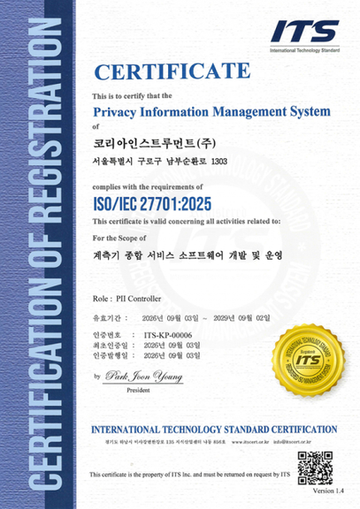
Korea Instrument has become the first among KOLAS accredited calibration agencies to simultaneously acquire ISO/IEC 27,001 and ISO/IEC 27,701 certifications. Through its proprietary platforms CWIZ Enterprise and CWIZ Partners, the company has embedded information security and personal data protection requirements across all business processes including customer information, equipment data, and calibration reports, with plans to continuously advance its management system through regular audits and security inspections.
2026.10.12by 배종인 기자
ETRI Unveils 3 Next-Generation Media Technologies Including AI-Dedicated Video Compression
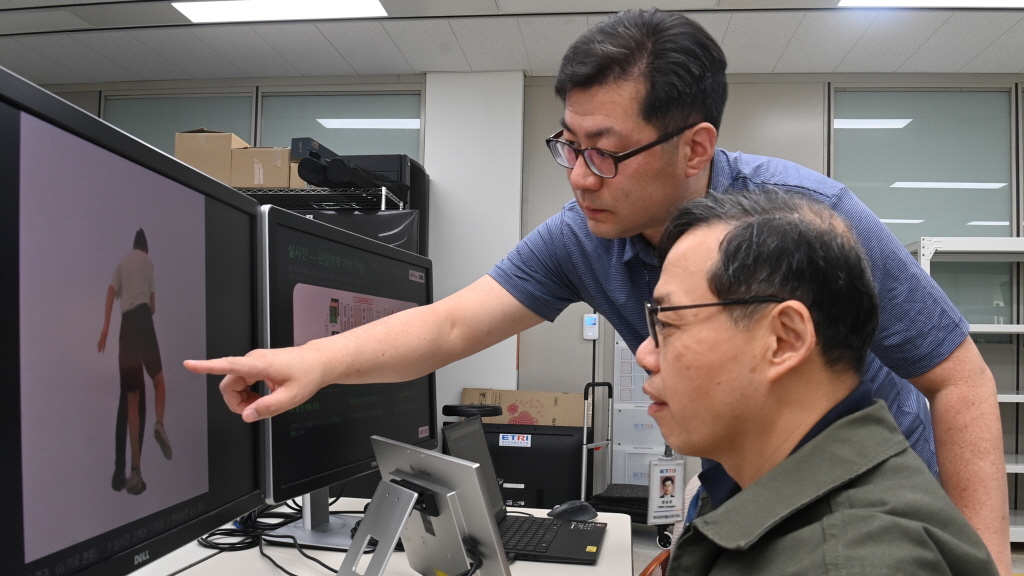
ETRI has unveiled three next-generation media technologies optimized for AI. These include AI-based video encoding (VCM), 3D human generation based on sparse cameras, and generative AI-based pre-visualization technology. In environments where AI directly processes video such as autonomous vehicles, robots, and drones, these technologies enable efficient compression and transmission of large-scale data, and can be applied across various industrial sectors including smart cities, video security, and sports broadcasting.
2026.10.12by 배종인 기자
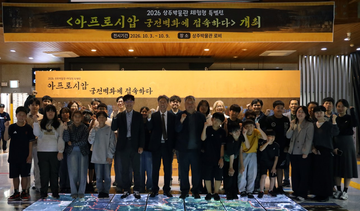
KETI Connects Domestic and Uzbekistan Museums Through Robot Telepresence for Remote Exhibition
The Korea Electronics Technology Institute (KETI) has hosted a remote experiential exhibition that connects domestic museums with an Uzbekistan museum in real-time using robot telepresence technology. Elementary school students in the Sangju area were able to directly operate autonomous robots to remotely view 7th-century Goguryeo envoy palace murals at the Afrasiab Museum in Samarkand, and the exhibition provides spatial experience comparable to on-site visits by combining real-time high-quality video transmission, AI docent, and autonomous driving technologies.
2026.10.12by 배종인 기자











