



Achieving 2050 Carbon Neutrality Begins in Full Swing
 Published2022.10.28 15:57
.jpg)
On the 26th, President Yoon Suk-yeol had lunch with the Carbon Neutral Green Growth Committee.
Considering domestic conditions… 100 key technologies for carbon neutrality
The Yoon administration is setting out to leap forward as a carbon-neutral global hub nation through the promotion of private-sector and local-led policies.
The Presidential Committee on Carbon Neutrality and Green Growth 2050 (co-chairs: Prime Minister Han Duck-soo and KAIST Vice President Kim Sang-hyup) announced on the 26th that it has newly appointed 32 private sector members and launched.
With the enactment and implementation of the Framework Act on Carbon Neutrality and Green Growth last March, the government announced that it has integrated the former 'Carbon Neutrality Committee' (Presidential Decree) and the 'Green Growth Committee' (Framework Act on Green Growth) into a single '2050 Carbon Neutrality Green Growth Committee' (hereinafter the Carbon-Green Committee).
The newly launched committee held its first plenary meeting to announce the 'Carbon Neutral Green Growth Promotion Strategy' and the 'Carbon Neutral Green Growth Technology Innovation Strategy,' and will also formulate detailed plans based on these.
The 'Carbon Neutral Green Growth Promotion Strategy' focuses on establishing effective plans to enhance feasibility through communication with stakeholders, and is based on public-private cooperation with the private sectorIt is said that carbon neutrality will be implemented under local leadership.
The key points are responsible practice, an orderly transition, and innovation-driven carbon neutrality and green growth.
To this end, the government aims to reduce greenhouse gases concretely and efficiently, foster technological innovation and industrial growth led by the private sector, and pursue a direction that garners the consensus of all members of society. Furthermore, by examining global trends, we will leap forward as a leading nation equipped with an active carbon neutrality system in the international community.
The 'Carbon Neutral Green Growth Technology Innovation Strategy' focuses on establishing a 'Carbon Neutral R&D Full-Cycle System' involving both the public and private sectors to accurately identify core carbon neutrality technologies and apply them in the field.
The goal of achieving carbon neutrality by 2050 is set forth with key directions, including: establishing a private-sector-led, mission-oriented technology innovation system through roadmap setting and public-private collaboration system operation; making rapid and flexible investments focused on core carbon-neutral technologies, such as shortening the preliminary feasibility study period from the existing 7 months to 4.5 months; and providing preemptive institutional support to create a foundation for technology innovation, such as joint research between industry, academia, and research institutes and strengthening the inter-ministerial R&D promotion system.
■ 100 Key Carbon Neutrality Technologies Tailored to Domestic Conditions
Science and technology are expected to be important in Korea due to conditions such as a high proportion of energy-intensive manufacturing industries, an unfavorable renewable energy infrastructure, and a tighter carbon neutrality deadline compared to developed countries.
In the 'energy transition' sector among key technologies, technologies such as solar power and SMR, which have diverse applications, are selected and intensively fostered in accordance with conditions such as limited land area and energy security.
In the 'Industry' sector, technologies such as eco-friendly fuel and raw material substitution methods, and CCUS are explored to suit Korea's industrial structure centered on high-carbon manufacturing.
In terms of 'buildings and the environment,' we are focusing on improving building energy efficiency and developing waste reduction materials to suit the reality of a high number of high-rise buildings and difficulties in waste disposal.
In addition, in the 'transportation' sector, internal combustion engine-based automobiles and ships are major players.Our country selects and innovates technologies such as next-generation batteries and actuator efficiency.
In addition, fields such as wind power (ultra-large wind turbine technology, etc.), power storage (ESS technology), power grids (intelligent transmission and distribution systems), carbon-free ships, steel, petrochemicals, and cement were presented.
Comments
Related news

Nvidia invests $5 billion in Intel
NVIDIA and Intel, leaders in global AI computing technology, are now forging ahead in providing cutting-edge solutions through NVLink-based architecture integration. NVIDIA and Intel have officially announced a strategic partnership and stated that they will jointly develop customized data center and personal computing products to accelerate diverse applications and workloads ranging from hyperscale to enterprise and consumer markets, thereby laying the foundation for the next generation computing era.
2025.09.22by 배종인 기자
.jpg)
Applied Materials Launches Environmental Protection Campaign to Mark World Cleanup Day
Applied Materials Korea (CEO Park Kwang-seon) is carrying out environmental cleanup activities with employees and their families around the Dongtan Sinricheon area on the occasion of World Cleanup Day, evolving into a company that engages with the local community beyond technological innovation.
2025.09.22by 명세환 기자
.jpg)
The combination of electrical and electronic technologies like AI, semiconductors, and electric vehicles with renewable energy will determine industrial competitiveness.
Professor Lim Chun-taek from Gwangju Institute of Science and Technology (GIST) stated in his keynote speech at the '2025 e4ds Tech Day' on the 9th, "Global energy investment is already shifting from fossil fuels to renewable energy, and the trend of electrification combined with electrical and electronic technologies is changing the industrial landscape."
2025.09.12by 배종인 기자
.jpg)
"Data Center Power Demand Surges: Distributed Energy is the Solution"
The power demand of data centers is surging rapidly alongside the accelerating growth of artificial intelligence (AI), cloud, and electric vehicle industries. In particular, the global power supply and demand structure centered on the United States is undertaking a massive infrastructure reorganization to adapt to this change, and Korea is no exception in this trend. As an alternative to overcome the limitations of the existing centralized power system, distributed energy systems and smart grid technologies are gaining attention.
2025.09.02by 배종인 기자
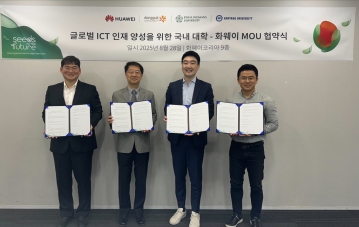
Huawei Begins Full-Scale Training of Young Korean Global ICT Leaders
Global ICT company Huawei Korea has signed a Memorandum of Understanding (MOU) with Dongguk University, Ewha Womans University, and Hanyang University, and will jointly implement a global education program to nurture next-generation ICT leaders.
2025.08.29by 배종인 기자











