


Universal Robots Leads Automation Solutions
 Published2022.11.02 11:42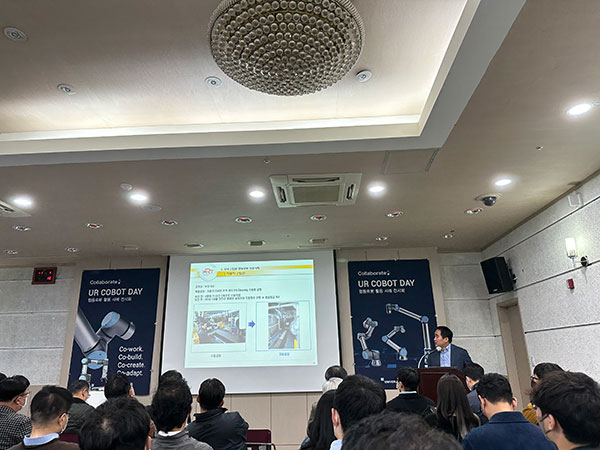
▲ An exhibition of Universal Robots collaborative robot application cases was held at SETEC on the 1st and 2nd.
November 1-2: Introduction to Collaborative Robot Application Cases and Features
First commercialized in 2008… 63,000 units delivered to 29 countries
Applied to automotive and food industries… 85% increase in efficiency
Experts predicted that the robot era would arrive. Robots have materialized a tangible journey to help improve human lives. Collaborative robots refer to robots that ensure safety and assist humans in performing tasks at close range.
Universal Robots, which commercialized the world's first collaborative robot, claimed that collaborative robots can be applied to all industrial sectors to realize automation and increase productivity by assisting humans and creating synergy.
Universal Robots held an exhibition of collaborative robot applications at the SETEC Convention Center on November 1-2, and provided an opportunity to introduce Universal Robots technology and demonstrate actual robots such as the e-series.
At the event, Universal Robots unveiled the collaborative robot technology and know-how gained through 15 years of trial and error, and introduced various manufacturing site examples.
■ Adoption of Collaborative Robots: “The Most Economical Automation Solution”
The industrial labor environment is rapidly changing due to factors such as the Russian War, the U.S.-China trade war, and COVID-19, and demands for multi-product, small-batch production, cost reduction, and quality improvement are continuing in manufacturing sites.
Samsung Electronics has declared the introduction of unmanned factories starting in 2030, and Tesla is also shifting toward a robot-friendly environment.
However, unlike large corporations, 97% of companies were found to feel an economic burden in realizing automation due to rising prices and labor costs, as well as a shortage of talent.
Kim Young-woo, a manager at Universal Robots, stated, “Improving the working environment is essential in accordance with ESG management trends, and the introduction of automation solutions using collaborative robots allows for the achievement of safety and economic efficiency due to their flexibility and lack of spatial constraints,” adding, “In building smart factories, we observed 85% higher efficiency when humans and robots coexist.”
■ Over 60% of collaborative robots are used in automobiles Industry application
HRT CEO Kim Man-gu said, “Currently, more than 60% of collaborative robots are being applied in the automotive industry, and cases are increasing in other sectors such as food, service, and textile industries.”
Major examples of the automotive industry introduced in Korea include the automated IPA cleaning process for glass attachment positions, the automated seat ventilation inspection, the automated head-up display vision inspection, the automated luggage high-frequency welding process, and the automated loading of automotive bearing cases.
In addition, examples such as smartphone parts, washing machine labeling, coffee making, rice cake making, museum public relations, and mobile collaborative robots (AMR + collaborative robot) were introduced.
CEO Kim stated, “We improved the manual operation where three people worked in three shifts and introduced automation using one UR10 unit and other devices, achieving cost reduction and increased productivity.”
■ Universal Robots product family maintains industry-leading capabilities
The Universal Robots product family has the longest history of launch and mass production. Universal Robots has delivered 63,000 collaborative robots across 29 countries over the past 10 years. The e-series products, including the UR3e, UR5e, UR10e, and UR16e, provide optimal functionality with payloads of 3kg, 5kg, and 16kg, respectively, and working radii tailored to each weight.
Universal Robots' product line maintains the highest level in the industry in terms of precision and has improved vibration over the past 10 years through motor control optimization. Real-time remote control is possible with a communication cycle of 2ms (500Hz). In addition, it is equipped with various application features including easy maintenance, high compatibility, and an intuitive programming interface.
According to experts, safety is paramount for collaborative robots, and they must also possess competitiveness and flexibility. Universal Robots announced that it has received TUV certification for Performance Level d and Category 3 across 17 safety function standards.
"Universal Robots possesses the most proven collaborative robots through the largest number of references and technical know-how," said Seong Hwang-hyeon, a manager at Universal Robots. "We have improved our product line through numerous trials and errors, such as changing and supplementing the robot's materials and structure after realizing that it was affected by external noise."
Meanwhile, at the event, Universal Robots exhibited actual collaborative robots through booths with partner companies including Inatech, Sungwon Trading Co., Ltd., WEGO, Asung Korea, HRT System Co., Ltd., and Samik THK. Robot demonstrations and YouTube live streams were conducted, drawing a great response from the participants.
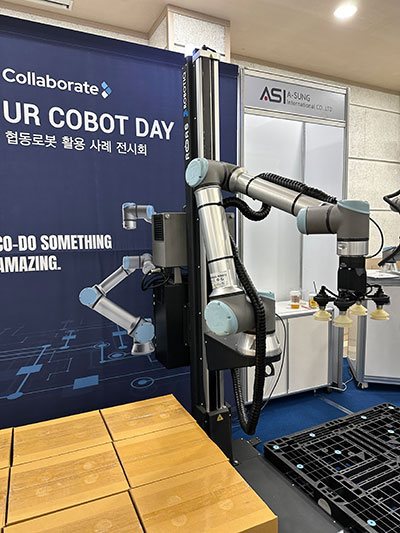
▲ Universal Robots Collaborative Robot Application Exhibition - View of Asung Korea's booth
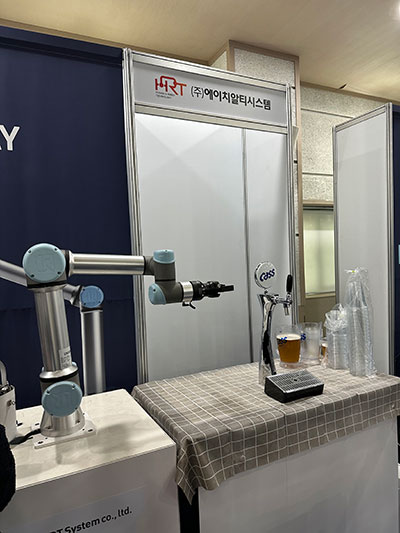
▲ Universal Robots Collaborative Robot Application Exhibition - View of the HRT System Co., Ltd. booth
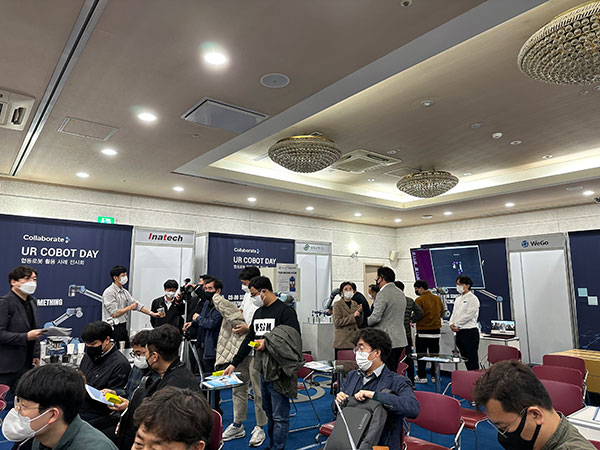
▲ View of the Universal Robots Collaborative Robot Application Exhibition
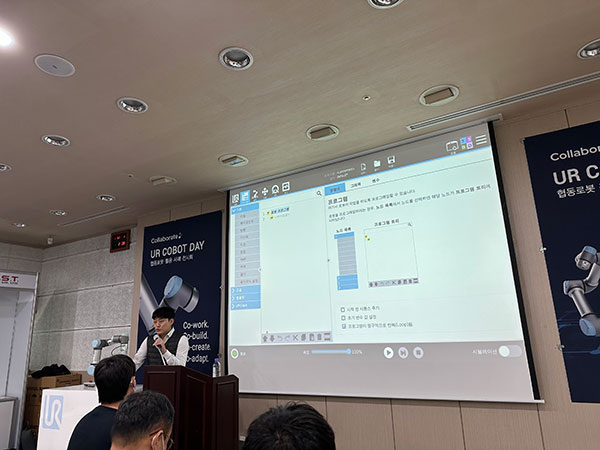
▲ Universal Robots Collaborative Robot Application Case Exhibition Demo
Comments
Related news
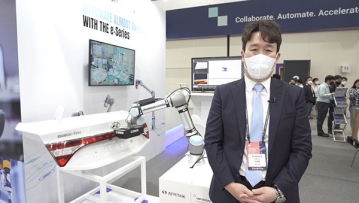
[Interview] Lee Nae-hyung, CEO of Universal Robots: "Safe collaborative robots help people in smart factories."
Universal Robots, the leading collaborative robot company both domestically and internationally, participated in the 2022 Smart Factory & Automation Industry Exhibition held at COEX in Samseong-dong from April 6th to 8th through booth exhibitions.
2022.04.07by 김예지 기자
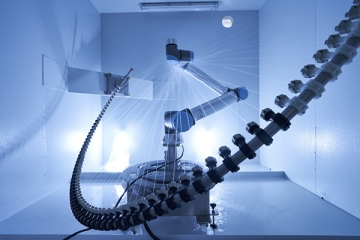
Universal Robots presents production automation collaborative robots
Global collaborative robot company Universal Robots will participate in SIMTOS2022 and showcase a demonstration of the e-series.
2022.05.18by 김예지 기자
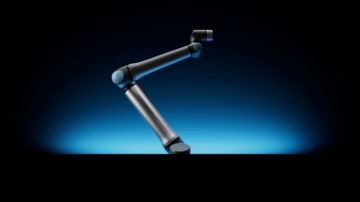
Universal Robots Launches 20kg High-Payload Collaborative Robot
Universal Robots has launched the 'UR20', a collaborative robot capable of lifting up to 20kg, enabling new task capabilities.
2022.06.22by 김예지 기자

Universal Robots' second-quarter sales reached $83 million.
Universal Robots, the world's leading collaborative robot company with the top market share both domestically and internationally, concluded the first half of 2022 with strong growth momentum.
2022.08.02by 배종인 기자
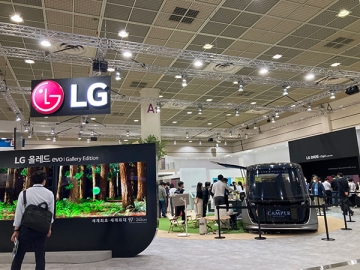
[KES 2022] A vibrant platform for sharing cutting-edge electronics and IT trends.
The 53rd Korea Electronics Show, hosted by the Ministry of Trade, Industry and Energy, was held at COEX from Tuesday the 4th to Friday the 7th. The exhibition featured 450 companies with 1,200 booths and was expected to attract approximately 70,000 visitors. The main exhibition categories included home appliances and smart homes, electronic components and materials (electronic components, semiconductors, displays, sensors, etc.), convergence new industries (XR, 3D, wearables, blockchain, security devices), and tech solutions (production manufacturing technology, AI, robotics, IoT, big data, deep learning, communications, smart cities).
2022.10.06by 김예지 기자











