


RE100 International Conference Held, “Carbon Neutrality Action Plans Consider Domestic Conditions”
 Published2022.11.02 16:39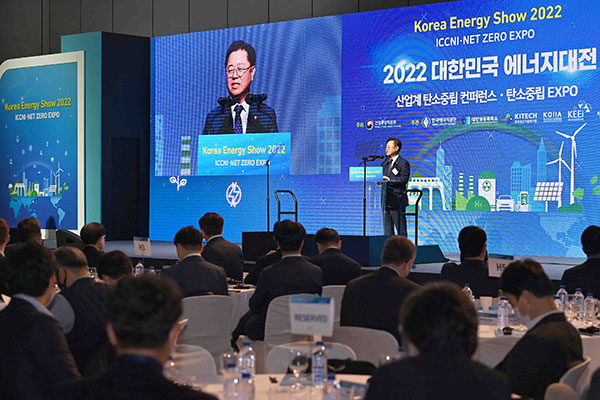
RE100 organizer CDP, The Climate Group, and domestic and international companies in attendance
Sharing RE100 status by country… Discussing ways to improve contributions to carbon neutrality
Achieving Net Zero and transitioning to renewable energy are emerging as international issues. A forum was held to discuss the current status and conditions of global RE100 implementation in each country and to explore practical measures for practicing carbon neutrality.
It was announced that at the 'RE100 International Conference for a Carbon-Neutral Future' hosted by the Ministry of Trade, Industry and Energy, the organizing body of the RE100 campaign and domestic and international companies and institutions discussed global cooperation measures regarding RE100 implementation methods, such as expanding the use of renewable energy.
This conference discussed effective RE100 implementation strategies for Northeast Asian countries, including South Korea, where the environment for the deployment and use of renewable energy is relatively unfavorable.
To achieve RE100, there are methods such as using only electricity produced from renewable energy, purchasing renewable energy electricity through the Green Premium system, or purchasing RECs (Renewable Energy Certificates) equivalent to the electricity consumed. However, there is a problem in the domestic market where all methods are at the level of 1.5 to 2 times that of Europe.
Furthermore, Korea's fundamental renewable energy production is low, which appears to be due to factors such as its small land area compared to overseas, a high proportion of mountainous terrain, limited potential for hydropower and bioenergy, and isolated power grids.
In the keynote speeches at the event, global RE100 organizers CDP and The Climate Group emphasized “corporate voluntary carbon VC” efforts, while KEI Consulting presented Korea’s RE100 implementation conditions and improvement measures.
Emphasizing the role of carbon emission information disclosure and the RE100 campaign in fulfilling climate change response responsibilities, recommendations were made for institutional improvements to expand Korea's RE100 implementation level.
■ RE100 Compliance Recognition Criteria: Different Standards from Overseas Must Apply
KEI Consulting stated that high renewable energy purchase and investment costs resulting from limited supply conditions are the biggest obstacle to implementing RE100 in Korea. Furthermore, they suggested that "there is a need to review flexible criteria for recognizing implementation that take these circumstances into account."
During the panel discussion, the panelists stated that renewable energy procurement conditions in countries such as South Korea and Taiwan are relatively unfavorable compared to the EU and North America. In addition, opinions were presented suggesting the need to review improvement measures for renewable energy procurement and certification standards.
Yuan Huanglin, Vice President of Taiwan Cement, stated, “There is a need to improve recognition standards, such as for overseas REC purchases,” and argued that “cooperative linkages are necessary not only between Korea and Taiwan, which have similar industrial structures, but also within the Northeast Asian region.”
Professor Yonghoon Jeong of KAIST stated, “Although RE100 is a global campaign, it is appropriate to proceed by considering the conditions of each country, as renewable energy prices and other factors vary by country,” and also expressed the opinion that “CF100, which aims for the carbon-free operation of real-time electricity consumption, should be promoted first to achieve carbon neutrality.”
CF100 stands for 'Carbon Free 100%,' meaning 'zero carbon emissions,' and signifies that all electricity consumed is supplied by carbon-free energy that does not emit carbon. This concept emerged because achieving 100% renewable energy usage is realistically difficult.
Choi Yeon-woo, Director General for Renewable Energy Policy at the Ministry of Trade, Industry and Energy, stated, "We highly appreciate the various considerations and efforts of companies toward carbon neutrality, such as their participation in the RE100 campaign." He added, "The government will continue to expand renewable energy to ensure that domestic companies face no setbacks in using it," while also noting, "In the short term, we will review various incentives for RE100 companies to alleviate their burden. In the long term, we plan to strive to establish a cost-effective deployment system and strengthen the competitiveness of the domestic renewable energy industry."
Comments
Related news
.jpg)
Demand for 30% Renewable Energy Use by Large Corporations: "Preemptive Policy Required"
According to a survey conducted by the Korea Chamber of Commerce and Industry targeting 300 domestic manufacturing enterprises, as RE100 has recently emerged as a key global supply chain issue, three out of every ten large domestic manufacturers in the manufacturing sector have been directly or indirectly required by global demand companies to use renewable energy in their product manufacturing processes. In response to the increasing demands for renewable energy use from global demand companies, it appears necessary to proactively address this matter in order to secure the supply chain.
2022.09.07by 김예지 기자
[ESG Management ①] The Green Wave of Industry, RE100: Effectiveness Questioned
While an increasing number of companies are declaring RE100 commitments, concerns are being raised regarding the practical effectiveness of Korean companies' achievement of RE100 targets.
2022.10.14by 김예지 기자
[ESG Management ②] Establishing a Practical Implementation Policy for RE100 is Essential
Global leading companies have increasingly demanded domestic companies to increase the renewable energy ratio in their supply chains and implement RE100, and Samsung Electronics, SK Group, and Hyundai Motor have already declared their participation in RE100 to respond to these demands, while the government is also emphasizing the expansion of renewable energy supply.
2022.10.18by 김예지 기자
Korea Instrument, KOLAS Accredited Calibration Agency First to Simultaneously Acquire ISO/IEC 27,001·27,701
Korea Instrument has become the first among KOLAS accredited calibration agencies to simultaneously acquire ISO/IEC 27,001 and ISO/IEC 27,701 certifications. Through its proprietary platforms CWIZ Enterprise and CWIZ Partners, the company has embedded information security and personal data protection requirements across all business processes including customer information, equipment data, and calibration reports, with plans to continuously advance its management system through regular audits and security inspections.
2026.10.12by 배종인 기자
TeamViewer One, IT Incident Automation Workflow and Resolution Center Enhanced
TeamViewer has added IT incident automation capabilities and an advanced Resolution Center to its integrated digital workplace management platform 'TeamViewer ONE'. Recurrent service disruptions, configuration errors, and capacity shortages are automatically handled according to preset policies, and device status verification through script deployment can be managed in a unified interface, significantly reducing repetitive tasks for IT teams.
2026.10.12by 배종인 기자











