


Autonomous Things and Autonomous Driving: An Integrated Approach Is Essential
 Published2022.11.07 12:31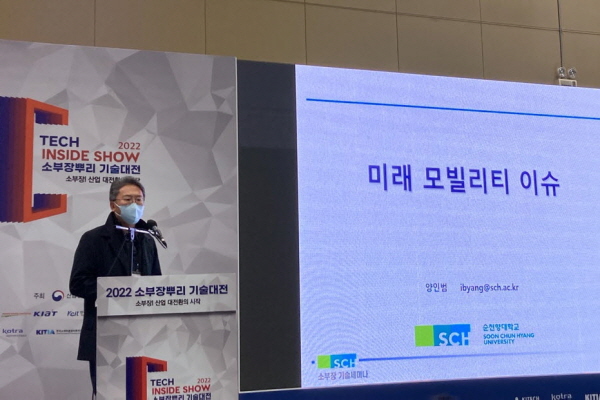
▲ Yang In-beom, Professor of Smart Automotive Engineering at Soonchunhyang University
Presenting a shift in perspective including autonomous objects and diversifying industrial approaches
Autonomous Things, Sharing of Autonomous Driving Technology, and Lower Market Entry Barriers
The Korean Society for Reliability held a technology seminar at the 2022 Tech Inside Show, held at KINTEX in Ilsan on the 3rd, and shared issues and trends in future mobility.
Professor Yang In-beom of the Department of Smart Automotive Engineering at Soonchunhyang University suggested a shift in perspective to include the field of autonomous objects as a future approach to the parts industry, along with the diversification of industrial approaches to future mobility.
He stated that an integrated approach to autonomous objects, autonomous driving, and future mobility is necessary.
Autonomous Things is a collective term for devices or equipment that possess autonomy based on artificial intelligence and IoT, encompassing autonomous vehicles, autonomous flying drones, robots, etc.
This began to attract attention as Gartner excluded autonomous vehicles from its top 10 technology strategic trends for 2020 and replaced them with autonomous objects.
The autonomous objects industry has a vast scope, including mobility such as autonomous vehicles, industrial applications such as transport and construction support robots, household applications such as smart shopping carts and robots for the disabled, military applications such as security robots, and research and exploration applications used in extreme environments.
One of the reasons autonomous objects are emerging is that they share core technologies with the field of cooperative autonomous driving, and the barriers to market entry are relatively low.
The ability to create new industries in various fields, such as agriculture and autonomous driving, as well as the accumulation of technology and operational know-how that enables linkage and expansion to Level 4 or higher autonomous driving, are also cited as major advantages of the autonomous objects industry.
Professor Yang In-beom stated that for the reasons mentioned above, autonomous objects, autonomous driving, and future mobility should be approached from an integrated perspective.
From this perspective, autonomous driving and electric drive platforms are fundamental, and the importance of UI/UX and service platforms is emerging.
Human Vehicle Interface (HVI) is called the fourth core technology of autonomous vehicles.
There are research findings suggesting that the control transfer time for autonomous vehicles should be considered up to 4 seconds, and based on the opinions of various experts that this is necessary from Level 2, the argument that interface innovation is needed is gaining traction.
The ultimate destination of mobility is people, and to solve challenges such as usability and acceptance, innovation in V2X and UX that includes pedestrians is necessary.
For Level 4 and higher autonomous driving, the lack of social operational experience is perceived as a greater problem than the technology itself, and the establishment of communication infrastructure and the situational response capabilities of AI are not yet perfect.
Professor Yang stated, “The industry must broaden its perspective and devise various measures for an industrial approach to future mobility,” adding that “it will also assist in a shift in perspective to include the field of autonomous objects and in the transitional strategies of automotive parts companies.”
Comments
Related news
[e4ds Tech Day 2026 ⑨] Sim Sang-gyu, Autocrypt CTO: "In the Physical AI Era, Automotive Security Must Extend Beyond the Vehicle"
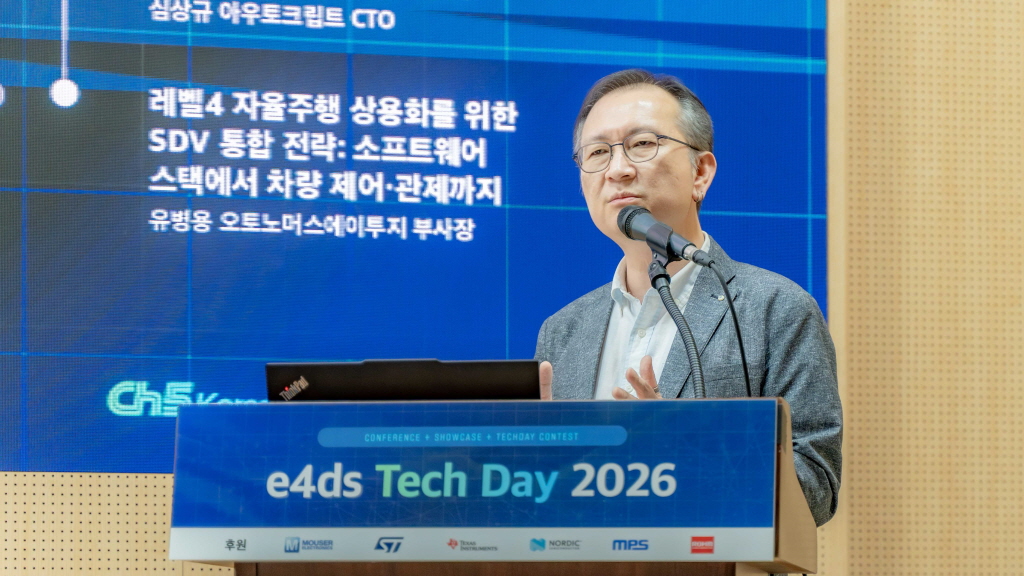
At e4ds Tech Day 2026, Sim Sang-gyu, CTO of Autocrypt, explained automotive cybersecurity strategies in the era of Physical AI and SDV (Software-Defined Vehicle). Automobiles are evolving as part of an ecosystem connected to AI, cloud, chargers, IoT, and robots, and he emphasized that the scope of security must expand beyond the vehicle interior to the entire connected environment. In particular, AI model tampering, adversarial attacks, OTA updates, and EV charger hacking were identified as major threats. He explained that response measures require zero trust, AI model integrity protection, intrusion detection, Security by Design and Default, and full lifecycle security management, and that proactive security system establishment beyond regulatory compliance is critical for securing future mobility competitiveness.
2026.10.12by 배종인 기자

Practical HIL Construction Strategy for Automotive and Off-Highway Controller Validation
As vehicle E/E architecture transitions to zonal structures and shifts to software-defined vehicles (SDV), the number of controllers (ECUs) requiring validation and software complexity are surging dramatically. Meanwhile, real vehicle testing cannot provide repeated verification under identical conditions and entails lead time and safety concerns. This white paper explains the principles of HIL (Hardware-in-the-Loop) validation and the structure of the NI platform composed of PXI, SLSC, and VeriStand, and through two actual implementation cases—Camera Record & Replay HIL for In-Cabin Monitoring Controller (ICMU) and Forklift Controller (VCU) HILS—describes how controller-level regression testing becomes possible. Additionally, it explicitly states application boundaries and limitations, such as lack of A2B support.
2026.10.12by 편집부
Korea Automotive Research Institute Signs MOU with Italy National Institute for Wireless Communications
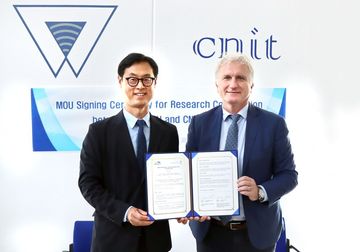
The Korea Automotive Research Institute will sign an MOU with Italy's National Institute for Wireless Communications and launch joint research on next-generation mobility technologies based on 6G, V2X, and connected vehicles. The two organizations will conduct research to apply advanced wireless communication technologies to vehicles and discover international joint projects to advance next-generation connected vehicle technology development.
2026.10.12by 배종인 기자
Color Accuracy Issues in Vehicle Interior Ambient Lighting and Intelligent LED Drivers
Vehicle interior ambient lighting is spreading across all price segments, and the level of color accuracy required of lighting designers is rising accordingly. This white paper quantitatively addresses why temperature drift and individual variations of RGB LEDs cannot be corrected by standard constant-current drivers, and explains an intelligent LED driver approach that integrates an MCU, calibration data, and a LIN network interface into the driver. It covers implementation details of the LITIX Interior TLD4020-3ET currently in production, portfolio roadmap, and evaluation/development environments, and clarifies application boundaries including lack of 48V support, lack of RGBi/ISELED support, and absence of direct optical degradation diagnostics.
2026.10.08by 명세환 기자
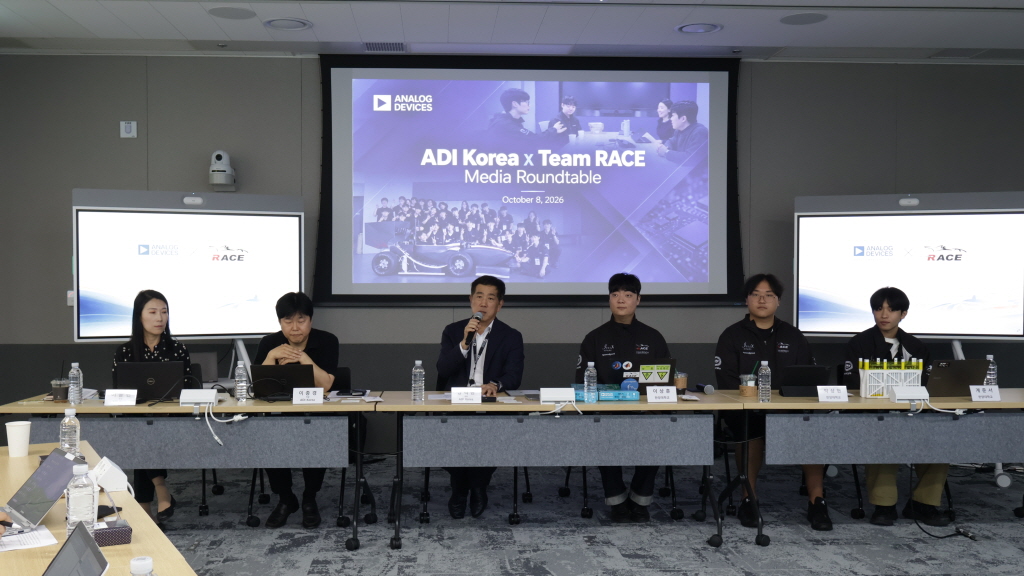
ADI, "Fostering Future Engineers Beyond Component Support"
Global semiconductor company Analog Devices (ADI) is drawing attention for moving beyond simply sponsoring university student car projects to serve as a partner in nurturing future engineers. Over the past three years, ADI has collaborated with Hanyang University's automotive research club Team RACE to support electric formula vehicle development, and recently has been providing technical consultation and semiconductor solutions to enable students to directly develop battery management systems (BMS), creating a model case of industry-academic cooperation.
2026.10.08by 배종인 기자











