



ST Launches Highly Integrated Ultrasound Transmitter to Support Miniaturization of Portable Scanners
 Published2022.11.08 13:59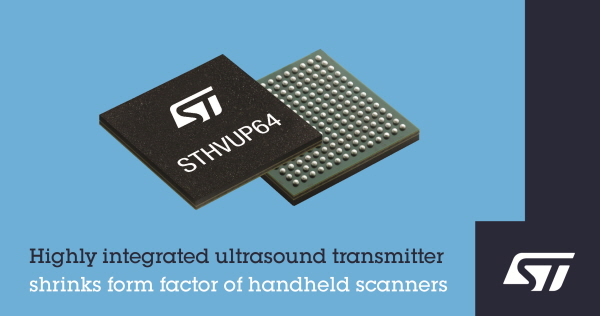
Added innovative features such as flexibility, digital beam steering, and space-saving features.
Various types of analysis possible, including cavity and liquid flow
STMicroelectronics today launched a 64-channel ultrasound transmitter with new features that improve image quality and convenience in high-performance portable industrial and medical devices.
Today's ultraportable scanners are roughly the size of a smartphone, yet offer image quality comparable to the expensive, large, high-end systems released just a few years ago.
ST's STHVUP64 transmitter, which drives the device's piezoelectric transducer, accelerates development by adding innovative features that enable flexibility, digital beam steering, and space savings.
Supporting 64 channels, the STHVUP64 is a highly integrated solution targeting the portable wireless scanner market.
Directly driving up to 256 probe elements eliminates the need for expensive high-voltage switches typically required between the transmitter and probe, reducing the bill of materials (BoM) and internal space required in the design.
Additionally, STHVUP64 introduces a new 5-level output function in addition to the standard 3-level output. Optimizes image quality by improving flexibility.
High currents of up to ±400 mA are provided, enabling high-speed transducer drive and enabling multiple imaging modes. High drive strengths achieve short pulse durations of just 5 ns, enhancing the transducer's controllability to maximize image detail.
This transmitter supports continuous wave (CW) and pulsed wave (PW) operation modes, enabling various types of analysis, including cavity and liquid flow.
Additionally, the digital beam steering function improves directional control with higher precision than conventional analog steering functions that use delay circuits.
This transmitter embeds logic on-chip, eliminating the need for dedicated beam-steering chips such as FPGAs, reducing PCB space and routing complexity while avoiding the burden of FPGA design.
This new transmitter features a self-biased driver architecture, which eliminates the need for power supply decoupling capacitors, which are typically placed externally to the chip.
It not only reduces the circuit footprint but also helps lower component costs. Because it comes in a smaller package than other ICs in its class, designers have greater flexibility to develop next-generation products in even smaller form factors.
The STHVUP64 is a feature-rich device that provides an excellent user experience while delivering extremely low power consumption, which is essential for battery-powered systems.
It has on-chip memory that stores the transmission pattern and can be synchronized with a clock signal of up to 200 MHz, minimizing jitter and improving image quality.
Additionally, this IC provides communication ports supporting several CMOS signaling standards recommended for today's highest system clock signal frequencies.
Built-in protection features include noise suppression, thermal protection, undervoltage protection, and recirculating current protection. Diagnostic registers are also provided to directly read the cause of interrupts, facilitating debugging in the event of a failure.
The transmitter is implemented in ST's proven BCD8s-SOI technology, which supports analog (bipolar), digital (CMOS), and power (DMOS) circuits on the same die.
Comments
Related news
Mouser and STMicroelectronics Release an Ebook on Using Responsive AI at the Edge
As AI migrates to the network edge, solutions with machine learning and AI embedded in MCUs are rapidly increasing.
2022.11.01by 명세환 기자
CharIN Testing, Cross-Verification Test between Electric Vehicles and Chargers
The Korea Electrotechnology Research Institute and CharIN held the 'CharIN Electric Vehicle Testing Festival (Test+Festival)' at the Korea Electrotechnology Research Institute's Ansan Branch from October 25th to 27th.
2022.11.01by 성유창 기자

[Serial] ST Yuji Kawano Engineer (20) - Is UART communication possible without an external oscillator?
The MCU is unfamiliar compared to CPUs or GPUs, but it is one of the most widely used semiconductors. Let us hear from Yuki Kawano, Manager at ST System Solutions Lab, about how broad the utility and potential of MCUs are.
2022.11.02by 명세환 기자

Intel Unveils Next-Generation 'Core Ultra Series 3' and vPro Platform for Enterprise PCs
Intel has officially unveiled the "Intel Core Ultra Series 3" for next-generation enterprise PCs and the latest vPro platform, addressing a wide range of demands from enterprise notebooks to high-performance workstations.
2026.03.26by 배종인 기자

ROHM Launches ESD Protection Diode Compatible with High-Speed Interfaces of 10Gbps or Higher
Semiconductor specialist ROHM has developed the 'RESDxVx series' of ESD (electrostatic discharge) protection diodes capable of responding to next-generation high-speed data communication environments exceeding 10Gbps, simultaneously enhancing both signal quality maintenance required in high-speed interfaces and IC protection performance.
2026.03.26by 배종인 기자











