


Robot Industry Development, Amendments to Intelligent Robot Act and Related Laws Necessary
 Published2022.11.16 17:00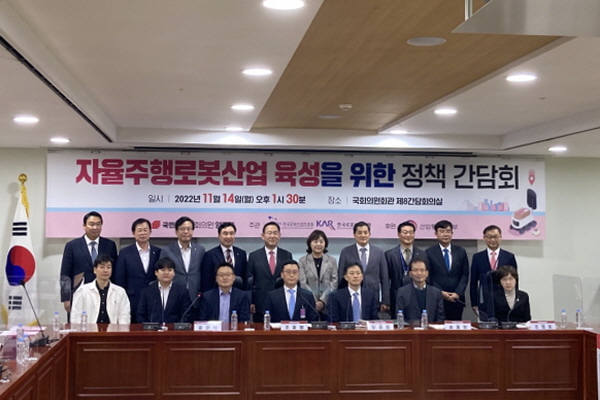
Major Items in Intelligent Robot Act Amendment, Allowing Sidewalk Passage for Autonomous Mobile Robots
Nubility, "Efforts to Protect Domestic Market and Promote Industry Must Proceed in Parallel"
National Assembly Member Yang Geum-hee held a "Policy Briefing Session for Autonomous Mobile Robot Industry Development" at the National Assembly Members' Hall on the 14th and created a forum where diverse opinions could be exchanged on the subject of "Major Amendment Contents of the Intelligent Robot Act" which she co-sponsored in August.
The autonomous mobile robot market is projected to show an average annual growth rate of 34.3% through 2030, and there are predictions from global research organizations that autonomous delivery robots will account for 20% of all deliveries.
Despite rapid growth and bright prospects, Korea currently faces difficulties in comfortably utilizing autonomous mobile robots.
Robots are classified as "vehicles" under the Road Traffic Act, and sidewalk passage is prohibited, making amendments to related laws urgent for the realization of complete services.
Even with proof-of-concept exemptions, operations are only possible within limited areas and regulations such as requiring on-site personnel to accompany robots have slowed the growth of the autonomous mobile robot industry, and there are limitations in accumulating data as demonstrations cannot be conducted in various locations.
In response, the need to clearly define robots that become eligible targets for sidewalk passage permission has been raised, and the major item of the Intelligent Robot Act amendment is to define intelligent robots capable of autonomous operation for delivery purposes and other functions as "outdoor mobile robots."
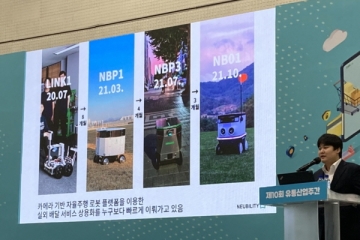
Sang-min Lee, CEO of Nubility, conveyed that this amendment to the Intelligent Robot Act will be recorded as the beginning of autonomous mobile robots transitioning from service in limited spaces to full-scale commercialization within the framework of laws and regulations.
Because of this, he argued that this amendment should serve as a benchmark for promoting and protecting the domestic robot industry.
He stated, "We must also consider the situation where overseas companies with over 8 years of technological gap are entering the domestic market and competing with Korean companies," and emphasized, "Starting with the amendment to the Intelligent Robot Act, not only rapid regulatory innovation but also efforts to protect the domestic market and promote industry must proceed in parallel."
The CEO then conveyed that the individual certification method by operating environment currently being discussed imposes a significant burden on mid-sized and small enterprises.
If certification must be obtained for each operating environment, it could become a high barrier to entry for startups and researchers seeking to advance technology development and service, and would negatively impact ecosystem development.
Ko Tae-bong, Head of the Research Division at Hi Investment & Securities, who served as a presenter, discussed "the present and future of the autonomous vehicle industry."
Ko stated that the completion of "unmanned operation" requires all elemental technologies to reach a certain level, but the most difficult technology to implement in autonomous vehicles and robots is AI.
Autonomous driving technology and data including AI obtained from the automotive industry are significant assets that can be applied to robots.
Ko noted that in 2021 Tesla was collecting data from 50 countries outside the United States, and emphasized once again that legislative amendments are urgent so that Korean companies do not fall further behind.
In the subsequent discussion, Ko also expressed that while a cautious approach to legislative amendments is necessary, he appealed for understanding that every day matters for companies.
After the discussion concluded, Member Yang Geum-hee stated, "I am grateful to the panelists and presenters who provided many opinions," and added, "I will work to ensure it can be deliberated as quickly as possible, and regarding insurance handling related to autonomous mobile robots, I believe it will be difficult at the private sector level, so I will discuss it further with the Robot Promotion Association."
Comments
Related news
Newbility's autonomous robots offer a solution to the delivery problem.
Newbility is realizing possibilities by developing autonomous delivery robots, and is taking the lead in market capture by beginning testing with GS25 to establish a convenience store robot delivery service model.
2022.06.13by 성유창 기자
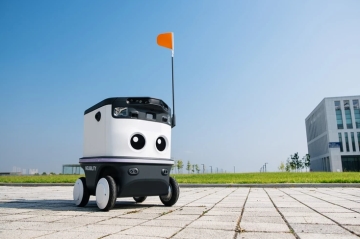
Newbility, 'Newbee' autonomous delivery robot dreams of the future
The day is not far off when quiet, compact autonomous delivery robots will deliver various items such as food and cosmetics, replacing motorcycles that roar loudly through alleyways.
2022.06.17by 성유창 기자
GAIA-Festa 2026, Autonomous Driving, AI, and Aerospace Experts Gather…Discussing Global Cooperation in the 'Silicon Intelligence Era'
GAIA-Festa 2026, which will be held in Suwon on October 27, is an industry-academia-research exchange event that explores the present and future of future mobility and AI technology through the global conference D-G2CAM 2026 and the international contest D-AMGC 2026. Domestic and international experts will share the latest research in autonomous driving, 5G/6G mobility, space technology, and data protection fields, while university students will showcase robots and physical AI prototypes that they have independently developed. Additionally, through poster presentations, corporate exhibitions, international cooperation meetings, and signing ceremonies, a platform will be established to connect the research capabilities and industrial needs of the Gyeonggi region with a global cooperation network.
2026.10.13by 배종인 기자

[e4ds Tech Day 2026 ⑨] Sim Sang-gyu, Autocrypt CTO: "In the Physical AI Era, Automotive Security Must Extend Beyond the Vehicle"
At e4ds Tech Day 2026, Sim Sang-gyu, CTO of Autocrypt, explained automotive cybersecurity strategies in the era of Physical AI and SDV (Software-Defined Vehicle). Automobiles are evolving as part of an ecosystem connected to AI, cloud, chargers, IoT, and robots, and he emphasized that the scope of security must expand beyond the vehicle interior to the entire connected environment. In particular, AI model tampering, adversarial attacks, OTA updates, and EV charger hacking were identified as major threats. He explained that response measures require zero trust, AI model integrity protection, intrusion detection, Security by Design and Default, and full lifecycle security management, and that proactive security system establishment beyond regulatory compliance is critical for securing future mobility competitiveness.
2026.10.12by 배종인 기자

Practical HIL Construction Strategy for Automotive and Off-Highway Controller Validation
As vehicle E/E architecture transitions to zonal structures and shifts to software-defined vehicles (SDV), the number of controllers (ECUs) requiring validation and software complexity are surging dramatically. Meanwhile, real vehicle testing cannot provide repeated verification under identical conditions and entails lead time and safety concerns. This white paper explains the principles of HIL (Hardware-in-the-Loop) validation and the structure of the NI platform composed of PXI, SLSC, and VeriStand, and through two actual implementation cases—Camera Record & Replay HIL for In-Cabin Monitoring Controller (ICMU) and Forklift Controller (VCU) HILS—describes how controller-level regression testing becomes possible. Additionally, it explicitly states application boundaries and limitations, such as lack of A2B support.
2026.10.12by 편집부











