



Practical policies are essential to activate 5G connectivity.
 Published2022.12.16 12:06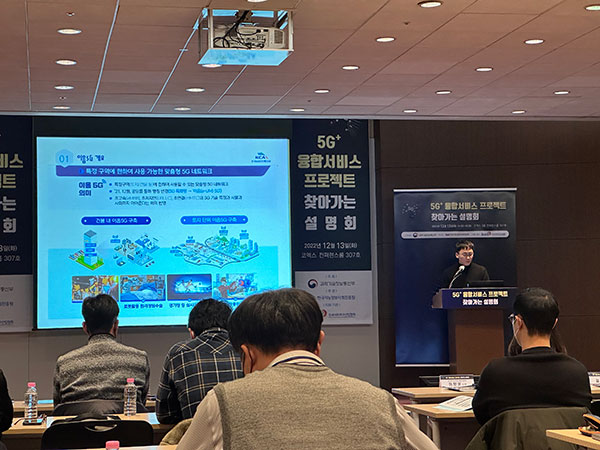
28GHz for ultra-high speed, ultra-low latency, and hyper-connectivity
5G Connectivity: Secures Flexible Operation and Security Tailored to Users
[Editor's Note] 5G convergence services are expected to expand to meet the exponentially increasing demand for traffic data. Ultra-high-speed, ultra-low latency, and hyper-connectivity 5G convergence services will continue to grow, and identifying diverse demand sources will be crucial for Korea to secure a global technological lead. While the government continues to actively support the expansion of 5G specialized network projects, there are growing calls for practical policies to encourage the continued entry of more new operators, including telecommunications companies.
A 5G specialized network is a 5G network available for specific regions, tailored to the services desired for that region. Customized deployment allows businesses to operate the network flexibly, and separation from commercial networks ensures security, leading to positive expansion potential.
The government has been naming the 5G specialized network "Ieum 5G" for 21 years and has been working hard to expand the business.
5G has frequency allocation and designation. Frequency allocation refers to the use of frequencies by telecommunications carriers to provide services, and currently applies to 9 organizations (as of December 2022): Naver Cloud (December 2021), LG CNS (March, June 2022), SK Networks Service (May, November 2022), Naver Communications (August 2022), CJ Olive Networks (August 2022), KTMOS Northern (September 2022), Sejong Telecom (September 2022), Wizcore (October 2022), and Newgens (November 2022).
The 5G frequency designation is for organizations to use the frequency for their own work, research and development, etc. through the use of wireless networks. The 6 organizations designated for the 5G frequency are: Navy (September 2022), Korea Electric Power Corporation (September 2022), KT (September 2022), Korea Water Resources Corporation (October 2022), UN Angel (November 2022), and Korea Hydro & Nuclear Power (November 2022).
So what is 5G, and why is it needed? To understand this, we need to understand the characteristics of 5G.
■ 5G 28GHz, an unscratchable lottery ticket?
Five years have passed since South Korea first commercialized 5G, but no one is experiencing the true benefits of 5G. This is because the 5G frequency bands are not fully utilized.
5G bands include Sub-6 (3.5/4.7 GHz) and mmWave (28 GHz). The 3.5/4.7 GHz band, characterized by high diffraction, offers wide coverage and is currently used nationwide. On the other hand, 28 GHz has strong straightness, wide bandwidth, and short propagation distance characteristics.
While the 28GHz band enables ultra-high-speed transmission speeds three to four times faster than the 3.5GHz band, its high construction and operating costs mean it has limited applications. Some argue that it's premature. An industry insider stated, "5G will eventually be valuable, and there's a lot of research being done, but the biggest problem is that there's currently no demand."
The government claimed that it had been discussing initiatives to revitalize the domestic 28GHz band ecosystem, including conducting 5G pilot services during the 2018 Pyeongchang Winter Olympics and demonstrating improvements to subway Wi-Fi performance using backhaul. However, mobile carriers were reluctant to expand the business, claiming it was "unprofitable." Ultimately, in November, SKT shortened its service period, and LG U+ and KT had their allocations canceled.
5G specialized network, realizing 'ultra-high speed, ultra-low latency, and hyper-connectivity'
Government and industry officials agree that the development of cutting-edge technologies such as AI and the metaverse is increasing the need for large-scale traffic processing, and that a specialized 5G network based on 28 GHz can be built and utilized.
The government is actively supporting projects to expand the 28GHz-based 5G network. Eleven consortia and 42 companies and organizations are currently working on the 2022 5G specialized network project, with a total budget of KRW 48 billion.
In the public sector, it can be used for logistics robots, integrated safety control systems, disaster situation relay services, digital twin virtual substations, and autonomous security robots. It is expected that it will be applicable to the private sector as well, including support for remote work in manufacturing environments, medical education, and theme park implementation.
In particular, in the US and Japan, it is being introduced to industries such as manufacturing, education, and entertainment, and it is noteworthy that, using this as a model, a consortium has been formed with a total scale of 3.6 billion won by the end of this year to support education (KT Consortium) and culture (SMPA Consortium) businesses.
Telecommunications companies have also conducted service demonstrations to explore 5G convergence service models to respond to the COVID-19 pandemic in 2020. SKT operated kiosks and quarantine robots at Incheon International Airport's departure hall. KT provided services to rural areas with emergency patient biometric healthcare kits. LGU+ also utilized a smart air quality monitoring robot.
At the '5G Convergence Service Project Visiting Briefing Session' held on the 13th, NIA Senior Researcher Lee Hyang-yoon said, "We will continue to discover convergence services based on 5G specialized networks by gathering opinions from industry experts in the future, and expand research and support by building a testing infrastructure (test bed)."
To realize true 5G, which is 10 times better than 4G (LTE), and to dominate the global market, private sector service development is necessary, and the government will likely continue to need to establish practical support policies for small and medium-sized enterprises.
Comments
Related news
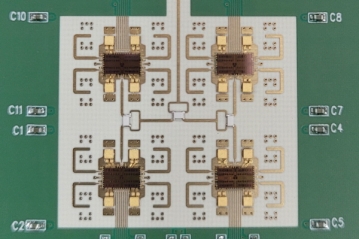
KETI Selects Top 100 National Achievements for Local Production of 5G Core Components
KETI's research achievement of developing "world-class 5G FR2 band RFIC" has been selected as one of the top 100 national research and development accomplishments in 2022.
2022.11.08by 배종인 기자

Innovation in regulations related to electromagnetic waves for wireless charging, IoT, and 5G
The government is moving forward in earnest with improvements to frequency-related regulations that have been a barrier to the spread of advanced digital technologies, and this is expected to accelerate digital-based economic innovation.
2022.11.10by 배종인 기자
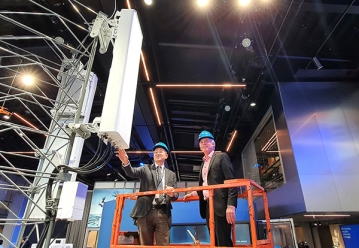
KT-Ericsson 5G Coverage Expansion Foundation
KT has completed the development of a Remote Unit combining LTE and 5G antennas in collaboration with Ericsson and Sweden's Ericsson Research Institute, and has successfully verified the technology.
2022.11.15by 김예지 기자
5G 28GHz Allocation Limits for the Three Major Telecom Companies
The Ministry of Science and ICT announced the results on the 18th as the compliance verification procedure for allocation conditions imposed during the 2018 5G frequency allocation was completed. To activate 5G 28 GHz, it appears most urgent to establish various use cases to eliminate questions about whether current 5G 28 GHz is suitable.
2022.11.21by 김예지 기자
5G, nuclear power plant safety management, etc. to be expanded nationwide
NewGens, Korea Hydro & Nuclear Power, SK Networks Service, and Unangela have received 5G frequency supply through Eeum 5G.
2022.11.28by 배종인 기자











