



Pohang Stakes All Its Life to Attract a Secondary Battery Specialized Complex
 Published2022.12.23 09:26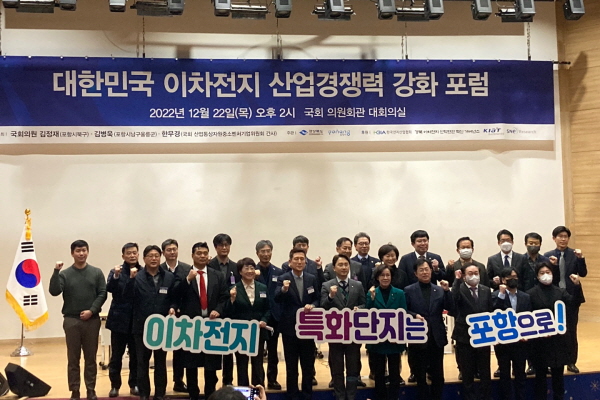
Designation of a specialized secondary battery complex scheduled for the first half of next year
Pohang Shows Active Interest Based on Port, Educational Institutions, and Experience
Lee Yong-pil, Director General of Materials Convergence Industry Policy at the Ministry of Trade, Industry and Energy, stated at the 'Forum on Strengthening the Competitiveness of the Republic of Korea Secondary Battery Industry' held by Pohang City in the main conference room of the National Assembly on the 22nd, "Demand for batteries will increase significantly not only in electric vehicles but also in UAM, which is called future mobility," adding, "We plan to designate a specialized secondary battery complex, and the open call will begin soon."
Earlier in November, the government announced plans to designate specialized complexes to provide focused support to the advanced strategic industry ecosystem, including leading domestic companies in national advanced strategic industries, materials, parts, and equipment companies, as well as universities and research institutes. The plan also includes securing locations, establishing infrastructure such as electricity and water, expediting licensing, and providing customized package support including technology, manpower, and finance.
The government has selected secondary batteries, known as a future growth engine, as one of the three major industries along with semiconductors and displays, and is designating specialized complexes to begin full-scale efforts to become the strongest nation in secondary batteries.
We will initiate the open call process next week targeting companies, metropolitan and provincial governments, and government ministries, based on the possession of national advanced strategic technologies, the maturity of regional industrial ecosystems, and infrastructureThe National Advanced Strategic Industry Committee plans to designate specialized complexes in the first half of next year, following a comprehensive evaluation of factors such as the feasibility of securing facilities and specialized personnel.
Accordingly, Pohang City is actively pursuing the designation of a 'Secondary Battery Specialized Complex' to strengthen the competitiveness of the secondary battery industry, a new future industry, and to continuously secure a significant lead in the explosively growing global battery market.
Pohang City expressed strong confidence in being designated as a 'secondary battery specialized complex,' highlighting its strengths such as possessing a port capable of facilitating import and export, educational institutions necessary for nurturing talent like POSTECH, experience gained from operating as a next-generation battery recycling regulatory free zone, and ownership of battery-related companies like EcoPro CNG.
The active desire of Pohang citizens to host the event also plays a role.
The forum, held in the main conference room of the National Assembly Members' Office Building, was packed with Pohang citizens.
A Pohang citizen who participated in the forum expressed his determination to attract the specialized complex, stating, “We chartered 16 buses, and 370 people, including neighborhood heads and women’s association members, came all the way to Seoul to support Pohang,” and added, “We braved the snow to return to Pohang, explain the situation to the residents, and join forces together.”
Pohang City hosted this forum, organized by National Assembly members Kim Jeong-jae and Kim Byung-wook representing the Pohang region, as well as Assembly member Han Moo-kyung, the secretary of the Industry, Trade, Resources, SMEs, and Venture Businesses Committee. Through policy consultations with domestic battery experts and an assessment of the secondary battery industry, the event aimed to enhance understanding of secondary batteries and explore ways to strengthen the competitiveness and development of the global secondary battery industry.
On this day, Song Jun-ho, a senior researcher at the Next-Generation Electronics Research Center of the Korea Electronics and Technology Institute (KETI), gave a presentation on the topic of "Development Plans for Secondary Batteries in the Advanced Strategic Industry." He stated, "The secondary battery market will grow 13-fold by 2030," adding, "The government is also making great efforts to ensure that Korea becomes the strongest nation in secondary batteries by 2030.""He said he is doing it."
One of the efforts mentioned by Senior Researcher Song includes the launch of the 'Battery Alliance' to fully pool the capabilities of the public and private sectors.
The 'Battery Alliance' aims to secure a stable supply chain, establish an advanced technology innovation hub, and foster a robust domestic ecosystem.
To secure a stable supply chain, there was a move to expand the global source of battery raw materials, which were previously imported from China.
SK ON secured 230,000 tons of lithium hydroxide from Australia over 10 years, Samsung SDI secured 95,000 tons of lithium hydroxide from Chile over 7 years, and LG Energy Solution secured 71,000 tons of nickel from Australia over 6 years.
The government indirectly supported companies in securing key miners through intergovernmental MOUs.
An example of these efforts is LG Energy Solution signing a lithium and cobalt supply contract with a Canadian company.
In addition, to build an advanced technology innovation hub, 1 trillion won will be invested in R&D by 2030 to secure technology, and to foster a sound domestic ecosystem, active efforts will be made to cultivate key talent through comprehensive institutional improvements and the establishment of a Battery Academy.
Senior Researcher Son emphasized the importance of R&D, stating, “As the trend of emphasizing eco-friendliness continues, pressure for battery reuse and recycling is expected to intensify,” and added, “It is crucial to secure these technologies starting now.”
In the subsequent panel discussion, chaired by Kim Kwang-ju, CEO of SNE Research, Professor Park Kyu-young of POSTECH, Lee Young-ju, Director of the Secondary Battery Comprehensive Management Center, and Lee Yong-pil, Director General of Materials Convergence Industry Policy at the Ministry of Trade, Industry and Energy, participated and opened the forum for discussion.
Prior to the start of the discussion, CEO Kim Kwang-ju stated, “If semiconductors led Korea’s exports, secondary batteries will lead the future.” “It has established itself as a key industry that determines our livelihoods for the next 10 or 15 years,” he said, once again emphasizing the importance of the secondary battery industry.
Professor Park Kyu-young of POSTECH gave a positive outlook, stating, “The international trend demanding advanced battery production technology could work to Korea’s advantage in R&D,” and adding, “While many regulations such as IRA may be difficult for companies in the short term, Korea will eventually become the best in the world.”
Lee Young-ju, head of the Secondary Battery Comprehensive Management Center at Gyeongbuk Technopark, expressed pride regarding the construction of Tesla's Gigafactory, stating, "Pohang, with POSCO, a port, and high-level workforce training institutions, is the best in Korea for attracting a Gigafactory," and added, "Active interest from residents is needed," asking for support.
Meanwhile, Pohang City, together with Gyeongsangbuk-do, completed the construction of the Secondary Battery Comprehensive Management Center in the Blue Valley National Industrial Complex in 2021, and the 'Battery Regulatory Free Zone' was selected as an excellent special zone for three consecutive years, the first in the nation.
With the establishment of national demonstration infrastructure, such as a used battery resource recycling cluster, an inline automated evaluation center, and a project to support the commercialization of high-safety, mass-produced lithium iron phosphate (LFP), as well as the recent attraction of a 1 trillion won investment from China's CNGR and the opening of Apple's manufacturing R&D support center, Pohang is emerging as the optimal location for the designation of a 'secondary battery specialized complex' and investment by battery companies.
Pohang Mayor Lee Kang-deok emphasized, “This forum served as a good opportunity to consolidate citizens’ interest in the secondary battery industry and the region’s innovation capabilities,” adding, “With the conviction that the secondary battery industry will be a new opportunity to propel Gyeongbuk and Pohang forward, we will concentrate all administrative efforts on attracting a secondary battery specialized complex and a gigafactory.”
Comments
Related news
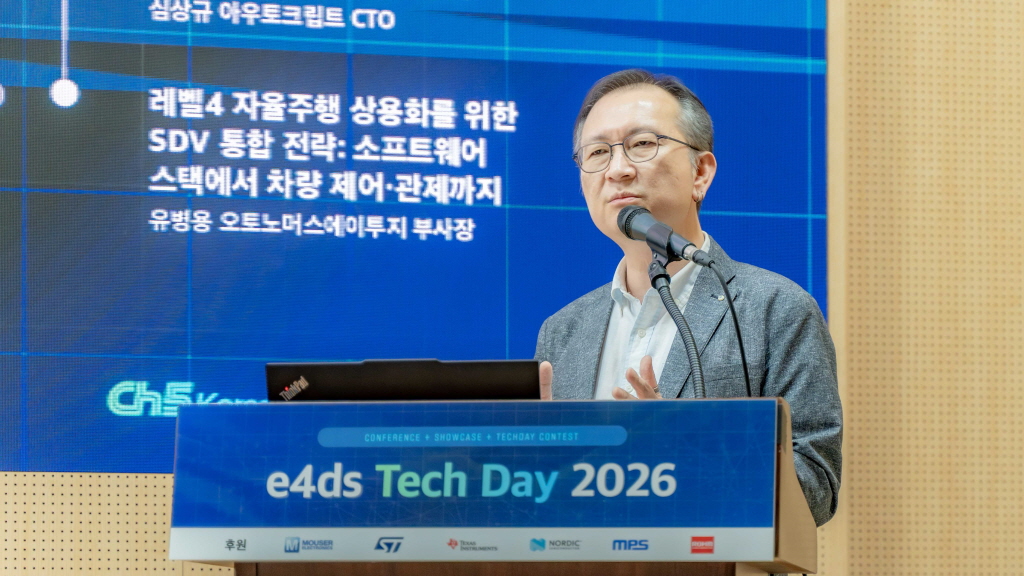
[e4ds Tech Day 2026 ⑨] Sim Sang-gyu, Autocrypt CTO: "In the Physical AI Era, Automotive Security Must Extend Beyond the Vehicle"
At e4ds Tech Day 2026, Sim Sang-gyu, CTO of Autocrypt, explained automotive cybersecurity strategies in the era of Physical AI and SDV (Software-Defined Vehicle). Automobiles are evolving as part of an ecosystem connected to AI, cloud, chargers, IoT, and robots, and he emphasized that the scope of security must expand beyond the vehicle interior to the entire connected environment. In particular, AI model tampering, adversarial attacks, OTA updates, and EV charger hacking were identified as major threats. He explained that response measures require zero trust, AI model integrity protection, intrusion detection, Security by Design and Default, and full lifecycle security management, and that proactive security system establishment beyond regulatory compliance is critical for securing future mobility competitiveness.
2026.10.12by 배종인 기자
Practical HIL Construction Strategy for Automotive and Off-Highway Controller Validation
As vehicle E/E architecture transitions to zonal structures and shifts to software-defined vehicles (SDV), the number of controllers (ECUs) requiring validation and software complexity are surging dramatically. Meanwhile, real vehicle testing cannot provide repeated verification under identical conditions and entails lead time and safety concerns. This white paper explains the principles of HIL (Hardware-in-the-Loop) validation and the structure of the NI platform composed of PXI, SLSC, and VeriStand, and through two actual implementation cases—Camera Record & Replay HIL for In-Cabin Monitoring Controller (ICMU) and Forklift Controller (VCU) HILS—describes how controller-level regression testing becomes possible. Additionally, it explicitly states application boundaries and limitations, such as lack of A2B support.
2026.10.12by 편집부
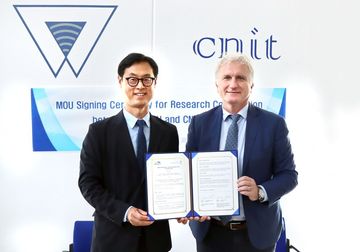
Korea Automotive Research Institute Signs MOU with Italy National Institute for Wireless Communications
The Korea Automotive Research Institute will sign an MOU with Italy's National Institute for Wireless Communications and launch joint research on next-generation mobility technologies based on 6G, V2X, and connected vehicles. The two organizations will conduct research to apply advanced wireless communication technologies to vehicles and discover international joint projects to advance next-generation connected vehicle technology development.
2026.10.12by 배종인 기자
Color Accuracy Issues in Vehicle Interior Ambient Lighting and Intelligent LED Drivers
Vehicle interior ambient lighting is spreading across all price segments, and the level of color accuracy required of lighting designers is rising accordingly. This white paper quantitatively addresses why temperature drift and individual variations of RGB LEDs cannot be corrected by standard constant-current drivers, and explains an intelligent LED driver approach that integrates an MCU, calibration data, and a LIN network interface into the driver. It covers implementation details of the LITIX Interior TLD4020-3ET currently in production, portfolio roadmap, and evaluation/development environments, and clarifies application boundaries including lack of 48V support, lack of RGBi/ISELED support, and absence of direct optical degradation diagnostics.
2026.10.08by 명세환 기자
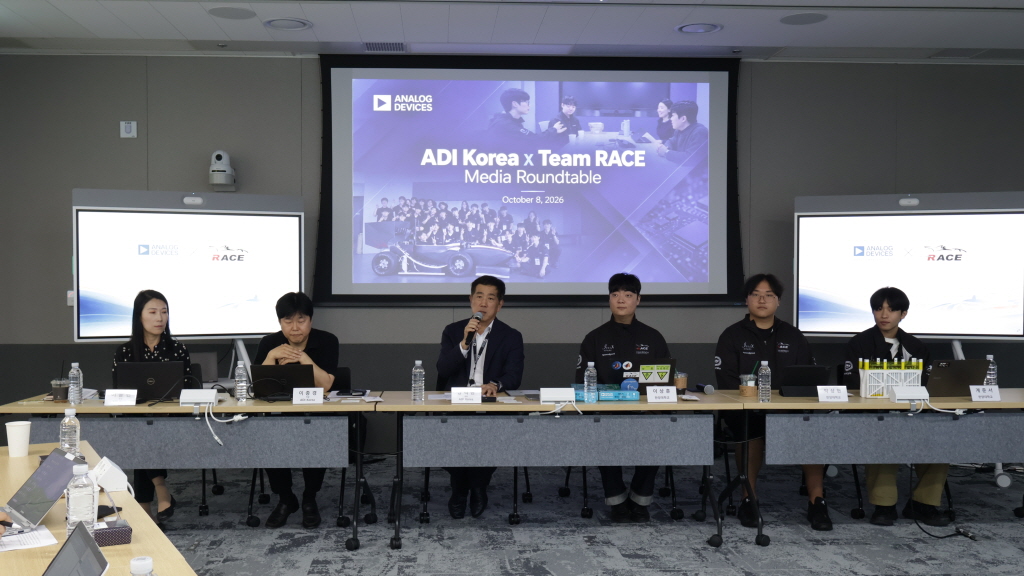
ADI, "Fostering Future Engineers Beyond Component Support"
Global semiconductor company Analog Devices (ADI) is drawing attention for moving beyond simply sponsoring university student car projects to serve as a partner in nurturing future engineers. Over the past three years, ADI has collaborated with Hanyang University's automotive research club Team RACE to support electric formula vehicle development, and recently has been providing technical consultation and semiconductor solutions to enable students to directly develop battery management systems (BMS), creating a model case of industry-academic cooperation.
2026.10.08by 배종인 기자











