


The government's digital platform initiative will be fully implemented in 2023.
 Published2022.12.28 16:42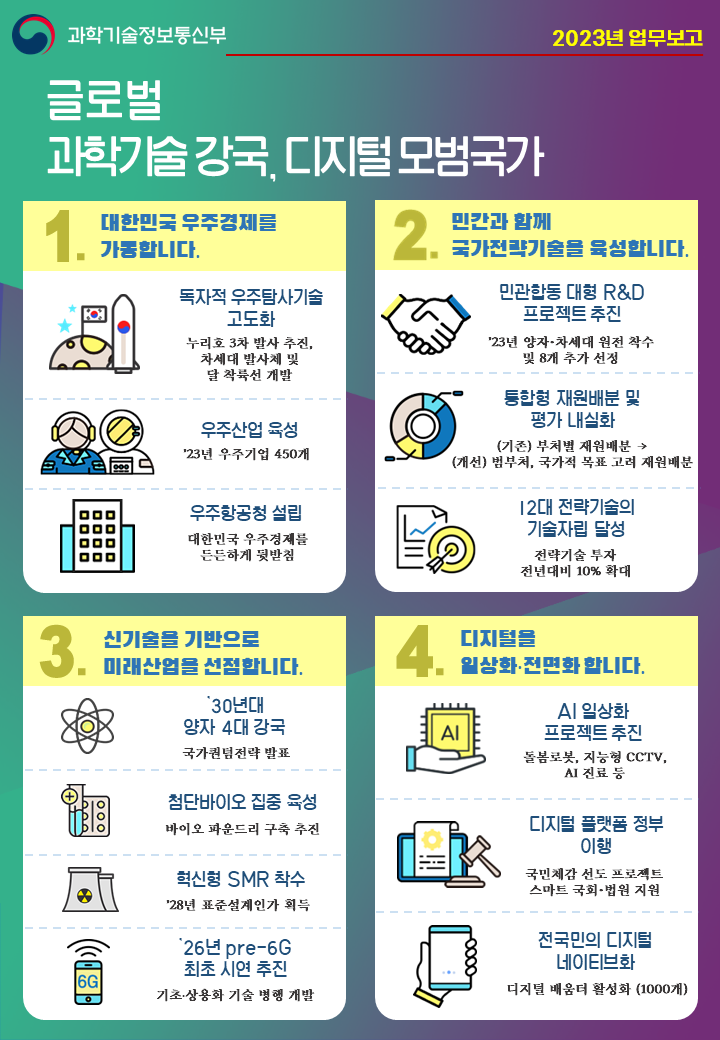
Promoting eight key science, technology, and digital-based tasks
Expanding space, quantum, 6G, and AI technology development, talent development, and regionalization.
The Ministry of Science and ICT announced its 2023 plan, which focuses on eight key tasks, to become a global science and technology powerhouse.
On the 28th, the Ministry of Science and ICT announced its 2023 work plan with the goal of "realizing a global science and technology powerhouse and a digital model nation."
The Ministry of Science and ICT evaluated that the new government has laid the foundation for its science, technology, and digital policies over the past eight months, and announced that it will actively pursue three major strategies and eight key tasks to contribute to the Republic of Korea's leap forward through science, technology, and digital innovation by 2023.
First, we will revitalize the Korean space economy by fostering a space industry ecosystem. We will promote the third launch of Nuriho and invest 2.132 trillion won by 2032 to begin development of next-generation launch vehicles. Furthermore, we will enact a special law to establish the Korea Aerospace Research Institute and develop a roadmap for fostering the space industry.
Second, the public and private sectors will work together to fully develop national strategic technologies. To this end, the goal is to invest 25 trillion won in strategic technology R&D, expanding it by more than 10% year-on-year, and promoting public-private joint R&D projects such as quantum and nuclear power plants.
Next, we will focus on fostering new technologies such as quantum, 6G, metaverse, and blockchain, and disseminate research results.
Quantum technology will be strengthened through the enactment of quantum legislation and the development of quantum computers. Furthermore, the government announced plans to develop basic and commercial 6G technologies in parallel and establish a demand-driven frequency supply system to foster related industries such as autonomous driving and UAM. To promote the metaverse and blockchain, the government will demonstrate new platforms, develop metaverse content, and invest KRW 23.4 billion to promote a nationally immersive blockchain project.
Fourth, we will promote digitalization across all aspects of people's lives. We will leverage AI in everyday life to address issues like care for the elderly living alone, integrate AI across all sectors, including agriculture, fisheries, and manufacturing, and introduce a software service purchasing system. Furthermore, we will promote national digitalization by providing online AI and software education, expanding primary and secondary education, and activating digital learning centers for vulnerable populations.
In particular, to fully implement the digital platform government, 12.1 billion won will be invested to build a public-private joint, large-scale AI hub, and a smart National Assembly and court will also be established.
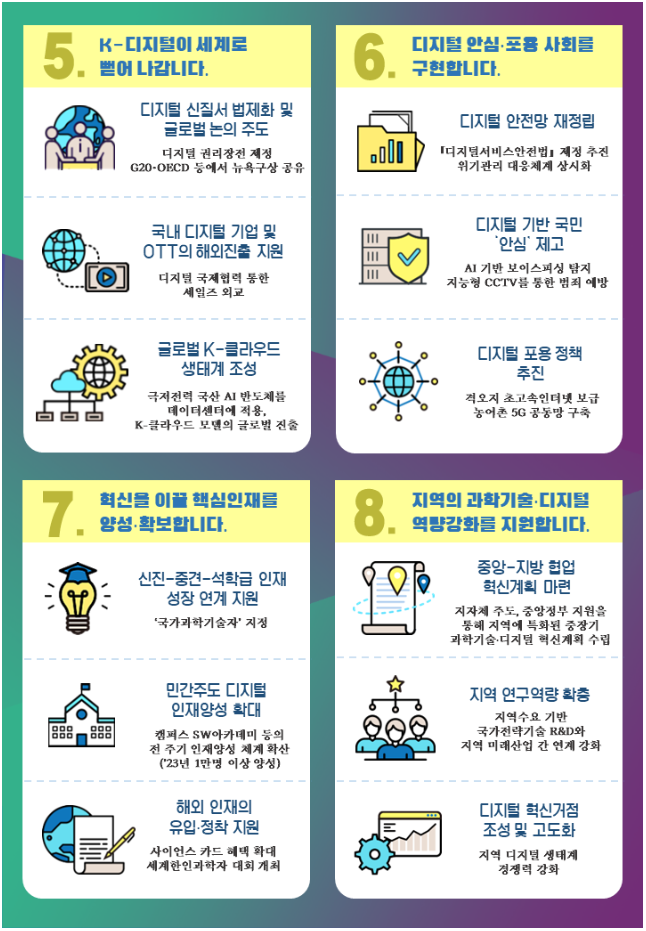
Next, we will establish a new digital order and promote the global expansion of K-Digital. We will revise digital laws and regulations and invest 42.8 billion won in the K-Cloud project to secure domestic AI semiconductor technology and foster a K-Cloud ecosystem.
Sixth, we will strengthen the prevention of digital disasters, such as data center fires and Kakao outages. We will establish a permanent response system to reestablish a digital safety net. AI-based responses prevent cyber threats, protecting citizens from disasters like voice phishing and stalking. They also expand communications infrastructure in vulnerable areas like rural areas and encourage the diversification of 5G rate plans.
Seventh, we will cultivate and secure key talent in science, technology, and digital innovation. We will promote customized talent development for 12 strategic technologies and expand private-sector-led training programs to train 10,000 individuals by 2023. We will strengthen linked support for long-term support, establish AI gifted schools, and expand the number of science and technology specialists.
Finally, we will expand regional research capabilities and establish and enhance digital innovation hubs. We will promote regionally-led mid- to long-term projects and establish key platforms. Furthermore, we will invest KRW 63.2 billion to expand AI regional convergence projects linked to specialized local industries and rural smart villages, foster digital innovation hubs, and establish regional information security clusters.
Minister of Science and ICT Lee Jong-ho stated, "In this era of technological revolution brought about by the COVID-19 crisis, national competitiveness will depend on which country develops science, technology, and digital technologies quickly and effectively." He added, "As a ministry that designs the future, the Ministry of Science and ICT will lead the Republic of Korea's leap forward by realizing that it is a global science and technology powerhouse and a digital model nation by 2023."
Comments
Related news
Ministry of Science and ICT Leads 6G International Standardization
The Ministry of Science and ICT announced that Korea completed the development of the '6G Future Technology Trend Report' on 6G vision and future technology research at the 41st International Telecommunication Union Radiocommunication Sector Working Party on IMT for 2030 and beyond (ITU-R WP5D) meeting held in Geneva, Switzerland from the 13th to the 24th.
2022.06.28by 김예지 기자
.jpg)
Ministry of Science and Technology to Grow AI Semiconductor Industry
Minister Lee Jong-ho of the Ministry of Science and ICT presided over the "1st AI Semiconductor Top-Level Strategic Dialogue," composed of industry, academia, and research institutions including Samsung Electronics and SK Hynix, as a cooperation channel in the AI semiconductor sector at the Korea Advanced Institute of Science and Technology headquarters on June 27, and announced the "AI Semiconductor Industry Growth Support Measures."
2022.06.30by 김예지 기자
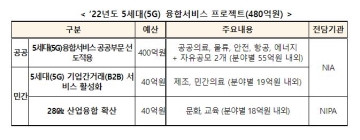
The Ministry of Science and ICT will invest 48 billion won in the Ieum 5G project.
The Ministry of Science and ICT, the Korea Intelligence Information Society Promotion Agency, and the Information and Communications Industry Promotion Agency announced on the 29th that they are launching a demonstration project for the '5G Mobile Communication Convergence Service Project'. This project comprises three demonstration businesses, and will invest a total of 48 billion won this year in the public and private sectors to demonstrate 11 tasks.
2022.07.01by 김예지 기자
Ministry of Science and ICT, 2023 total budget 18.8 trillion won
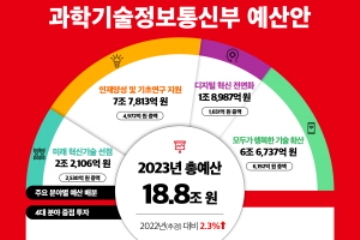
The Ministry of Science and Technology and Information and Communications (Minister Lee Jong-ho) will increase the total budget for 2023 by 13% compared to this year and focus on securing differentiated strategic technologies in the era of technological hegemonic competition and driving national digital innovation.
2022.09.02by 배종인 기자
Ministry of Science and ICT Encourages Expansion of Domestic AI Semiconductors in Public Sector
The Ministry of Science and ICT announced that it attended the 4th Central-Local Policy Coordination Meeting on the 2nd and requested the application of domestically developed AI semiconductors in the public sector.
2022.09.05by 김예지 기자











