


The Autonomous Ship Performance Demonstration Center holds the world's first and only title in Korea.
 Published2023.02.13 16:38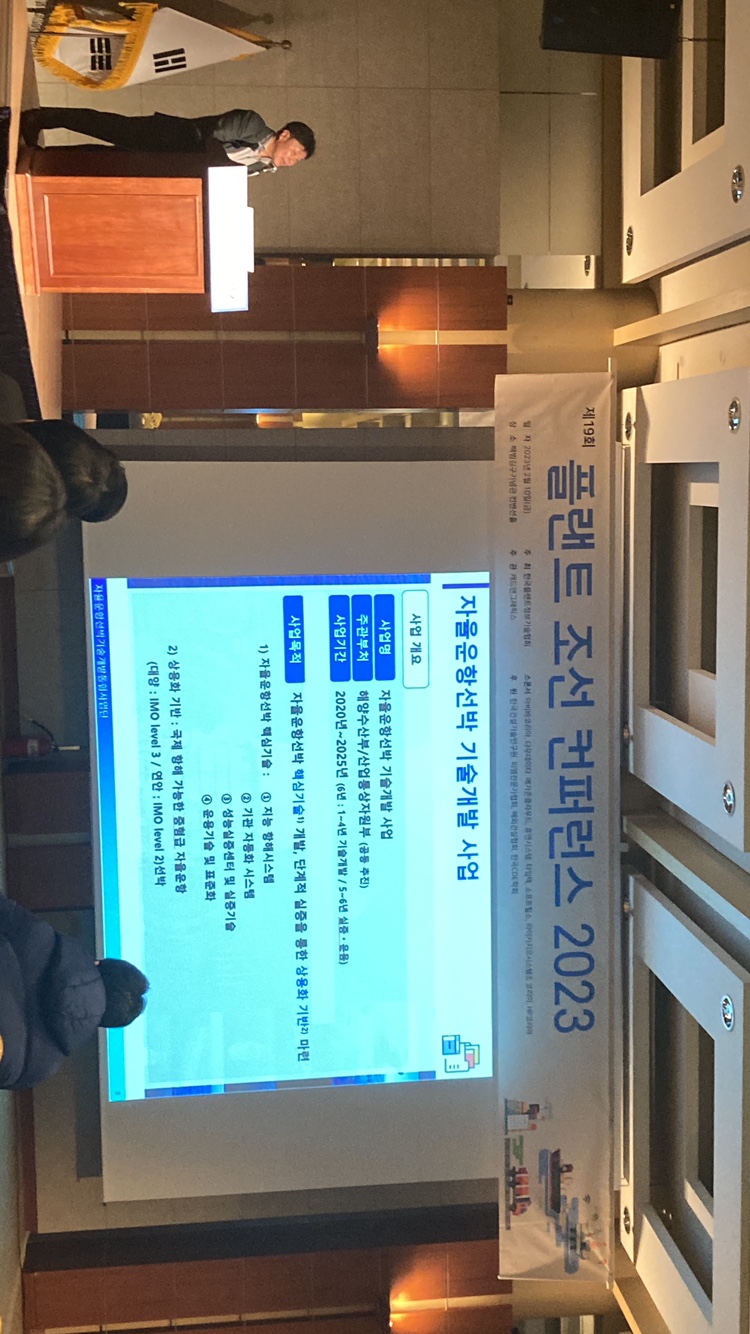
▲Im Geun-tae, director of the Ship and Ocean Research Institute, is giving a presentation at the 'Plant Shipbuilding Conference 2023.'
The world's first land-and-sea test bed serves as an internationally recognized testing and certification agency.
The only government-funded research institute in Korea to provide autonomous ship testing and evaluation services.
Through demonstrations, we plan to secure a technological edge in the global market by securing the lead in autonomous driving-related technology development and verification technologies, and also to secure data accumulation and track records through the operation of advanced equipment.
Comments
Related news
Nvidia invests $5 billion in Intel
NVIDIA and Intel, leaders in global AI computing technology, are now forging ahead in providing cutting-edge solutions through NVLink-based architecture integration. NVIDIA and Intel have officially announced a strategic partnership and stated that they will jointly develop customized data center and personal computing products to accelerate diverse applications and workloads ranging from hyperscale to enterprise and consumer markets, thereby laying the foundation for the next generation computing era.
2025.09.22by 배종인 기자
.jpg)
Applied Materials Launches Environmental Protection Campaign to Mark World Cleanup Day
Applied Materials Korea (CEO Park Kwang-seon) is carrying out environmental cleanup activities with employees and their families around the Dongtan Sinricheon area on the occasion of World Cleanup Day, evolving into a company that engages with the local community beyond technological innovation.
2025.09.22by 명세환 기자
.jpg)
The combination of electrical and electronic technologies like AI, semiconductors, and electric vehicles with renewable energy will determine industrial competitiveness.
Professor Lim Chun-taek from Gwangju Institute of Science and Technology (GIST) stated in his keynote speech at the '2025 e4ds Tech Day' on the 9th, "Global energy investment is already shifting from fossil fuels to renewable energy, and the trend of electrification combined with electrical and electronic technologies is changing the industrial landscape."
2025.09.12by 배종인 기자
.jpg)
"Data Center Power Demand Surges: Distributed Energy is the Solution"
The power demand of data centers is surging rapidly alongside the accelerating growth of artificial intelligence (AI), cloud, and electric vehicle industries. In particular, the global power supply and demand structure centered on the United States is undertaking a massive infrastructure reorganization to adapt to this change, and Korea is no exception in this trend. As an alternative to overcome the limitations of the existing centralized power system, distributed energy systems and smart grid technologies are gaining attention.
2025.09.02by 배종인 기자
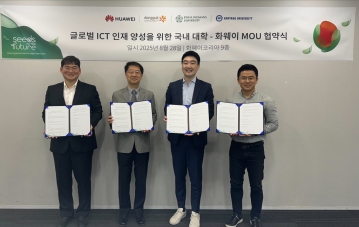
Huawei Begins Full-Scale Training of Young Korean Global ICT Leaders
Global ICT company Huawei Korea has signed a Memorandum of Understanding (MOU) with Dongguk University, Ewha Womans University, and Hanyang University, and will jointly implement a global education program to nurture next-generation ICT leaders.
2025.08.29by 배종인 기자











