



ETRI develops 5G small cell software...speeding up 5G specialized networks
 Published2023.03.02 11:39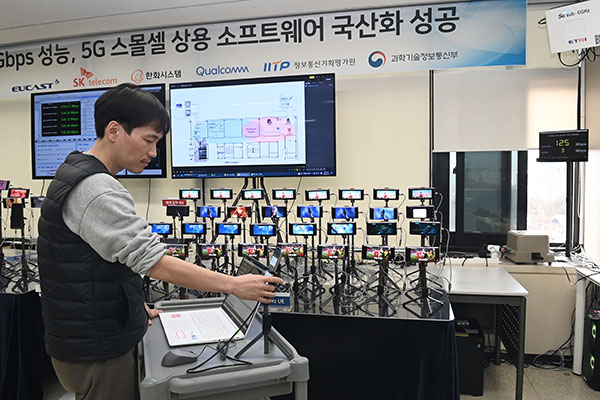
The expansion of Korea's 5G infrastructure is expected to strengthen the competitiveness of SME equipment.
It is expected that the development of commercial SW technology for 5G millimeter wave band small cells by domestic researchers will accelerate the expansion of domestic 5G infrastructure.
The Electronics and Telecommunications Research Institute (ETRI) announced on the 21st that it has developed commercial SW technology for 5G small cells that provides downlink speeds of 2.2 Gbps in the 5G millimeter wave band.
Utilizing this technology is expected to lead the expansion of 5G infrastructure by increasing the perceived communication speed of 5G users in densely populated areas and providing large amounts of high-quality data at high transmission speeds even in 5G-specific networks.
It is also expected that domestic small and medium-sized enterprises will be able to reduce their dependence on foreign products and increase product competitiveness by applying domestic software to 5G small cell communication equipment.
In particular, the small cell SW technology developed by the research team is expected to be useful for 5G specialized networks. The research team also successfully demonstrated high-definition video services, fire alarm services, and seamless voice and video calls between base stations using augmented reality glasses that connect to 5G smartphones.
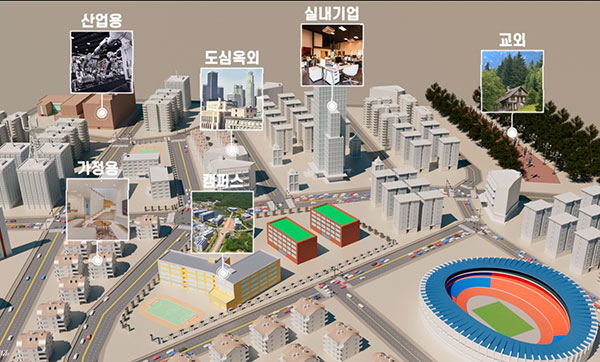
▲Use of 5G small cells
5G communications utilize high-bandwidth "millimeter wave" frequencies ranging from 3 to 30 GHz. The ultra-high 28 GHz band is a golden band capable of high transmission speeds, but it suffers from short transmission distances and the potential for communication interruptions even by small obstacles.
Therefore, to prevent this and ensure smooth communication, the minimum radius of base stations must be set and they must be installed densely and in large numbers.
5G small cells are ideal for this application due to their low radio output and small size. They can be easily installed anywhere there's internet access, and their construction costs are low.
The newly developed 5G small cell software technology integrates carrier aggregation (CA) technology with 5G communications, delivering transmission speeds of 2.2 Gbps per user in the 400 MHz frequency band. Access testing on commercial terminals utilizing platforms from global telecommunications company Qualcomm has been completed, enabling immediate commercialization.
ETRI also significantly improved the performance of the 5G small cell standalone (SA) base station developed last year. The base station's maximum uplink performance has more than doubled, reaching 230 Mbps. We have also completed verification of handover technology that provides seamless service even when moving between base stations.
The ability to achieve performance similar to that of a macro base station with low-spec hardware is possible thanks to the accumulated technological know-how in △5G NR radio resource scheduling technology supporting CA technology, △data plan optimization technology for ultra-high-speed data transmission, △5G small cell scheduling technology, △beam management algorithm, and △5G NR call control technology.
Going forward, the research team plans to advance the technology to meet next-generation standards, following the 5G NR phase-by-phase standards. Furthermore, the team is actively exploring the use of 5G small cells in various ways while conducting a domestic 5G specialized network pilot service project.
Choi Seong-ho, PM of the Institute for Information and Communications Technology Planning and Evaluation (IITP), said, "This research and development achievement has earned SMEs world-class 5G small cell products recognition. It is expected to be of great help not only in commercial 5G networks but also in various services, including specialized 5G networks."
This technology was developed in collaboration with SKT, Ucast, Hanwha Systems, and Qualcomm as part of the '5G NR-based Intelligent Open Small Cell Technology Development' project, which has been supported by the Ministry of Science and ICT and the Information and Communications Technology Promotion Center (IITP) since 2018.
Comments
Related news
ETRI succeeds in localizing millimeter wave band 5G small cell SW
ETRI has successfully developed 28GHz band-supporting 5G small cell software technology that improves transmission capacity and perceived communication speed in 5G coverage blind spots and densely populated areas. This has opened the path for domestic small and medium-sized enterprises to commercialize Korean-developed software rather than foreign software in 5G small cell communication equipment.
2020.10.28by 이수민 기자
ETRI Successfully Develops 5G Standalone Mode Small Cell Software
Domestic researchers have developed technology that enables 5G implementation without LTE assistance in small base stations, which is expected to be widely utilized in providing users with high-capacity, high-quality data or delivering 5G specialized network services.
2021.11.25by 배종인 기자

Korea Airports Corporation Successfully Implements '5G Specialized Network' in Airport Environment
According to the "5G Specialized Network Small Cell Network Technology Verification (PoC) Implementation Result Report" disclosed by the Korea Airports Corporation's Smart Airport Promotion Division, a 5G-grade wireless communication network can now be established even at aeronautical radiobeacons not serviced by the three telecom carriers, enabling a communication system for emergency response.
2022.12.22by 김예지 기자

2026, 5G market value '45 trillion won'
TrendForce announced on the 19th that the global 5G market size in 2023 is expected to reach $14.5 billion (17 trillion won) through activation of enterprise 5G private networks, advancement of small cell dedicated equipment, and 5G FWA, and is projected to reach $37 billion (45 trillion won) in 2026 with a CAGR of 11.0%. Metaverse-related applications were noted as a noteworthy application area.
2023.01.31by 김예지 기자
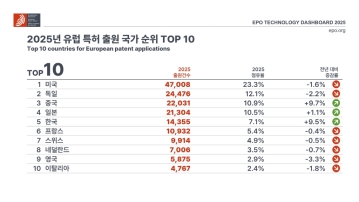
European Patent Applications Surpass 200,000 for the First Time… South Korea Maintains 5th Place, Led by Batteries and Telecommunications
According to the European Patent Office (EPO)'s 'Technology Dashboard 2025', European patent applications last year reached 201,974, surpassing 200,000 for the first time. Korean companies and inventors filed 14,355 applications, representing a 9.5% increase from the previous year and maintaining 5th place by country. Battery, digital communication, and semiconductor technologies led the growth, with Samsung ranking as the top EPO applicant for the second consecutive year and LG reaching 3rd place. The presence of major domestic cities such as Seoul, Suwon, and Yongin was also confirmed. It was also revealed that Korea's European patent strategy is expanding beyond individual technologies to span the entire industry.
2026.03.24by 명세환 기자











