


ST Launches Highly Integrated 32-Channel Ultrasonic Transmitter Optimized for Portable Scanners
 Published2023.03.03 14:25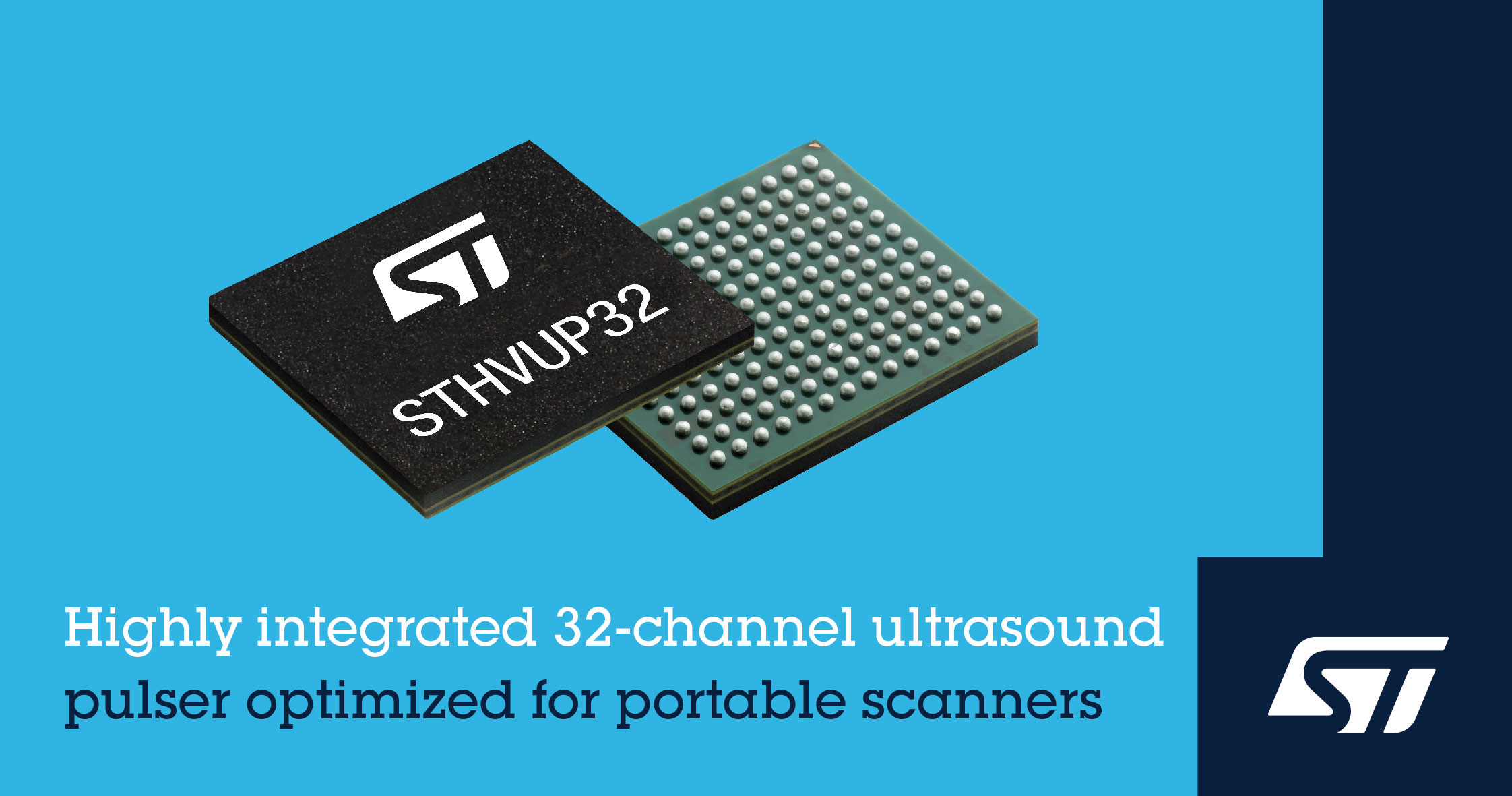
Supports maximized image quality, integrated digital beam steering, low power consumption, etc.
High-speed drive of scanner piezoelectric transducer and achievement of minimum pulse duration of 5ns
ST announced on the 3rd that it has launched a family of 32-channel advanced ultrasonic transmitter models that support portable applications with high output current.
The new STHVUP32 transmitter provides ±800mA, supporting portable systems that require additional drive capabilities for coaxial cable-mounted probes.
The new 32-channel version added to the portfolio features similar capabilities to the 64-channel STHVUP64, and of.
These transmitter products support innovative features that maximize image quality, integrated digital beam steering, a space-saving driver architecture, and low power consumption.
In addition to the standard 3-level output, the STHVUP32 features a 5-level output function to optimize image quality more flexibly.
In addition, the high output current drives the scanner's piezoelectric transducer at high speed to support various imaging modes and helps achieve a minimum pulse duration of 5ns to enhance image detail.
<bThis transmitter supports continuous-wave (CW) and pulsed-wave (PW) operating modes, providing various types of analysis such as cavity and fluid flow.
Digital beam steering improves directional control capabilities by providing superior precision compared to conventional analog steering that uses delay circuits.
Since beam steering logic is integrated, there is no need to use companion chips such as FPGAs. This reduces PCB space and routing complexity, and avoids FPGA design issues.
In addition, the new transmitter features a self-biased driver architecture, eliminating the need to connect decoupling capacitors to the transmitter's power supply pins.
This reduces the circuit footprint and lowers the Bill of Materials (BoM). Since the STHVUP32 is available in a smaller package compared to ICs in its class, designers can also develop next-generation products with much smaller form factors.
STHVUP32 supports ultra-low power consumption, which is the core of battery-operated systems, while providing a wealth of features that deliver an excellent user experience.
It has built-in memory for storing transmission patterns and supports synchronization using a clock signal of up to 200 MHz, thereby minimizing jitter and improving image quality.
In addition, it incorporates protection functions such as noise blocking, thermal protection, undervoltage protection, and recirculating current protection, and provides a diagnostic register that can directly read the cause of an interrupt to facilitate debugging in the event of a malfunction.
STHVUP32 is currently being produced in an 11.5mm x 10.5mm x 1.35mm 168-ball FC-BGA168 package.
Comments
Related news
.jpg)
[Serial] ST Yuji Kawano, Engineer (27) - Using a GNSS Module, Challenge Map Tracking! - GUI Edition (Settings Change 2)
MCUs are unfamiliar compared to CPUs or GPUs, yet they are among the most widely used semiconductors. Let's hear from Yuki Kawano, Manager at ST System Solutions Lab, about the versatility and potential of MCUs.
2023.02.28by 명세환 기자
[Interview] Jang Tae-jong, Vice President of STMicroelectronics: "STM32 MCUs Meet Performance, Power Efficiency, and Security"
ST will introduce the new STM32Hx MCU, which succeeds the STM32F4 that has been popular across various fields over the past decade, featuring higher performance, improved efficiency, and the latest functionality at this webinar.
2023.03.02by 성유창 기자
.jpg)
ST Announces Wide-Range Antenna Matching RF IPD Family Supporting STM32WL MCUs
ST announced on the 2nd that it has launched nine RF IPD (Integrated Passive Device) products optimized for the STM32WL wireless MCU, integrating antenna impedance matching, balun, and harmonic filter circuits.
2023.03.02by 성유창 기자
Mouser Expands Domestic Supply of ST Semiconductor Solutions
Global electronic components distributor Mouser Electronics is stably supplying a wide range of products from world-leading semiconductor manufacturer STMicroelectronics to the domestic market and strengthening the electronic design environment.
2026.03.24by 배종인 기자

Mouser Expands Online Resource Center to Support Real-World Deployment of Autonomous Vehicles
Global electronics distribution company Mouser has strengthened its autonomous vehicle (AV) resource hub, focusing on design challenges and system architecture necessary for implementing production-ready autonomous driving systems.
2026.03.17by 배종인 기자











