



“Autonomous Driving Levels 3 and 4, ‘Sensors and Semiconductors’ are the Key”
 Published2023.03.13 14:53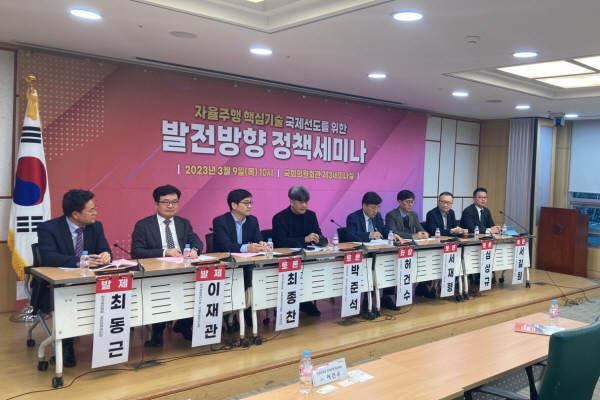
Standards, a means of generating revenue, not something 'to be followed'
RSU·Electric Vehicle Charger, Cyber Security Discussion Urgently Needed
The 'Policy Seminar on Development Direction for Leading the International Autonomous Driving Core Technology' hosted by National Assemblyman Kim Seong-won and organized by the Korea Industrial Technology Assessment and Management Institute and the Autonomous Driving Technology Development Innovation Center was held on the 9th in Seminar Room 3 of the National Assembly Members' Hall.
Choi Dong-geun, head of the Standards Policy Center at the Korea Standards Association, presented on the ‘Current status of autonomous driving technology standardization and response strategies.’
To secure the reliability of autonomous driving, various international standards are being developed domestically and internationally, including vehicle control, human engineering, and cooperative driving, and Korea is leading 19 projects, which is about 5% of the international standardization projects.
There are 96 international standardization projects underway in Germany, 50 in the US, and 47 in Japan. China is behind Korea with 4 projects, but has recently been actively pursuing standardization of core autonomous driving components such as lidar.
Center Director Choi emphasized the importance of sensors in autonomous driving and stressed that a strategy should be adopted to check China's technology-centered standardization lead and to ensure that our country's technology is reflected.
In the discussion that followed the opening presentation, Choi Jong-chan, national standards coordinator for autonomous vehicles at the National Institute of Standards and Technology, asked the question of who benefits as standards become established.
ISO/TC 22 and 204 were committees that discussed standards related to existing automobiles, but as many issues related to autonomous driving began to be discussed, they are putting a lot of effort into creating an environment where domestic experts can actively participate and propose domestic standards.
In relation to national standards, many policies are being promoted and technology development is underway to establish the autonomous driving new industry, and the issue is what standards should be established in areas such as cybersecurity and insurance to stably establish the industry domestically.
From our country's perspective, the argument is that we should operate this standard in a policy and strategic manner so that the government, automobile manufacturers, IT companies, and startups can create a foundation for developing businesses based on the standard.
He said that rather than taking a passive stance of thinking that the standard itself is something that must be ‘kept,’ we should look at it proactively and ensure that it can secure competitiveness and generate profits.
“It is regrettable that automobile manufacturers and parts suppliers are moving in a direction that avoids claiming that they have met UN regulations,” said Sim Sang-gyu, executive director of Autocrypt. “In order to increase the acceptance of technology, safety-related security is also very important.”
According to Executive Director Shim, the reality of automotive cybersecurity is that companies are only responding to the minimum set of requirements required to obtain ISO 22434 certification.
While automobiles are evolving toward wireless and wired connections, such as RSU (Road Side Unit) in the case of C-ITS and electric vehicles connecting to chargers, there is a lack of discussion on cybersecurity for roadside facilities and chargers both domestically and internationally.
/> When we conducted a security assessment diagnosis on electric vehicle chargers and RSUs, we found that there were already many dangerous cases.
If the chargers were hacked, it could cause problems and fires for the entire power grid in our country, and in the case of RSUs, it could even cause traffic chaos.
As we move towards SDV (Software Defined Vehicle), the importance of software architecture separate from hardware architecture is increasing, and the security technologies in the two fields are clearly different.
In the case of Europe, several countries have been gathering since 2016 to discuss automotive data security in earnest, but in Korea, progress has been slow from an automotive data perspective, said Executive Director Shim, emphasizing security.
Seo Jae-hyung, an autonomous driving PD at the Korea Industrial Technology Assessment and Management Institute, said, “The advancement of sensors has recently been included in the planning direction of R&D,” and “Sensors and the semiconductors that support them are the most important elements in expanding to autonomous driving levels 3 and 4.”
He continued, “We need to draw a big picture that encompasses architecture-based platforms, software, and semiconductors, and it is important to fill in the gaps in technology, such as software, which is our country’s weakness.”
Professor Heo Geon-su of Hanyang University’s Department of Future Automotive Engineering, who chaired the event, also said, “Both domestic and foreign autonomous driving companies consider sensor companies to be the core autonomous driving companies,” adding, “Companies with sensors will dominate autonomous driving.”
Park Jun-seok, a professor of electronic systems engineering at Kookmin University, said, “Autonomous vehicles that make judgments and control based on machine learning-based probability and experience make judgments based on grounds that humans cannot understand.” He added, “In the European GDPR, all systems that include autonomous driving modules must be able to communicate with at least human language and logic.” He argued that “interpretation and explanation must be possible.”
He emphasized that we need to discuss the creation and management of technologies and data that can provide human language for all events and actions judged and controlled by machines.
Professor Park then raised the issue that not all road infrastructure may be suitable for autonomous vehicles.
He concluded by saying, “There needs to be an evaluation of what the standards for suitable roads on which autonomous vehicles can run are,” and “Ultimately, I think that roadmaps related to autonomous vehicles need blueprints and systems related to road infrastructure, such as road plans, infrastructure evaluation plans, and new and old city development.”
Seo Gil-won, head of the Future Automobile Industry Division at the Ministry of Trade, Industry and Energy, said, “The Future Automobile Industry Division at the Ministry of Trade, Industry and Energy is in charge of fostering the autonomous driving industry and training future car personnel,” and “The policy goal for 2023 is to launch a mass-produced Level 3 autonomous vehicle, conduct a Level 4 test run in 2024, and complete the autonomous driving road infrastructure in 2025.”
The Ministry of Trade, Industry and Energy, the Ministry of Science and ICT, the Ministry of Land, Infrastructure and Transport, and the National Police Agency are jointly investing more than 1 trillion won to collaborate to commercialize Level 4+ autonomous vehicles by 2027. The Ministry of Trade, Industry and Energy is in charge of overall autonomous driving policy, the Korea Agency for Technology and Standards is in charge of standardization work, the Ministry of Land, Infrastructure and Transport is in charge of transportation infrastructure, the Ministry of Science and ICT is in charge of ICT linkage, and the National Police Agency is in charge of work related to road traffic safety.
In addition, the government felt the need for a large-scale test bed where companies developing autonomous driving technology and operating service products can gather to verify and evaluate technologies, and announced that it is considering establishing a self-driving car commercialization test complex as a national project for 2023 and plans to provide intensive support and promotion.
Manager Seo Gil-won said, “Preparation for the future automobile parts industry is urgently needed,” and “Recently, “In relation to the Future Vehicle Special Act, which has been proposed four times in the National Assembly, we are also preparing a bill related to fostering an ecosystem to support the transition of the automobile boom industry to future vehicles,” he said.
Comments
Related news
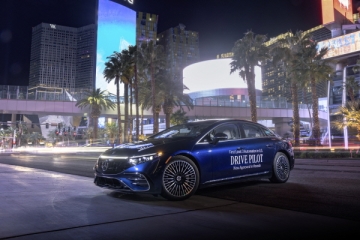
Mercedes-Benz Level 3 Autonomous Driving Enters Nevada, USA
Nevada has approved Mercedes-Benz's SAE Level 3 conditional autonomous driving.
2023.01.31by 성유창 기자
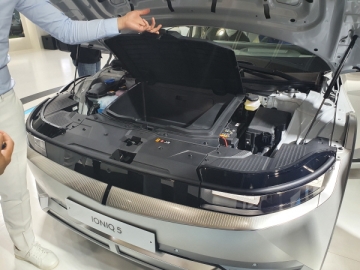
The Ministry of Trade, Industry and Energy will invest KRW 499.4 billion in R&D for eco-friendly and autonomous vehicles.
The government is investing 499.4 billion won in future vehicle technology development, including eco-friendly vehicles and autonomous vehicles, focusing on future vehicle technology development and corporate support.
2023.02.09by 배종인 기자

Samsung Electronics and Ambarella to Collaborate on 5nm Semiconductor Production for Autonomous Vehicles
Samsung Electronics announced on the 21st that it will produce autonomous vehicle semiconductors for U.S. AI semiconductor specialist Ambarella using its advanced 5-nanometer foundry process.
2023.02.22by 성유창 기자
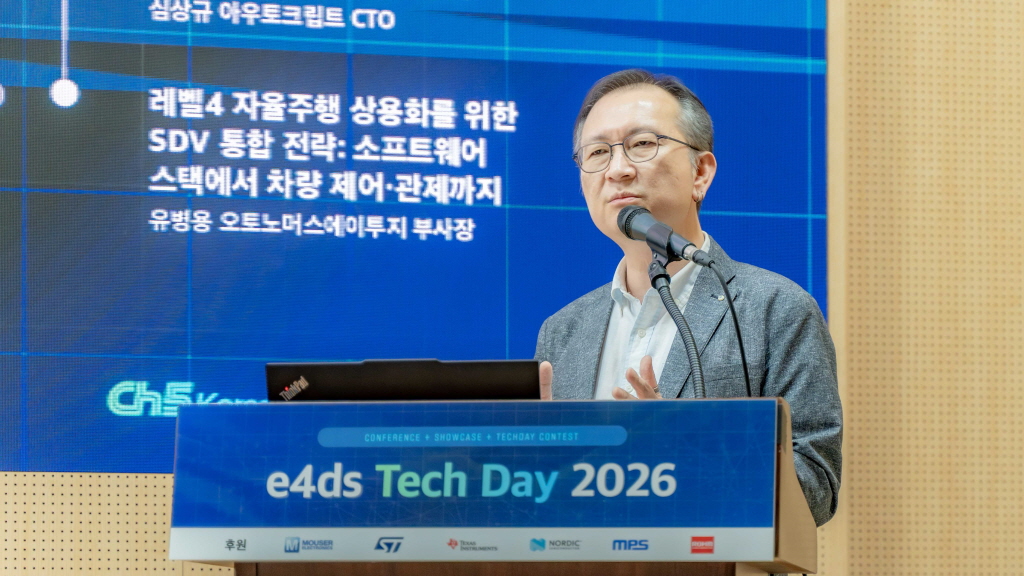
[e4ds Tech Day 2026 ⑨] Sim Sang-gyu, Autocrypt CTO: "In the Physical AI Era, Automotive Security Must Extend Beyond the Vehicle"
At e4ds Tech Day 2026, Sim Sang-gyu, CTO of Autocrypt, explained automotive cybersecurity strategies in the era of Physical AI and SDV (Software-Defined Vehicle). Automobiles are evolving as part of an ecosystem connected to AI, cloud, chargers, IoT, and robots, and he emphasized that the scope of security must expand beyond the vehicle interior to the entire connected environment. In particular, AI model tampering, adversarial attacks, OTA updates, and EV charger hacking were identified as major threats. He explained that response measures require zero trust, AI model integrity protection, intrusion detection, Security by Design and Default, and full lifecycle security management, and that proactive security system establishment beyond regulatory compliance is critical for securing future mobility competitiveness.
2026.10.12by 배종인 기자

Practical HIL Construction Strategy for Automotive and Off-Highway Controller Validation
As vehicle E/E architecture transitions to zonal structures and shifts to software-defined vehicles (SDV), the number of controllers (ECUs) requiring validation and software complexity are surging dramatically. Meanwhile, real vehicle testing cannot provide repeated verification under identical conditions and entails lead time and safety concerns. This white paper explains the principles of HIL (Hardware-in-the-Loop) validation and the structure of the NI platform composed of PXI, SLSC, and VeriStand, and through two actual implementation cases—Camera Record & Replay HIL for In-Cabin Monitoring Controller (ICMU) and Forklift Controller (VCU) HILS—describes how controller-level regression testing becomes possible. Additionally, it explicitly states application boundaries and limitations, such as lack of A2B support.
2026.10.12by 편집부











