


Road Network Digital Twins: Virtual Testing Benefits and Budget Concerns Coexist
 Published2023.06.01 15:43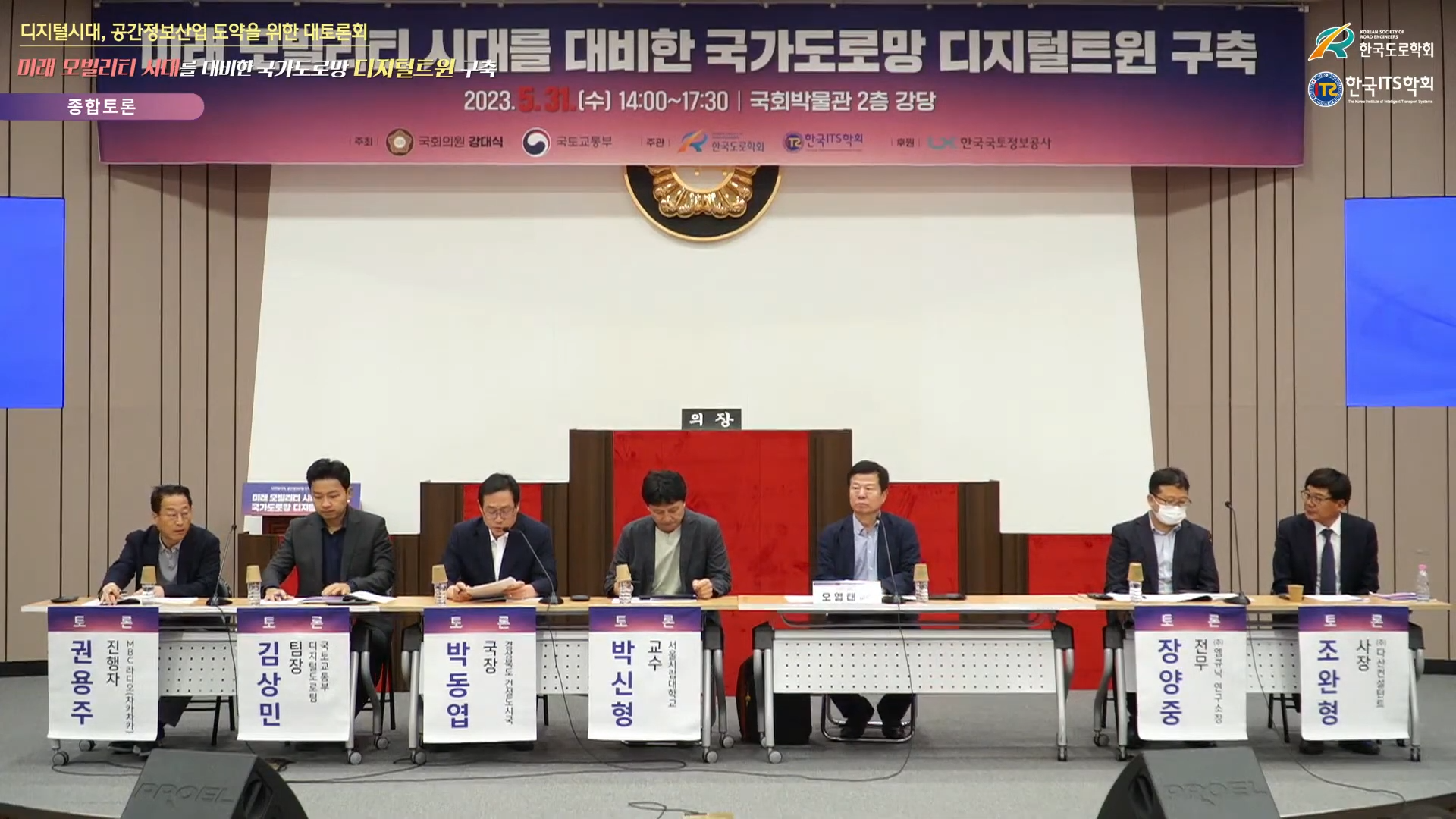
▲ Seminar discussion on building a national road network digital twin in preparation for the future mobility era (Photo: Capture from the Korean Road Society YouTube channel)
Advantages of virtual testing, such as signal optimization and autonomous driving system response
Expected investment of 20-30 billion won per local government… Urgent need for discussion on non-urban areas
On the 31st, Rep. Kang Dae-sik and the Ministry of Land, Infrastructure and Transport held a seminar and discussion at the National Assembly Museum on the topic of ‘Establishing a National Road Network Digital Twin to Prepare for the Future Mobility Era.’
The discussion, moderated by former Korea Transportation Safety Authority Chairman Oh Young-tae, included in-depth discussions on the national road network digital twin.
Professor Park Shin-hyung of Seoul City University, who participated as a panelist, emphasized, “Although there was a lot of noise in the early days of the NGIS (National Geographic Information System) project that started in the 1990s, the digital maps built through it have brought convenience to our lives, such as navigation,” and “We must definitely consider how much added value we can create in the future.”
He said he couldn't test signal optimization on real roads, and he couldn't test how autonomous vehicles would react when there were jaywalkers.Although this is impossible in reality, it is possible through simulation using a digital twin.
Building a digital twin will cost a significant amount of money and time, but we need to examine and predict how much it will change society in the future and gain consensus on its necessity.
Considering trends such as smart mobility and autonomous driving, the future value of roads is quite significant.
The roads that contributed to the country's development during the industrial growth period are aging.
He said that as we see this as a time when physical aging and the value of advanced infrastructure coexist, we need to have an in-depth discussion on how to manage roads, which are important assets.
Professor Park continued, “The value of data shines when it is utilized, but it is regrettable that there are many restrictions on sharing data, and I hope that there will be discussion on the utilization of data.”
They pointed out the problem that the data was not received even after 6 months of requesting it due to the complicated process and time required for data built through taxes, and they also expressed their hope that a virtuous cycle would be created in which the private sector, if it creates data using public assets, returns it to the public, excluding sensitive parts.
Park Dong-yeop, Director of the Gyeongsangbuk-do Construction and Urban Development Bureau, expressed his opinion on the construction of digital twins for roads and the limitations of non-urban areas, and emphasized that digital twins that can be used nationwide should be created.
He said, “There is a lot of research being done on building digital twins to prepare for future mobility, but most of it is about cities with high traffic volumes.” He added, “More than 80% of our country’s land area is non-urban, and there are questions about how to proceed with building a digital twin in Gyeongbuk Province.”
Pointing out the problems of building digital twins in road management situations by road management agencyHe added that there is a need to think deeply about how to operate roads suitable for the era of autonomous driving.
When talking about building a digital road ledger, he also mentioned budgetary issues.
Gyeongbuk invested 12 billion won in computerizing road registers about 10 years ago, and spends 60 million won annually on system maintenance, with 5 to 30 million won invested in update costs.
Despite this investment of budget, if an emergency situation such as heavy rain or a landslide occurs, the data that has been built cannot be used and the survey must be started over.
Park, the director of the Construction and Urban Development Bureau, said, “If we move toward digital twins, it seems that 20 to 30 billion won will need to be invested per local government,” and added, “Research by experts is urgently needed regarding construction in non-urban areas.”
Cho Wan-hyung, CEO of Dasan Consultants, who participated in the discussion, said, “Korea Expressway Corporation has been ordering all highway designs using BIM design since last year,” and insisted, “We need to make sure that it can help not only with design but also with maintenance.”
On the other hand, there are problems that arise in BIM design, such as confusion caused by different programs used by each company even when carrying out the same project.
He also expressed his hope that measures would be put in place to ensure that construction workers and public officials can effectively utilize BIM.
He then strongly agreed with the idea that all roads across the country should be integrated, managed, and operated with standardized information, and that they should be built in a unified form for the era of autonomous driving.
It was also suggested that the digital twin national road network should prioritize providing precise maps and road information to users and autonomous vehicles rather than managers.
The last debater is Sangmin Kim The head of the Ministry of Land, Infrastructure and Transport's digital road team has stepped forward.
Team Leader Kim talked about the necessity and direction of the national road network digital twin, and said that according to the results of a survey conducted last summer, 60% of local government road ledgers were managed on paper, and 40% were managed in PDF format.
They also shared the results of a survey that showed that it is difficult to grasp the status of roads because they are managed on paper, cannot be used immediately, and there are difficulties in administrative processing.
The use of digitized information can bring benefits in road management and safety.
He went on to say that if information such as aging, safety ratings, and safety inspection dates are digitized and standardized, it can also solve safety issues, such as being used to prevent accidents.
Last year, the digitalization of road registers began as a national task and is underway with the goal of completion in 2027. Some local governments have already begun digitalization of roads under their jurisdiction with the Ministry of Land, Infrastructure and Transport.
Uljin, which conducted a digital twin pilot project in 2021, also introduced a case of flooding and inundation simulation on a coastal road through the construction of a digital twin.
Team leader Kim said, “The Ministry of Land, Infrastructure and Transport is currently trying to actively provide real-time information on road construction and other issues by introducing a system for frequent updates,” adding, “The revision of the Road Act is currently under discussion and we plan to promote various related policies.”
Comments
Related news

[e4ds Tech Day 2026 ⑨] Sim Sang-gyu, Autocrypt CTO: "In the Physical AI Era, Automotive Security Must Extend Beyond the Vehicle"
At e4ds Tech Day 2026, Sim Sang-gyu, CTO of Autocrypt, explained automotive cybersecurity strategies in the era of Physical AI and SDV (Software-Defined Vehicle). Automobiles are evolving as part of an ecosystem connected to AI, cloud, chargers, IoT, and robots, and he emphasized that the scope of security must expand beyond the vehicle interior to the entire connected environment. In particular, AI model tampering, adversarial attacks, OTA updates, and EV charger hacking were identified as major threats. He explained that response measures require zero trust, AI model integrity protection, intrusion detection, Security by Design and Default, and full lifecycle security management, and that proactive security system establishment beyond regulatory compliance is critical for securing future mobility competitiveness.
2026.10.12by 배종인 기자

Practical HIL Construction Strategy for Automotive and Off-Highway Controller Validation
As vehicle E/E architecture transitions to zonal structures and shifts to software-defined vehicles (SDV), the number of controllers (ECUs) requiring validation and software complexity are surging dramatically. Meanwhile, real vehicle testing cannot provide repeated verification under identical conditions and entails lead time and safety concerns. This white paper explains the principles of HIL (Hardware-in-the-Loop) validation and the structure of the NI platform composed of PXI, SLSC, and VeriStand, and through two actual implementation cases—Camera Record & Replay HIL for In-Cabin Monitoring Controller (ICMU) and Forklift Controller (VCU) HILS—describes how controller-level regression testing becomes possible. Additionally, it explicitly states application boundaries and limitations, such as lack of A2B support.
2026.10.12by 편집부
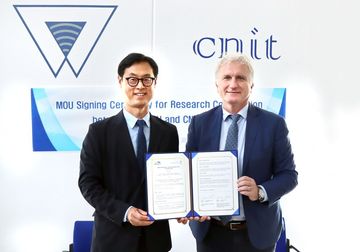
Korea Automotive Research Institute Signs MOU with Italy National Institute for Wireless Communications
The Korea Automotive Research Institute will sign an MOU with Italy's National Institute for Wireless Communications and launch joint research on next-generation mobility technologies based on 6G, V2X, and connected vehicles. The two organizations will conduct research to apply advanced wireless communication technologies to vehicles and discover international joint projects to advance next-generation connected vehicle technology development.
2026.10.12by 배종인 기자
Color Accuracy Issues in Vehicle Interior Ambient Lighting and Intelligent LED Drivers
Vehicle interior ambient lighting is spreading across all price segments, and the level of color accuracy required of lighting designers is rising accordingly. This white paper quantitatively addresses why temperature drift and individual variations of RGB LEDs cannot be corrected by standard constant-current drivers, and explains an intelligent LED driver approach that integrates an MCU, calibration data, and a LIN network interface into the driver. It covers implementation details of the LITIX Interior TLD4020-3ET currently in production, portfolio roadmap, and evaluation/development environments, and clarifies application boundaries including lack of 48V support, lack of RGBi/ISELED support, and absence of direct optical degradation diagnostics.
2026.10.08by 명세환 기자
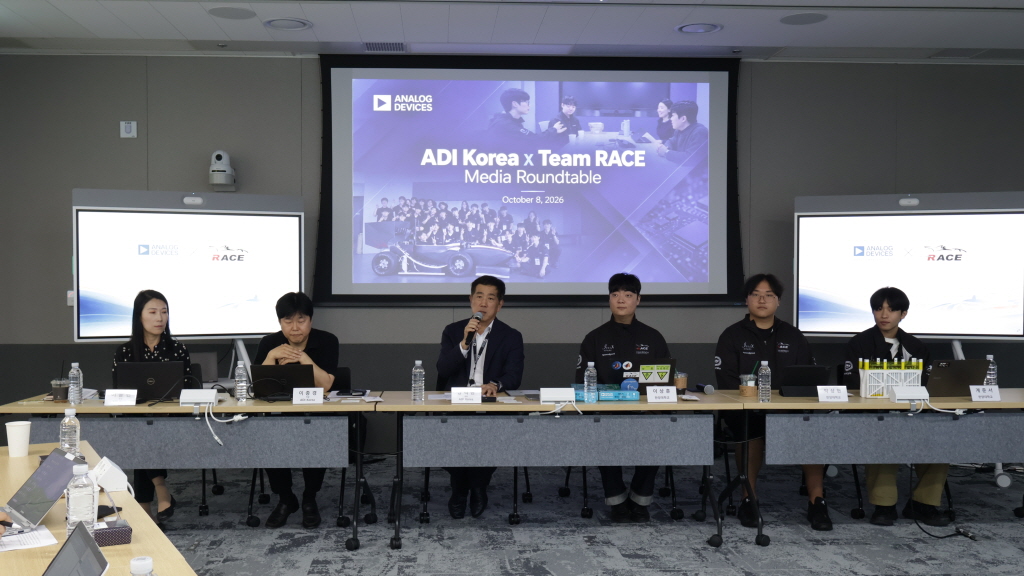
ADI, "Fostering Future Engineers Beyond Component Support"
Global semiconductor company Analog Devices (ADI) is drawing attention for moving beyond simply sponsoring university student car projects to serve as a partner in nurturing future engineers. Over the past three years, ADI has collaborated with Hanyang University's automotive research club Team RACE to support electric formula vehicle development, and recently has been providing technical consultation and semiconductor solutions to enable students to directly develop battery management systems (BMS), creating a model case of industry-academic cooperation.
2026.10.08by 배종인 기자











