


Hyundai Motor Intensifies Efforts to Secure Preemptive Position in China's Hydrogen Market
 Published2023.06.01 16:26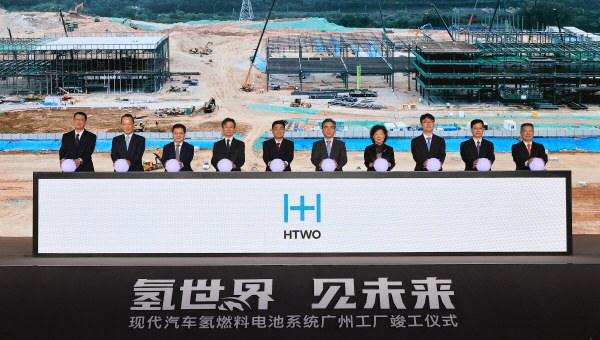
▲ Scene of the Hyundai Motor Group HTWO Guangzhou completion ceremony (Photo credit: Hyundai Motor Group)
Hyundai Motor Completes Hydrogen Fuel Cell Production Plant in Guangzhou, China
HTWO Guangzhou Serves as Bridgehead for Global Hydrogen Business Expansion
Hyundai Motor Group held a completion ceremony for 'HTWO Guangzhou' on the 1st in Huangpu District, Guangzhou, China, attended by approximately 200 people, including Kang Sang-wook, Consul General of the Republic of Korea in Guangzhou, Lin Keqing, Chairman of the Guangdong Provincial CPPCC and Secretary of the Guangzhou Municipal Committee, government officials from both countries, executives from major partner companies, and Hyundai Motor Group employees.
Hyundai Motor Group built HTWO Guangzhou to secure a leading position in the Chinese hydrogen market, launch its global hydrogen business in earnest, and expand the hydrogen industry ecosystem.
HTWO (Hydrogen+Humanity) is a hydrogen fuel cell system brand launched by Hyundai Motor Group in 2020.
HTWO Guangzhou is the first hydrogen fuel cell system factory built overseas by Hyundai Motor Group, and the company plans to take the lead in realizing carbon neutrality by expanding hydrogen fuel cell systems as a power source for various mobility and industrial sectors.
A hydrogen fuel cell system is a type of generator that combines an air supply system, a hydrogen supply system, and a thermal management system with a hydrogen fuel cell stack to produce electricity through the electrochemical reaction between oxygen from the air and hydrogen supplied from a hydrogen tank. It is used not only in passenger and commercial vehicles but also in the future It can be utilized in various fields such as emergency power generation, electric vehicle charging, ships, trams, and urban aircraft.
Hyundai Motor Group signed an MOU with the Guangdong Provincial Government of China in December 2019 to establish HTWO Guangzhou and spent about a year preparing, including market research and site selection. Subsequently, an investment contract was signed in January 2021, and construction began in March.
HTWO Guangzhou has built a stack factory, activation factory, research building, office building, and innovation center on a 202,000 m² site covering 82,000 m², and has an annual production capacity of 6,500 hydrogen fuel cell systems.
Hyundai Motor Group will produce and sell hydrogen fuel cell systems in HTWO Guangzhou and plans to gradually expand supply volume in the future, taking into account the Chinese market conditions and central government policies.
Hyundai Motor Group expects HTWO Guangzhou to play a pivotal role in cooperation and business expansion in the upstream and downstream hydrogen industries within China.
At the completion ceremony, Hyundai Motor President Jang Jae-hoon stated, “HTWO Guangzhou will operate as Hyundai Motor Group’s first overseas hydrogen fuel cell hub, prioritizing eco-friendliness, smart technology, and safety.” He added, “Hyundai Motor Group will strengthen strategic partnerships with leading companies in China to contribute to the high-quality development of the hydrogen industry in China and Guangdong Province, as well as the achievement of carbon neutrality goals.”
In his congratulatory remarks, Li Xin, Vice Chairman of the Guangdong Provincial CPPCC, stated, “I believe that the completion of HTWO Guangzhou will serve as a new starting point, opening up room for broader cooperation and development in the field of hydrogen energy.”
He added, “I look forward to Hyundai Motor Company playing a leading role as a hydrogen leader, sharing its advanced experience in fields such as hydrogen technology and products, and further expanding the hydrogen industry ecosystem to contribute together to the high-quality development of Guangdong Province’s hydrogen industry.”
Meanwhile, at the completion ceremony held on the same day, HTWO Guangzhou signed a Memorandum of Understanding (MOU) with Guangdong Province and Guangzhou City to supply 1,500 hydrogen electric commercial vehicles, including hydrogen electric trucks and hydrogen electric sanitation vehicles, to state-owned enterprises under Guangdong Province and Guangzhou City by 2024. It was decided to distribute it.
China has recently announced various policies to reduce carbon emissions and transition to eco-friendly energy.
China presented the "Double Carbon" goal at the 75th United Nations General Assembly in September 2020, aiming to peak carbon emissions in 2030 and achieve carbon neutrality by 2060.
Subsequently, in October of the same year, the Society of Automotive Engineers of China, an advisory body on automotive policies for the Ministry of Industry and Information Technology of China, announced the 'Energy Saving and Eco-friendly Vehicle Technology Roadmap 2.0' and presented targets for the adoption of hydrogen electric vehicles in China.
This roadmap includes a specific goal for China to deploy a cumulative total of 1 million hydrogen electric vehicles, centered on commercial vehicles, by around 2035, offering a glimpse into the atmosphere of fostering the hydrogen industry within China.
In 2021, China announced that to revitalize the hydrogen economy, it designated five city groups—Jingjinji (Beijing, Tianjin, Hebei) and surrounding regions (Shandong), as well as Shanghai, Guangdong, Hebei, and Henan—as pilot cities and plans to supply a total of 33,010 hydrogen electric vehicles by 2025.
Subsequently, in March 2022, the 'Mid-to-Long-Term Plan for Hydrogen Energy Development (2021–2035)' was announced.
This plan is China's first mid-to-long-term plan applicable to the entire hydrogen industry and sets a goal to increase the number of hydrogen electric vehicles to 50,000 and the annual production of green hydrogen to 100,000 to 200,000 tons by 2025, while reducing annual carbon dioxide emissions by 1 million to 2 million tons.
In addition, there is a plan to establish a complete hydrogen industry technology innovation system and a green hydrogen supply system by 2030, create a diverse hydrogen utilization ecosystem by 2035, and increase the proportion of hydrogen consumption.
In August 2022, Guangdong Province [issued] the 'Action Plan on Accelerating the Construction of the Guangdong Province Fuel Cell Vehicle Pilot City Cluster (202It announced the '2020-2025' plan and stated that it aims to supply more than 10,000 hydrogen electric vehicles during the pilot period and expand its annual hydrogen production capacity to 100,000 tons.
In addition, it presented goals such as installing 200 hydrogen refueling stations and lowering the final consumer price of hydrogen for vehicles to 30 yuan or less per kilogram.
In December 2022, Guangzhou City announced the '2022-2025 Guangzhou City Fuel Cell Vehicle Pilot Operation Work Plan,' stating that it would mass-produce, distribute, and utilize hydrogen electric vehicles by 2025 and promote the construction of hydrogen charging stations to create a hydrogen energy hub with international influence.
Hyundai Motor Group expects HTWO Guangzhou to play a pivotal role in the Chinese hydrogen market as China's hydrogen industry is expected to grow rapidly.
A Hyundai Motor Group official stated, “HTWO Guangzhou will play a significant role in solidifying the global Hyundai Motor Group’s leadership as a first mover in the hydrogen market,” adding, “Hyundai Motor Group has taken the lead in building a sustainable hydrogen ecosystem and realizing global carbon neutrality, just as it has in the past and will continue to do so.”
Comments
Related news
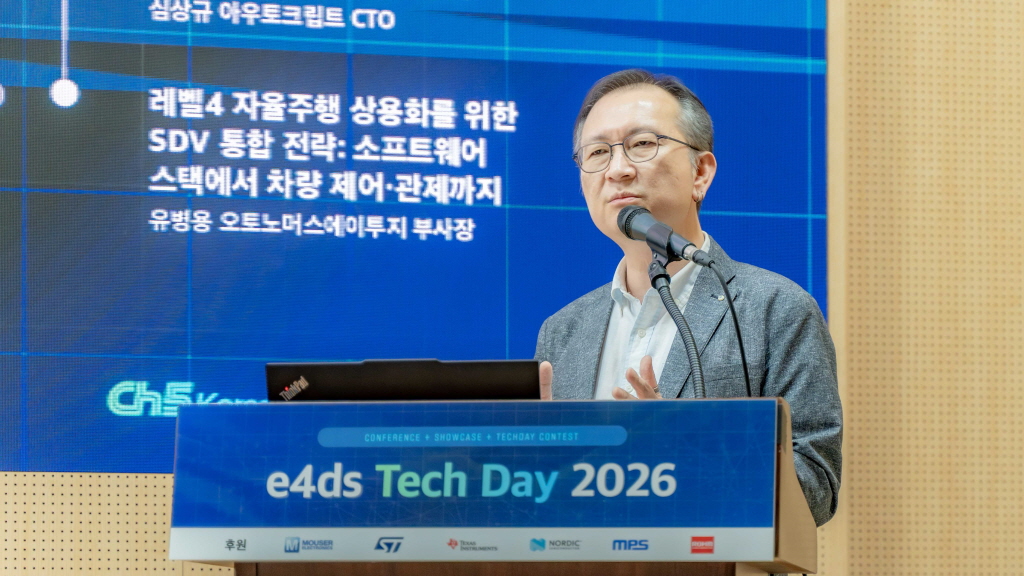
[e4ds Tech Day 2026 ⑨] Sim Sang-gyu, Autocrypt CTO: "In the Physical AI Era, Automotive Security Must Extend Beyond the Vehicle"
At e4ds Tech Day 2026, Sim Sang-gyu, CTO of Autocrypt, explained automotive cybersecurity strategies in the era of Physical AI and SDV (Software-Defined Vehicle). Automobiles are evolving as part of an ecosystem connected to AI, cloud, chargers, IoT, and robots, and he emphasized that the scope of security must expand beyond the vehicle interior to the entire connected environment. In particular, AI model tampering, adversarial attacks, OTA updates, and EV charger hacking were identified as major threats. He explained that response measures require zero trust, AI model integrity protection, intrusion detection, Security by Design and Default, and full lifecycle security management, and that proactive security system establishment beyond regulatory compliance is critical for securing future mobility competitiveness.
2026.10.12by 배종인 기자
Practical HIL Construction Strategy for Automotive and Off-Highway Controller Validation
As vehicle E/E architecture transitions to zonal structures and shifts to software-defined vehicles (SDV), the number of controllers (ECUs) requiring validation and software complexity are surging dramatically. Meanwhile, real vehicle testing cannot provide repeated verification under identical conditions and entails lead time and safety concerns. This white paper explains the principles of HIL (Hardware-in-the-Loop) validation and the structure of the NI platform composed of PXI, SLSC, and VeriStand, and through two actual implementation cases—Camera Record & Replay HIL for In-Cabin Monitoring Controller (ICMU) and Forklift Controller (VCU) HILS—describes how controller-level regression testing becomes possible. Additionally, it explicitly states application boundaries and limitations, such as lack of A2B support.
2026.10.12by 편집부
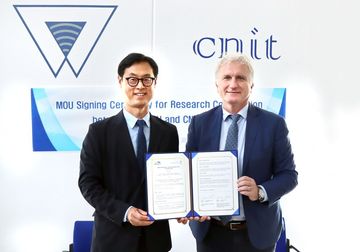
Korea Automotive Research Institute Signs MOU with Italy National Institute for Wireless Communications
The Korea Automotive Research Institute will sign an MOU with Italy's National Institute for Wireless Communications and launch joint research on next-generation mobility technologies based on 6G, V2X, and connected vehicles. The two organizations will conduct research to apply advanced wireless communication technologies to vehicles and discover international joint projects to advance next-generation connected vehicle technology development.
2026.10.12by 배종인 기자
Color Accuracy Issues in Vehicle Interior Ambient Lighting and Intelligent LED Drivers
Vehicle interior ambient lighting is spreading across all price segments, and the level of color accuracy required of lighting designers is rising accordingly. This white paper quantitatively addresses why temperature drift and individual variations of RGB LEDs cannot be corrected by standard constant-current drivers, and explains an intelligent LED driver approach that integrates an MCU, calibration data, and a LIN network interface into the driver. It covers implementation details of the LITIX Interior TLD4020-3ET currently in production, portfolio roadmap, and evaluation/development environments, and clarifies application boundaries including lack of 48V support, lack of RGBi/ISELED support, and absence of direct optical degradation diagnostics.
2026.10.08by 명세환 기자
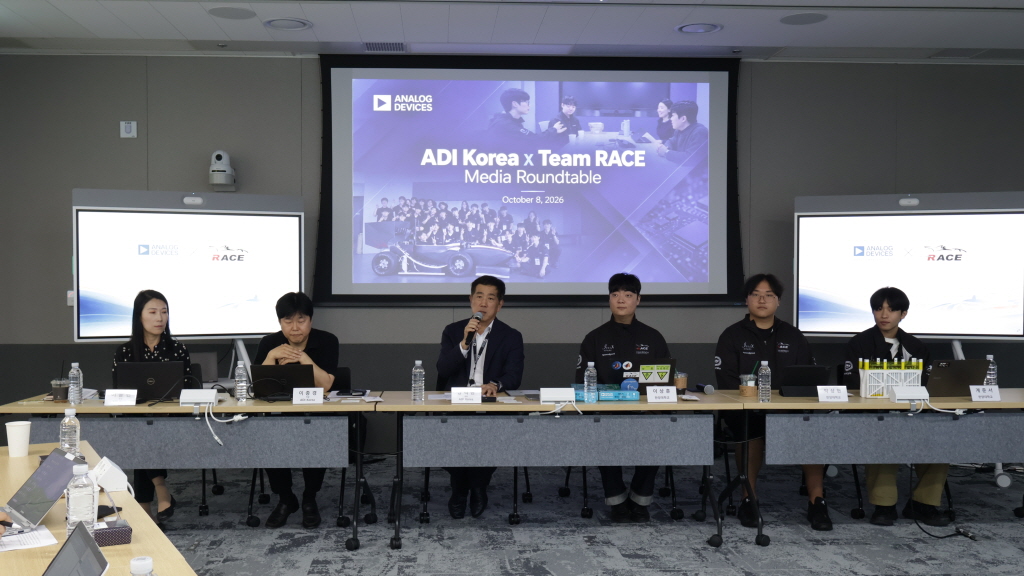
ADI, "Fostering Future Engineers Beyond Component Support"
Global semiconductor company Analog Devices (ADI) is drawing attention for moving beyond simply sponsoring university student car projects to serve as a partner in nurturing future engineers. Over the past three years, ADI has collaborated with Hanyang University's automotive research club Team RACE to support electric formula vehicle development, and recently has been providing technical consultation and semiconductor solutions to enable students to directly develop battery management systems (BMS), creating a model case of industry-academic cooperation.
2026.10.08by 배종인 기자











