


Will autonomous vehicles comply with the law and meet citizen safety and satisfaction?
 Published2023.10.20 16:23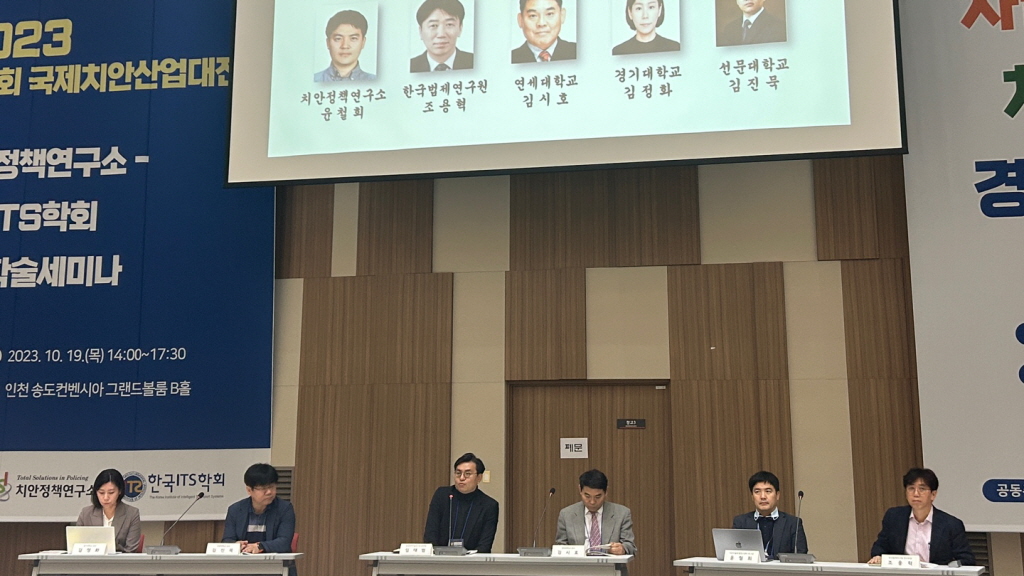
Autonomous vehicle accidents: Who should be safer: the driver or the pedestrian?
Conservative systems in autonomous vehicles in dilemma zones could cause traffic congestion.
The Korea Institute of Public Safety and Security and the Korea Institute of Information and Communication Systems (KIS) held a seminar titled “Public Safety Technology and Future Police Strategies in the Autonomous Driving Era” at the 5th Public Safety Industry Expo held at Songdo Convensia on the 19th, and discussed various topics related to autonomous vehicle law-abiding operation.
Chief Lim Tae-beom opened the discussion by saying that autonomous vehicles are being developed with the logic of naturally following the law, but that the social acceptance of fully autonomous vehicles and the satisfaction of passengers when driving in compliance with the law are issues that must be continuously considered.
Kim Jeong-hwa, an assistant professor in the Department of Urban and Transportation Engineering at Kyonggi University, said, “In the accident involving a self-driving car and a pedestrian that occurred in San Francisco, the self-driving car was operating in compliance with the law.”“We need to focus on the fact that accidents can happen even when driving legally, and the question is who should be safer – the driver or the pedestrian,” he said.
He continued by saying that as one way to ensure pedestrian safety, it is necessary to develop systems and standards that can inform pedestrians of the status and information of autonomous vehicles stopped on the road.
Professor Kim Si-ho of Yonsei University said, “When judging compliance with the law, there are parts that humans can arbitrarily interpret rather than based on mathematical or physical standards,” and added, “It is now time to think about laws and systems from a mechanical standpoint.”
Professor Kim Si-ho expressed concern that “the conservative system of autonomous vehicles in the dilemma zone could cause traffic congestion,” adding, “We also need to consider how much relaxation of this conservative system is necessary.”
Cho Yong-hyeok, a research fellow at the Korea Legislation Research Institute, emphasized, “From a legal scholar’s perspective, we must distinguish between legality, law-abiding, illegality, and unlawfulness,” and “If we are talking about law-abiding operation, the subject of law-abiding must also be defined.”
Meanwhile, as the theme of this seminar was 'Public Safety Technology and Future Police Strategy in the Autonomous Driving Era,' the importance of changes in laws and systems, along with the role of the police brought about by autonomous driving, was continuously mentioned.
Choi Jong-sang, director of the Institute for Public Safety Policy, said in his opening remarks, “There are many obstacles before AI systems, not humans, are put on the road.” He added, “The National Police Agency is also reinterpreting human-centered road traffic laws to suit the situation of AI driving and adapting to changes in the road conditions as new technologies are introduced in order to proactively respond to the commercialization of new technologies.” “We must prepare to face the environment,” he said.
Nam Du-hee, president of the Korea ITS Society, expressed his expectations, saying, “The introduction of autonomous vehicles will revolutionize future transportation systems and urban life, and also improve traffic safety and convenience.” He also said, “The introduction process will require various considerations, such as laws, regulations, and privacy protection, and the roles and duties of the police are expected to change significantly compared to the past.”
He continued, “In order to respond to the various changes brought about by autonomous vehicles, police organizations will strengthen their capabilities and adapt in various fields such as education, regulation, technology development, and cybersecurity.” He emphasized, “I hope that the police will continue to invest in technology, and the Korea ITS Society will also work with various experts and related industries to advance the field of public safety.”
Ryu Yeon-soo, head of the Science and Security Industry Team at the National Police Agency, read a congratulatory address from Park Seong-ju, director of the Future Security Policy Bureau, and said, “Autonomous driving technology is completely changing the paradigm of the existing traffic environment, and the National Police Agency also needs to make efforts to prepare for a safe future.” He added, “The police urgently need technological development and changes in laws and systems to allow autonomous vehicles equipped with artificial intelligence to drive on the road.”
Comments
Related news
C-ITS, the core of traffic management, overcomes the limitations of autonomous driving
As the importance of Intelligent Transportation Systems (ITS) in improving traffic efficiency and safety, and the necessity of C-ITS aimed at supporting road infrastructure to overcome the limitations of autonomous vehicles, becomes increasingly evident, an opportunity to learn about the history of ITS through the latest technology trends has been arranged.
2023.09.26by 성유창 기자
.jpg)
[2023 e4ds Automotive Conference] Professor Park Shin-hyung of Seoul City University: "ITS is the canvas, paint, and brush that will shape the future transportation system."
We invited Professor Park Shin-hyung, who is actively engaged in academia to advance the safety and convenience of 'mobility', as a speaker for the '2023 e4ds Automotive Conference', and held a discussion with him prior to the event.
2023.10.04by 성유창 기자
Gangneung City Expands ITS Scope to Participate in 2023 Suzhou ITS World Congress
Gangneung City is stepping directly onto the international stage to actively promote exchanges, strengthening its capabilities to lead the advanced mobility field and raising global recognition as the host city for the '2026 Gangneung ITS World Congress'.
2023.10.16by 성유창 기자
[C-ITS·ITS Market Trends] C-ITS·ITS, the Core of Autonomous Driving and Future Transportation, to Reach $35.8 Billion by 2026
C-ITS, referred to as next-generation intelligent transportation systems, is a core technology field that can maximize system-level efficiency in the autonomous driving sector, where research and development is currently being actively conducted.
2023.10.17by 성유창 기자

[e4ds Tech Day 2026 ⑨] Sim Sang-gyu, Autocrypt CTO: "In the Physical AI Era, Automotive Security Must Extend Beyond the Vehicle"
At e4ds Tech Day 2026, Sim Sang-gyu, CTO of Autocrypt, explained automotive cybersecurity strategies in the era of Physical AI and SDV (Software-Defined Vehicle). Automobiles are evolving as part of an ecosystem connected to AI, cloud, chargers, IoT, and robots, and he emphasized that the scope of security must expand beyond the vehicle interior to the entire connected environment. In particular, AI model tampering, adversarial attacks, OTA updates, and EV charger hacking were identified as major threats. He explained that response measures require zero trust, AI model integrity protection, intrusion detection, Security by Design and Default, and full lifecycle security management, and that proactive security system establishment beyond regulatory compliance is critical for securing future mobility competitiveness.
2026.10.12by 배종인 기자











