


[Interview] Kang Chung-gu, Executive Chairman of the Satellite Communications Forum ② – “6G Satellite Communications: A Two-Track Strategy for Technology and Service Development Is Essential”
 Published2023.10.20 17:18
New satellite and 3D spatial communication businesses are driving growth.
Development of terminal-to-satellite direct connection low-orbit satellites
Priority of securing mass production technology and component history for low-orbit satellites
 [Editor's Note] Recently, low-orbit satellites capable of providing ultra-high-speed internet access services have been garnering attention. In particular, with the 6G era approaching commercialization in 2030, a new standard involving the convergence of terrestrial networks and low-orbit satellite communication networks has emerged as a critical technical requirement. As SpaceX drastically reduces network construction costs through the development of reusable launch vehicles, bringing the realization of a low-orbit satellite-based space internet closer, it is urgent for Korea to foster a 6G satellite communication industry ecosystem before it is too late. The Satellite Communication Forum was established at the center of this effort to revitalize the industry through the formulation of national R&D policies. This publication met with Kang Chung-gu, Executive Chairman of the Satellite Communications Forum, to discuss the future outlook of the satellite communications industry and Korea's response strategies.
■ If an initial operator installs a gateway after frequency allocation, what factors should be considered regarding the future sharing of satellite frequencies with later entrants?
If the government decides, as a policy, to issue licenses only if even overseas operators establish a gateway within Korea, it may not be easy for them to enter the domestic market.
In the case of Inmarsat, which effectively provides maritime satellite communication services, it operates without a gateway in Korea. Considering this aspect, it may be common practice to proceed by obtaining approval for cross-border supply without installing a domestic gateway, as SpaceX is requesting.
However, a point that must be considered in our government's licensing process is to present requirements that ensure satellite frequency interference does not become an issue for all networks established for public purposes in the future.
For example, domestic satellite operator KT SAT uses a Ku-band geostationary satellite network, so it appears that protection is necessary. However, since there is no legal basis to impose sanctions when the gateway is located overseas, it is necessary to establish institutional frameworks in advance to protect existing domestic operators.
■ The field where the demand for satellite communication is expected to be discussed most actively is
Currently, low-orbit satellite communication has the advantage of being able to easily provide 100Mbps-class services immediately, even in remote mountainous areas where it is difficult to build high-speed internet.
It plays a very important role in countries like the United States and China, where high-speed internet service provision is still incomplete relative to the vast land area. Given that more than one-third of the world's population still cannot access the internet, it will be the fastest means to spread the internet to all regions of the globe.
In addition, even if it is outside the service area of the terrestrial network, smartphones will be able to connect directly through the 6G satellite communication network. At present, this can be utilized as a complementary service to respond to such special situations or disaster situations where the terrestrial network is lost.
Although the market size of the industrial ecosystem considering only the domestic market is bound to be very small, the role of satellite communication networks could be newly highlighted when considering the emergence of 3D spatial communication services in the upcoming 6G era.
In particular, satellite communication networks will be the only alternative capable of providing low-latency connectivity for the control of autonomous vehicles in various spaces and for mobility environments in three-dimensional spaces such as UAM. Through this, a new ecosystem spanning equipment, platforms, and terminals will emerge as a new axis of the ICT industry.
■ Whether domestic smartphone personal satellite communication services, such as satellite text messaging, can be commercialized
Currently, Apple provides smartphone connectivity services using Globalstar, a first-generation low-orbit satellite network. By utilizing already developed satellite communication chipsets, it was easy to develop smartphones capable of providing text messaging services. Similarly, Samsung Electronics utilizes existing low-orbit satellite networks such as Iridium and can connect to satellites from smartphones using already developed chipsets.
However, because these technologies utilize first-generation low-orbit satellite networks built a long time ago, they are only capable of very limited services such as text or voice calls due to issues such as low speed and low-quality antenna performance.
Recently, new low-orbit satellites are being designed to support connectivity services comparable to those of terrestrial smartphones. This concept expands the coverage of terrestrial mobile communication networks by allowing smartphones to directly connect to ground-based mobile base stations via low-orbit satellites. To achieve this, various technologies must be installed on low-orbit satellites to enable mobile terminals with limitations, such as antenna size, to connect directly to the satellite.
In the upcoming 6G era, it is expected that standard communication satellites and terminals optimized for 3D stereoscopic communication services will be developed through the true convergence of terrestrial and satellite networks.
■ If ICT technologies such as AI are applied to satellites
There will be aspects where AI technology is utilized in the construction of satellite networks, and aspects where satellite networks are utilized to apply AI technology.
Achieving optimization in the construction and operation of low-orbit satellite networks is extremely difficult because it involves deploying and managing a large number of satellites. Research results are being published indicating that these problems can be efficiently solved by applying AI technology.
Meanwhile, implementing AI requires a massive amount of computation, making technologies such as edge computing and cloud computing essential. It is predicted that attempts will be made to develop technologies such as building a backbone network for cloud deployment at a low cost by applying satellite networks, or establishing data centers in space by directly equipping satellites with computing capabilities.
■ Please briefly introduce the key topics covered in SCSS 2023.
SCSS is an international academic symposium (Symposium on Satellite Communications Systems & Services) organized by the Satellite Communications Forum to share the latest research results in the field of 6G satellite communications and to serve as a venue for exchange with experts from various countries. We held our first event in 2022 and successfully concluded our second event in mid-October of this year.
This year, the number of papers increased dramatically compared to last year, with over 50 papers published. This surge in the number of published papers can be attributed to the active progress of related research at domestic universities. Meanwhile, the participation of low-orbit satellite communications experts from Spain and Luxembourg has created an opportunity for close future cooperation with overseas companies and research institutions.
This academic conference is expected to serve as a starting point for Korea to play a pivotal role in bringing together experts from around the world to share research results and cooperate with one another as the standardization and commercialization of 6G satellite communication proceed in earnest.
■ Please share your thoughts on the future outlook of the satellite communications industry, and the goals of the Satellite Communications Forum are
The 6G network will provide three-dimensional communication services in which terrestrial and non-terrestrial networks converge into one. In other words, it will become a new communication service infrastructure that enables ultra-high-speed internet everywhere, whether on land, at sea, or in the air.
The satellite communications market is expected to grow continuously across the mass production of satellites and payloads for low-orbit satellite communication, smartphones capable of direct satellite access, and new application services.
To be incorporated into the supply chain of overseas operators that have already secured a dominant market position with massive technological and capital power, securing technological capabilities and component history must be a prerequisite.
From a national strategic perspective, the establishment of an independent satellite network must be considered, and it is expected that this will enable entry into overseas service markets and drive national growth through a Korea-led industrial ecosystem.
The Satellite Communications Forum will serve as a central hub for public-private cooperation necessary for formulating upcoming industrial strategies and national R&D policies, discuss plans for establishing an independent satellite network, and fulfill the role of a think tank to secure the national capabilities required to expand beyond the domestic market and enter the global service market.
Viewed as an extension of our formidable competitiveness—including the world's first commercialization of 5G and the number one global smartphone market share—6G satellite communication is undoubtedly a national industrial foundation that cannot be overlooked. Recognizing its importance early on, our government and industry have been discussing countermeasures and prioritizing the securing of technology through research and development and the establishment of an ecosystem. Accordingly, attempts to conduct a preliminary feasibility study for government R&D investment have been made for several years, but the study has yet to be approved.
It should be noted that the domestically produced fully electronic switching system developed under government leadership laid the foundation for the world's first commercialization of CDMA, and that the construction of the high-speed information and communication network was also made possible by the government's strong policy support. Now is the time to prepare for the era of 6G satellite communication through strong government support, and the Satellite Communication Forum will serve as a focal point for public-private cooperation to secure such policy support.
Comments
Related news
[Electronics: Survive the Super Cold Wave] 6G is the Key to Extreme Environment Communications
Satellite communication is increasingly becoming a focal point in the communications market, and opinions are emerging that Korea needs to respond quickly to this trend. Satellite communication is a system that provides mobile communication services using artificial satellites, and since satellites are launched into space, it can be utilized for special purposes such as areas where conventional wireless communication cannot be used or on ships at sea. It is anticipated that satellite communication will become an important key to future 6G technology.
2023.01.26by 김예지 기자
6G satellite communications, terrestrial-satellite network integration emphasized
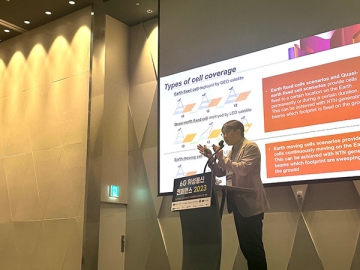
On the 12th, a 6G satellite communication conference was jointly held at Dragon City in Yongsan by the Satellite Communication Forum, ETRI, Korean Institute of Communications and Information Sciences, Korean Institute of Electromagnetic Engineering and Science, and Korea Satellite Information and Communication Society. At the presentations that day, experts from industry, academia, and research institutions discussed 6G satellite communication policies and trends, as well as 6G satellite communication standardization activities. The ITU is a standardization body that establishes technical standards in the telecommunications field. In fact, it evaluates detailed technical standard proposals submitted by 3GPP, a standardization body, and adopts the final international standards. The key objective of the satellite IMT-2020 vision is to provide seamless services using terrestrial and satellite communication links. The 3GPP NTN standardization work for 5G satellite communications is evolving into 6G NTN.
2023.07.13by 김예지 기자
.jpg)
Hanwha Systems and Korea Aerospace University Join Hands to Cultivate Talent in Space and Satellite Fields
Hanwha Systems has signed an MOU with Korea Aerospace University for 'cultivating field-oriented talent in the space and satellite sectors in the New Space era.'
2023.09.21by 배종인 기자
“Concerns over satellite communications dependency… Establishment of independent low-orbit network is essential”
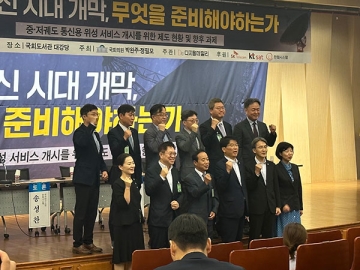
On the 25th, a forum was held at the National Assembly Grand Hall hosted by Representative Park Wan-joo and Representative Jeong Pil-mo under the theme of "Opening the Satellite Communications Era: What Should We Prepare?" The event provided a venue to share the current status of institutional frameworks for initiating medium and low-orbit communication satellite services and to discuss future challenges. As satellite communications is receiving attention as a key infrastructure for next-generation networks, expert opinions converged on the urgent need for an independent low-orbit satellite infrastructure construction strategy at the national level in order for Korea to lead the satellite communications industry.
2023.09.27by 김예지 기자

[Interview] Kang Chung-gu, Executive Director of Satellite Communication Forum ① - “6G Satellite Communication, Technology and Service Development Two-Track Strategy Required”
Low-earth orbit satellites capable of providing ultra-high-speed internet access services have recently garnered significant attention. Particularly in the lead-up to the commercialization of 6G in 2030, a new standard that converges terrestrial networks and low-earth orbit satellite communication networks has emerged as an important technical requirement. As SpaceX lowers network construction costs dramatically through the development of reusable launch vehicles and the realization of space-based internet using low-earth orbit satellites draws closer, South Korea faces an urgent need to foster a 6G satellite communication industry ecosystem before it is too late. The Satellite Communications Forum was established at the center of these efforts to promote industry activation through the formulation of national R&D policies. This publication met with Kang Chung-goo, Executive Chairman of the Satellite Communications Forum, to discuss the future outlook of the satellite communications industry and South Korea's response strategies going forward.
2023.10.19by 김예지 기자











