This page was machine-translated and may differ from the original. View original
Morai and the Korea Automobile Testing & Research Institute (KATRI) partner with M-City in the US to conduct autonomous driving research.

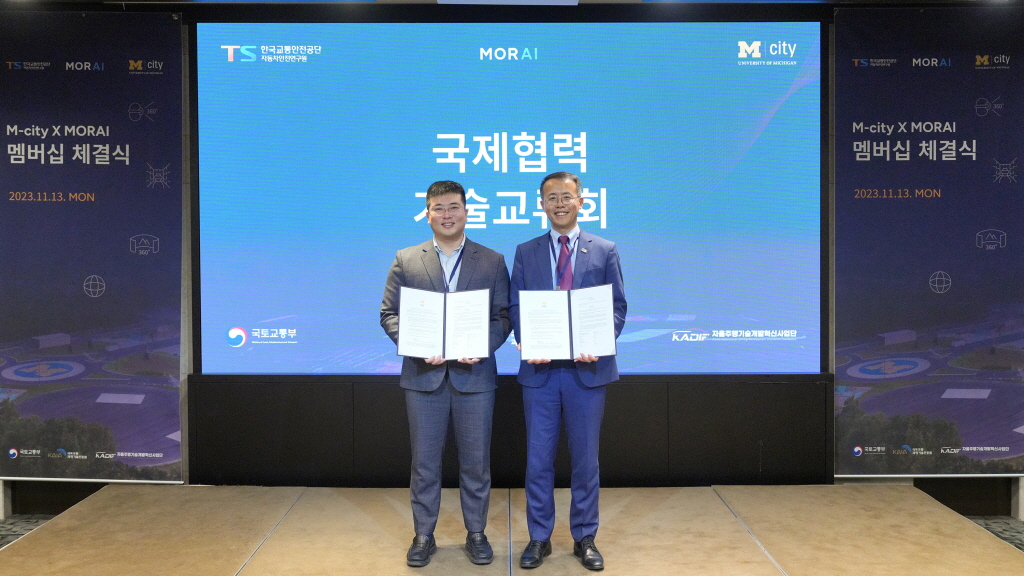
▲(From left) Jeong Ji-won, CEO of Morai, and Henry Liu, Director of M-City Research Institute (Photo provided by Morai)
Signing a membership agreement to secure core technologies and establish core strategies
Sharing the latest technology trends for commercializing autonomous driving by 2027.
Morai is strengthening its autonomous driving technology research activities in cooperation with the Korea Transportation Safety Authority's Automobile Safety Research Institute and the University of Michigan's M-City.
On the 13th, Morai signed an MOU for mutual cooperation with M-City at Yangjae El Tower and held a membership signing ceremony to secure core technologies and establish core strategies.
The two organizations will establish a virtual autonomous driving testing environment, share data, and engage in international joint research to promote international research exchanges.
Additionally, Morai participates in a three-party technology research project between the Korea Automobile Testing & Research Institute, Morai, and M-City.
The three organizations will strengthen cooperation for autonomous driving virtual verification and joint research in related technologies, including improving the environment for autonomous driving test cities and sharing a physical and virtual environment evaluation platform through the combination of real roads and virtual environments.
As part of the collaboration, Morai and the Korea Automobile Testing & Research Institute, which are participating in the autonomous driving inter-ministerial R&D project, held an international cooperation technology exchange meeting with M-City in the United States to promote autonomous driving technology exchange and strengthen the domestic autonomous driving evaluation and verification base.
The inter-ministerial project began in 2021. This is a multi-ministerial research and development project worth 1.1 trillion won (Ministry of Land, Infrastructure and Transport, Ministry of Trade, Industry and Energy, Ministry of Science and ICT, and National Police Agency), and is being promoted with the goal of commercializing convergence-type Level 4/4+ autonomous driving by 2027, encompassing not only basic technologies such as vehicles and parts, but also infrastructure, laws and systems, and services.
Currently, Morai is participating as a joint research institute in a research project under the Ministry of Land, Infrastructure and Transport's jurisdiction, led by the Korea Transportation Safety Authority's Automobile Safety Research Institute, to develop a multipurpose, variable, expandable virtual testing environment platform capable of autonomous vehicle AI learning, autonomous vehicle performance verification, and autonomous vehicle evaluation/certification in a Level 4 autonomous driving environment.
In addition, Morai is collaborating with the Korea Transportation Safety Authority's Automobile Safety Research Institute for the national R&D project 'Establishment of a Metaverse-based Autonomous Driving Virtual Test Environment and Development of Demonstration Technology' promoted by the Ministry of Land, Infrastructure and Transport, the Korea Agency for Infrastructure Technology Advancement, and the Autonomous Driving Technology Development Innovation Center.
Through this project, we are developing a metaverse-based virtual testing environment that applies △open simulation and AI-based scenario advancement, △metaverse-based operating environment and reporting technology, △parallel testing technology utilizing hybrid cloud, and △autonomous driving development support and certification evaluation technology.
Against this backdrop, this international cooperation technology exchange meeting, in conjunction with the Ministry of Land, Infrastructure and Transport's support project, discussed the latest international trends and specific application plans for scenario generation technology based on real data that can be utilized in the development, evaluation, and certification of autonomous vehicle technology.
On the 13th, Morai signed an MOU for mutual cooperation with M-City at Yangjae El Tower and held a membership signing ceremony to secure core technologies and establish core strategies.
The two organizations will establish a virtual autonomous driving testing environment, share data, and engage in international joint research to promote international research exchanges.
Additionally, Morai participates in a three-party technology research project between the Korea Automobile Testing & Research Institute, Morai, and M-City.
The three organizations will strengthen cooperation for autonomous driving virtual verification and joint research in related technologies, including improving the environment for autonomous driving test cities and sharing a physical and virtual environment evaluation platform through the combination of real roads and virtual environments.
As part of the collaboration, Morai and the Korea Automobile Testing & Research Institute, which are participating in the autonomous driving inter-ministerial R&D project, held an international cooperation technology exchange meeting with M-City in the United States to promote autonomous driving technology exchange and strengthen the domestic autonomous driving evaluation and verification base.
The inter-ministerial project began in 2021. This is a multi-ministerial research and development project worth 1.1 trillion won (Ministry of Land, Infrastructure and Transport, Ministry of Trade, Industry and Energy, Ministry of Science and ICT, and National Police Agency), and is being promoted with the goal of commercializing convergence-type Level 4/4+ autonomous driving by 2027, encompassing not only basic technologies such as vehicles and parts, but also infrastructure, laws and systems, and services.
Currently, Morai is participating as a joint research institute in a research project under the Ministry of Land, Infrastructure and Transport's jurisdiction, led by the Korea Transportation Safety Authority's Automobile Safety Research Institute, to develop a multipurpose, variable, expandable virtual testing environment platform capable of autonomous vehicle AI learning, autonomous vehicle performance verification, and autonomous vehicle evaluation/certification in a Level 4 autonomous driving environment.
In addition, Morai is collaborating with the Korea Transportation Safety Authority's Automobile Safety Research Institute for the national R&D project 'Establishment of a Metaverse-based Autonomous Driving Virtual Test Environment and Development of Demonstration Technology' promoted by the Ministry of Land, Infrastructure and Transport, the Korea Agency for Infrastructure Technology Advancement, and the Autonomous Driving Technology Development Innovation Center.
Through this project, we are developing a metaverse-based virtual testing environment that applies △open simulation and AI-based scenario advancement, △metaverse-based operating environment and reporting technology, △parallel testing technology utilizing hybrid cloud, and △autonomous driving development support and certification evaluation technology.
Against this backdrop, this international cooperation technology exchange meeting, in conjunction with the Ministry of Land, Infrastructure and Transport's support project, discussed the latest international trends and specific application plans for scenario generation technology based on real data that can be utilized in the development, evaluation, and certification of autonomous vehicle technology.
.jpg)
▲Moray-hosted international cooperation technology exchange meeting (photo) Provided by: Morai)
On this day, CEO Jeong Ji-won of Morai presented the 'ND (Naturalistic Driving) Data Framework for the Development of Generative Scenario DB'.
ND data is data that enables machine learning and situation reproduction based on actual road driving information.
He explained how real-world driving data can be applied to autonomous driving simulations to generate various driving scenarios, which can then be integrated into Morai's simulation platform to enhance the vehicle's cognitive performance and control capabilities, emphasizing that this can contribute to improving the safety and reliability of autonomous vehicles.
Henry Liu, Director of M-City Research Institute, gave a presentation titled ‘Learning naturalistic driving environment with statistical realism.’
M-City recently established a cloud-based virtual testing environment linked to surrounding real roads and is providing functions (MCity 2.0) that can be efficiently utilized for autonomous driving technology development through a data center.
He explained that M-City's new digital infrastructure combines real-world traffic data sets and high-quality AI training and simulation capabilities with a physical test track, allowing users to access it remotely, allowing autonomous driving research teams and startups to move faster and develop new technologies.
Next, we will explain how realistic driving data can contribute to improving the sensors and perception systems of autonomous vehicles, and in particular how statistically realistic data can be used to understand complex road conditions and driver behavior. He emphasized that learning behavior can serve as an important foundation for developing safer and more efficient autonomous driving technology.
Lee Jin-han, leader of Naver Labs' autonomous driving team, presented on "Scenario Generation Technology Based on Real Data." He introduced the autonomous driving project currently underway at Naver Labs and shared research trends and methods for scenario generation based on real-world driving data.
Seongbok Eom, the president of the Korea Automobile Testing & Research Institute, said, “I think it is meaningful that we held an international cooperation technology seminar for practical mutual technological exchange as an extension of the business agreement signed with the University of Michigan M-City last May,” and “We will continue to promote the exchange of autonomous driving technologies between the two countries and continuously strengthen the functions and usability of K-City so that it can be fostered as a global autonomous driving technology development and safety verification platform.”
“Morai is committed to developing technologies that enhance the safety and reliability of autonomous vehicles through a virtual testing environment platform capable of AI learning, performance verification, evaluation, and certification of autonomous vehicles,” said Jeong Ji-won, CEO of Morai. “We will further dedicate ourselves to advancing autonomous driving simulation technology so that we can contribute to achieving the government’s goal of commercializing autonomous vehicles by 2027.”
ND data is data that enables machine learning and situation reproduction based on actual road driving information.
He explained how real-world driving data can be applied to autonomous driving simulations to generate various driving scenarios, which can then be integrated into Morai's simulation platform to enhance the vehicle's cognitive performance and control capabilities, emphasizing that this can contribute to improving the safety and reliability of autonomous vehicles.
Henry Liu, Director of M-City Research Institute, gave a presentation titled ‘Learning naturalistic driving environment with statistical realism.’
M-City recently established a cloud-based virtual testing environment linked to surrounding real roads and is providing functions (MCity 2.0) that can be efficiently utilized for autonomous driving technology development through a data center.
He explained that M-City's new digital infrastructure combines real-world traffic data sets and high-quality AI training and simulation capabilities with a physical test track, allowing users to access it remotely, allowing autonomous driving research teams and startups to move faster and develop new technologies.
Next, we will explain how realistic driving data can contribute to improving the sensors and perception systems of autonomous vehicles, and in particular how statistically realistic data can be used to understand complex road conditions and driver behavior. He emphasized that learning behavior can serve as an important foundation for developing safer and more efficient autonomous driving technology.
Lee Jin-han, leader of Naver Labs' autonomous driving team, presented on "Scenario Generation Technology Based on Real Data." He introduced the autonomous driving project currently underway at Naver Labs and shared research trends and methods for scenario generation based on real-world driving data.
Seongbok Eom, the president of the Korea Automobile Testing & Research Institute, said, “I think it is meaningful that we held an international cooperation technology seminar for practical mutual technological exchange as an extension of the business agreement signed with the University of Michigan M-City last May,” and “We will continue to promote the exchange of autonomous driving technologies between the two countries and continuously strengthen the functions and usability of K-City so that it can be fostered as a global autonomous driving technology development and safety verification platform.”
“Morai is committed to developing technologies that enhance the safety and reliability of autonomous vehicles through a virtual testing environment platform capable of AI learning, performance verification, evaluation, and certification of autonomous vehicles,” said Jeong Ji-won, CEO of Morai. “We will further dedicate ourselves to advancing autonomous driving simulation technology so that we can contribute to achieving the government’s goal of commercializing autonomous vehicles by 2027.”
본 기사에 대한 정정·반론·추후보도 청구는 보도 청구 안내를, 그간 게재된 보도문은 정정·반론보도 모아보기를 참고해 주세요.

.png)