



ETRI, Agency for Defense Development and Preemptive Cooperation in 6G Satellite Communications
 Published2023.11.17 14:26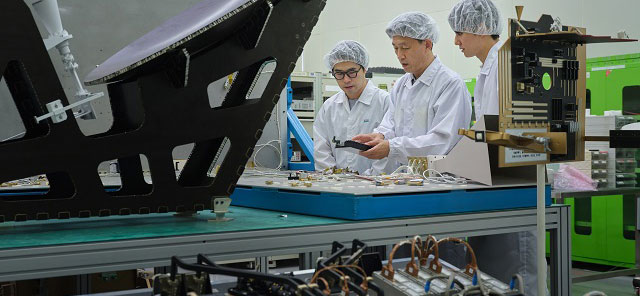
Collaboration on 6G low-orbit satellite communication technology begins
Activation of domestic satellite communication industry through cooperation with the Republic of Korea
Domestic researchers are joining forces to secure and globalize 6G satellite communication technology.
The Electronics and Telecommunications Research Institute (ETRI) announced on the 17th that it has decided to pursue business cooperation with the Agency for Defense Development (ADD) to strengthen cooperation in the field of satellite communication technology, which is receiving increasing attention worldwide.
The two organizations plan to cooperate in areas such as ▲strengthening research and development capabilities through the convergence of IT and defense technologies, ▲exchanging research and development information, ▲joint use of research facilities and equipment, and ▲space technology.
Through this collaboration, we plan to solidify cooperation in the currently jointly promoted micro-satellite system development project and the Korea Satellite Navigation System (KPS) development project, and to fully promote cooperation related to low-orbit satellite communications.
The research team said, “This collaboration is being promoted as a follow-up to the business agreement between the two government ministries last year, with the aim of strengthening cooperation between research institutes. It is very meaningful that the two institutions representing our country’s civilian and military have joined forces.”
The International Telecommunication Union Radiocommunication Sector (ITU-R), which defines telecommunications standards, completed the IMT-2030 framework in June as a 6G service vision targeting services in the 2030s. Low-orbit satellite communications are rapidly emerging as a key 6G communication service that overcomes time and space constraints. It is expected to provide various future services such as future defense communications, disaster relief, urban air mobility (UAM), large-scale internet in airplanes, and ships at sea.
Meanwhile, in December last year, the Ministry of Science and ICT and the Defense Acquisition Program Administration signed a business agreement for the development of satellite communication technology between the civilian and military.
ADD Director Jong-Seung Park said, “Low-orbit satellite communications are an opportunity for a new leap forward in national defense and national space development. ADD is preemptively securing defense space technologies such as ultra-small satellites and a Korean low-orbit tactical satellite constellation. Through this civilian-military cooperation with ETRI, we will discover a model for mutual cooperation projects and contribute to national defense and security by securing national space technology competitiveness.”
ETRI President Seung-chan Bang also said, “6G communication will gradually grow into a service that integrates ground and satellite and develop into various services. In times of emergency, the utility of low-orbit satellites will increase even more. We will take the lead in developing 6G satellite communication technology by establishing a technology cooperation system with ADD, which is leading future defense, and take the lead in revitalizing our country’s satellite communication industry.”
In the future, ETRI and ADD will establish an effective R&D cooperation system, including technology exchanges and joint research and development, to lay the foundation for the development of both organizations, secure core technologies based on 6G low-orbit satellite communications, and expand support for fostering Korea's satellite communications industry.
Comments
Related news
LG Uplus and LG Electronics Host '6G Tech Festa'
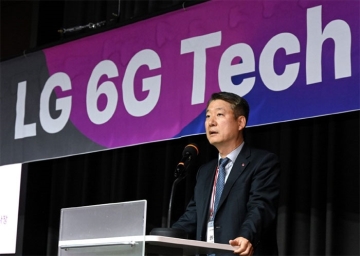
LG Uplus and LG Electronics exchanged knowledge with 6G experts on core 6G technologies and accelerated their efforts to secure technological leadership. The two companies held a '6G Tech Festa' on the 17th at LG Science Park, inviting industry, academic, and research experts as well as R&D partner companies, they announced. They exchanged core 6G technologies, which are foundational technologies for future businesses such as autonomous driving, mobility, and smart factories, and discussed the direction forward.
2023.10.18by 김예지 기자

[Interview] Kang Chung-gu, Executive Director of Satellite Communication Forum ① - “6G Satellite Communication, Technology and Service Development Two-Track Strategy Required”
Low-earth orbit satellites capable of providing ultra-high-speed internet access services have recently garnered significant attention. Particularly in the lead-up to the commercialization of 6G in 2030, a new standard that converges terrestrial networks and low-earth orbit satellite communication networks has emerged as an important technical requirement. As SpaceX lowers network construction costs dramatically through the development of reusable launch vehicles and the realization of space-based internet using low-earth orbit satellites draws closer, South Korea faces an urgent need to foster a 6G satellite communication industry ecosystem before it is too late. The Satellite Communications Forum was established at the center of these efforts to promote industry activation through the formulation of national R&D policies. This publication met with Kang Chung-goo, Executive Chairman of the Satellite Communications Forum, to discuss the future outlook of the satellite communications industry and South Korea's response strategies going forward.
2023.10.19by 김예지 기자

[Interview] Kang Chung-gu, Executive Chairman of the Satellite Communications Forum ② – “6G Satellite Communications: A Two-Track Strategy for Technology and Service Development Is Essential”
Low Earth orbit satellites capable of providing ultra-high-speed internet access services have recently garnered significant attention. Particularly in the 6G era ahead of commercialization in 2030, the convergence of terrestrial networks and low Earth orbit satellite communication networks has emerged as an important technical requirement. As SpaceX dramatically reduces network construction costs through the development of reusable launch vehicles and the realization of low Earth orbit satellite-based space internet draws closer, South Korea faces an urgent need to foster a 6G satellite communication industry ecosystem before it is too late. The Satellite Communication Forum was established at the center of these efforts to promote industry activation through the establishment of national R&D policies. This publication met with Kang Chung-gu, Executive Committee Chairman of the Satellite Communication Forum, to discuss future prospects of the satellite communication industry and measures for South Korea's response going forward.
2023.10.20by 김예지 기자
SK Hynix Completes Performance Verification of Mobile DRAM 'LPDDR5T' with Qualcomm
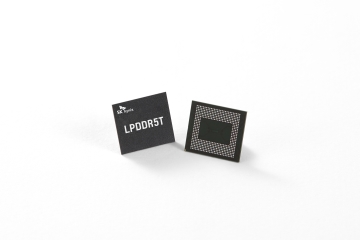
SK Hynix has begun commercializing 'LPDDR5T (Low Power Double Data Rate 5 Turbo)', which implements 9.6Gbps (9.6 gigabits per second), the highest speed currently available for mobile DRAM.
2023.10.27by 명세환 기자
ETRI, “Technology Pioneer Creating a Happy Future Through Digital Innovation”
The Electronics and Telecommunications Research Institute (ETRI) held the 'ETRI Conference 2023', where it unveiled its vision as a technology pioneer creating digital innovation and a prosperous future through proactive and outstanding technologies, including introducing six top challenge projects such as △AI computing △AI robot intelligence △6G △metaverse △advanced mobility △advanced biotechnology to the public.
2023.11.08by 배종인 기자











