



ETRI Performs Robotic Tasks Without Programming
 Published2023.12.28 16:52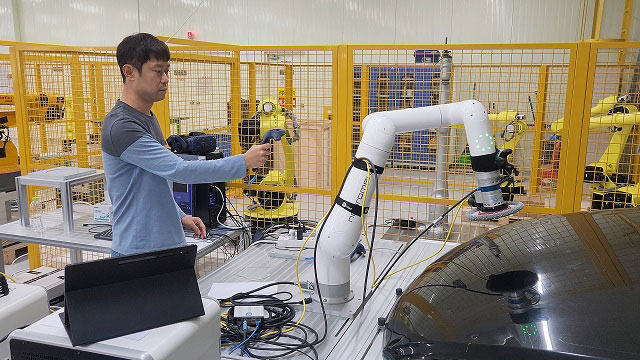
Intelligent task execution… Industrial robots can be connected.
Interactive Wizard App-Based UX Development
A domestic research team has enabled robots to perform difficult tasks without the need for expert programming.
The Electronics and Telecommunications Research Institute (ETRI) announced on the 27th that it has developed a technology that enables high-difficulty tasks requiring control of speed, acceleration, and contact force without expert programming training using a robot arm.
It uses a portable teaching device that works with the Wizard app, a robot teaching app. The intuitive user interface of the Wizard app allows the device to demonstrate robot movements.
The researchers said, “Robot tasks that previously required weeks or months of development can now be developed in just a few minutes, even by first-time users.”
He also explained, “It provides the flexibility to re-teach at any time even if the robot’s teaching results are not satisfactory to the user or an error occurs during the process, and it is versatile because it can be applied to industrial robots that only have position control without direct force control by connecting a force/torque sensor to the end tool position.”
ETRI demonstrated the robot's sanding process at a test bed built at Neuromeka Pohang Branch in Heunghae-eup, Pohang-si, Gyeongsangbuk-do. When the user uses a teaching device to specify only four points in space where the robot wants to work, the robot automatically finds the surface to be polished and proceeds with the work.
As a result of repeated test evaluations, the robot was able to successfully perform sanding tasks while maintaining performance at more than 90% of the target value when applying a weak or strong force in the vertical direction of the surface in the range of 10 to 30 N compared to wiping.
According to the research team, the developed robot teaching technology has been successfully applied to tasks other than sanding, such as opening/closing doors and fastening/separating parts.
This was revealed to be the result of the integration of △human-robot interface technology, △composite control technology that allows the robot to move its position while maintaining contact force, and △technology that automatically recognizes the vertical direction of the contact surface in real time based on the sensor's measurement values and controls the posture.
The research team expressed their expectations, saying, “It is expected that this will significantly reduce development time as it can be applied to process facilities such as smart factories in the future.”
ETRI plans to continue expanding the usability and application areas of Wizard based on the results of user research conducted on general users at the Usability Evaluation Research Center of Keimyung University and Georgia Tech in the United States.
He added that in addition to research on intelligent robot tasks, they are also conducting various research in the field of robotics, including autonomous driving and human following of mobile robots, environmental perception of robots, and reinforcement learning.
ETRI Robot IT Convergence Lab Principal Researcher Kang Dong-yeop said, “Currently, research is underway on task teaching for mobile manipulator robots, and in the future, we plan to develop teaching and control technologies for various types of robots, such as dual-arm robots and quadruped robots.”
Comments
Related news
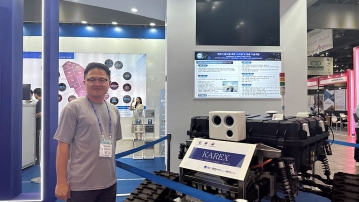
From neighborhood chicken joints to the Antarctic... The robot age is taking a big step forward.
Robots, which are attracting attention as a future strategic industry, are expected to form forward and backward industrial ecosystems across all manufacturing and service sectors and to drive innovation. Robots are divided into industrial robots and service robots. Robots, which have developed mainly in the manufacturing industry, have recently expanded into intelligent service sectors that can provide diverse benefits in daily life such as delivery, care, serving, and patrolling by converging with ICT technologies including sensors, AI, and autonomous driving.
2023.10.20by 김예지 기자
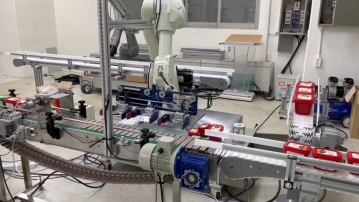
KETI, “AI robots make kimchi packaging convenient”
The Korea Electronics Technology Institute (KETI, Director Shin Hee-dong) has developed robot work intelligence recognition system technology for automating manufacturing processes in traditional food sectors (kimchi, traditional fermented sauces) that have been primarily manual.
2023.11.14by 배종인 기자
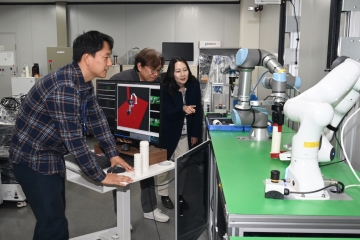
ETRI develops AI technology for autonomous robot assembly.
The Electronics and Telecommunications Research Institute (ETRI) has successfully developed technology that enables articulated robots (robot arms) to independently perform cognitive, judgment, planning, and motion operations required for product assembly by leveraging cutting-edge artificial intelligence (AI) and digital twin technologies in the product assembly field.
2023.11.24by 배종인 기자
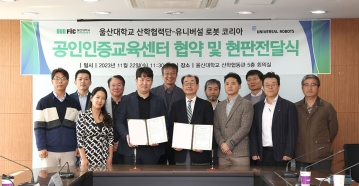
Universal Robots, Ulsan University Collaborative Robot Certification Center Designated
Global collaborative robot specialist "Universal Robots" announced on the 27th that it designated Ulsan University as the company's eleventh authorized training center in South Korea, and held a plaque ceremony.
2023.11.27by 김예지 기자
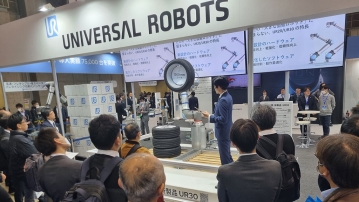
Universal Robots Launches 'UR30', Collaborative Robot with Record-Breaking 30kg Payload
Universal Robots announced on the 29th that it has launched its new collaborative robot product 'UR30'. It is the heaviest payload collaborative robot on the market, with a maximum payload capacity (the maximum weight a collaborative robot can lift) of 30 kg.
2023.11.29by 김예지 기자











