This page was machine-translated and may differ from the original. View original
LG Display Proposes SDV-Optimized Automotive Display Solution
LG Innotek Unveils Automotive Electronics Components and Software Solutions in Acceleration of SDV Trends
Hyundai Mobis brings together cutting-edge technologies, including high-power ICCUs and transparent displays.
Following last year, CES 2024 (January 9-12) is expected to see a surge in automotive-related products and technologies. With software-defined vehicles (SDVs) being cited as a key keyword, attention is focused on corresponding electrical components.
SDV (Software Defined Vehicle) is a vehicle that provides value to customers through services. It is characterized by being able to update through the cloud even after the vehicle is released via OTA, maintaining the latest performance and downloading new features.
LG Display, LG Innotek, and Hyundai Mobis, Korea's leading automotive electronics companies, will explore in advance how they will respond to the SDV trend with their exhibits.
■ LG Display
LG Display will unveil a slew of next-generation automotive display solutions at CES 2024.
LG Display has set up a dedicated booth for automotive displays at the West Hall of the Las Vegas Convention Center (LVCC) targeting global automakers and automotive components customers, and is showcasing the 'Optimal Solutions for Future Mobility &The exhibition is held under the theme of rsquo;.
SDV (Software Defined Vehicle) is a vehicle that provides value to customers through services. It is characterized by being able to update through the cloud even after the vehicle is released via OTA, maintaining the latest performance and downloading new features.
LG Display, LG Innotek, and Hyundai Mobis, Korea's leading automotive electronics companies, will explore in advance how they will respond to the SDV trend with their exhibits.
■ LG Display
LG Display will unveil a slew of next-generation automotive display solutions at CES 2024.
LG Display has set up a dedicated booth for automotive displays at the West Hall of the Las Vegas Convention Center (LVCC) targeting global automakers and automotive components customers, and is showcasing the 'Optimal Solutions for Future Mobility &The exhibition is held under the theme of rsquo;.

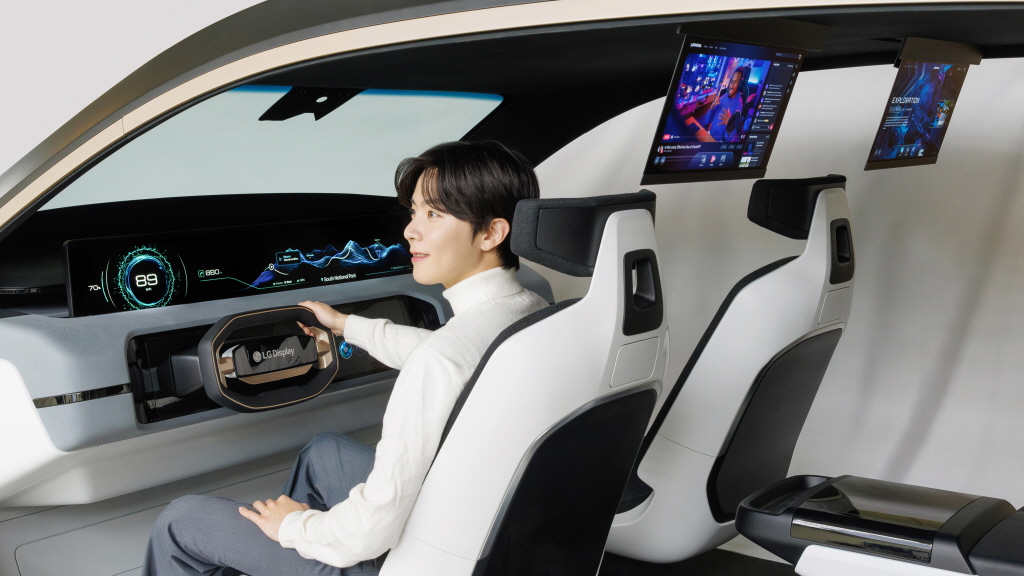
▲Photos related to LG Display's CES 2024 (Photo source: LG Display)
We plan to offer customers a vehicle display solution optimized for SDV, which has recently emerged as a hot topic in the mobility industry.
SDV, also known as a 'smartphone on wheels', is characterized by 'screenification', which increases the number of displays and enhances various vehicle control and infotainment functions.
Accordingly, LG Display plans to propose various ultra-large vehicle display solutions that will fill the dashboard based on differentiated technologies such as P(plastic)-OLED, ATO(Advanced Thin OLED), and LTPS(low-temperature polycrystalline silicon) LCD.
P-OLED is a premium lineup of ultra-high definition, lightweight, and bendable displays using a flexible plastic substrate, while ATO is a new product that offers differentiated value for automotive OLEDs at a reasonable price using a glass substrate. LTPS LCD is advantageous in implementing large-size and high-resolution displays compared to conventional LCDs.
We also introduce 'Switchable Privacy Mode' (SPM), a viewing angle control technology that helps drivers keep their eyes on the road by controlling the display viewing angle.
Recently, as the screen size of premium cars has expanded from the instrument panel in front of the driver's seat to the front passenger seat, the importance of the SPM function is increasing.
When SPM is activated, you can watch a movie on the passenger seat screen, but it will not be visible from the driver's seat, helping you drive more safely.
Additionally, solutions that maximize the efficiency of limited space in a vehicle, such as applying sliderable and foldable OLEDs to the rear seats of a vehicle and allowing passengers to unfold the screen according to their needs, will also be introduced.
LG Display's Auto Business Group Head (Executive Director) Kim Byeong-gu said, "We will further strengthen our position as the world's leading company by providing the optimal vehicle display solution for future mobility."
■ LG Innotek
LG Innotek also announced that it will showcase innovative mobility-related products and technologies at CES 2024.
Through this, the company aims to further strengthen its global recognition as a leading company driving future technological innovation in the mobility sector and accelerate the discovery of potential customers.

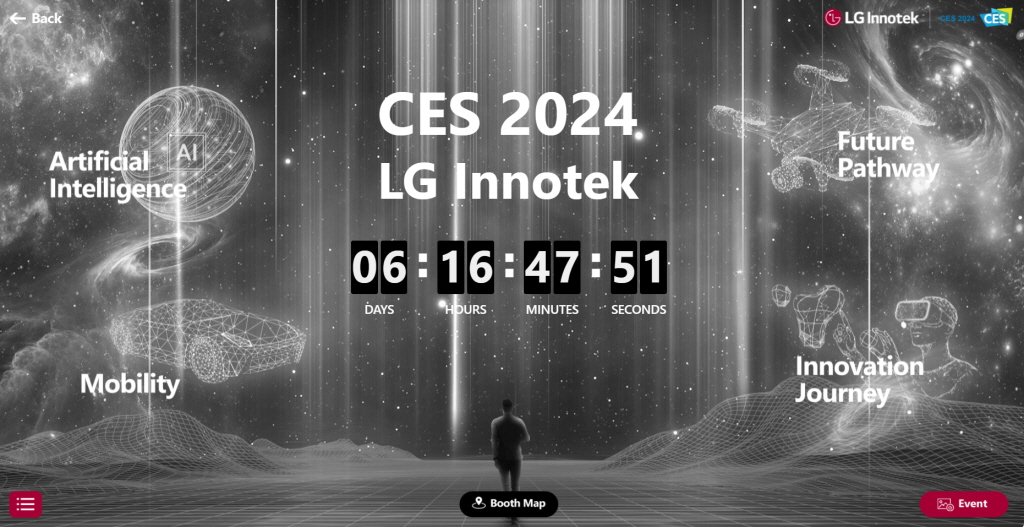
▲LG Innotek CES 2024 Online Exhibition Hall (Photo Source: CES homepage)
In keeping with the SDV trend, LG Innotek plans to unveil solutions at CES 2024 that include not only the development and production of automotive electrical components hardware, but also software technology that enables performance control and management of electrical components based on data collected in real time during vehicle operation.
LG Innotek will also exhibit vehicle mockups equipped with key mobility components, such as electric and autonomous vehicles.
In the case of electric vehicle-related components, power products such as DC-DC converters, second-generation charging communication controllers (EVCC), and the industry's first 800V wireless battery management system (Wireless BMS) were featured, as well as vehicle lighting products designed to reflect the latest trends, such as Nexlide.
In addition, key electrical components for autonomous vehicles, such as camera modules for advanced driver assistance systems (ADAS) and LiDAR, which utilize world-class optical technology, can also be found in the mockup.
Moon Hyuk-soo, CEO of LG Innotek, said, “CES 2024 will be a valuable opportunity for LG Innotek to demonstrate to global customers that it is a technologically innovative company that will continue to provide differentiated customer value in the future based on its core technologies in the fields of mobility and AI.”
■ Hyundai Mobis
Hyundai Mobis is expected to capture the attention of buyers at its customer-only spaces with its core future mobility technologies, including the 'High-Output Integrated Charge Control Module (ICCU)', which is packed with high value-added cutting-edge technology, and the 'Innovative Display' series.
Hyundai Mobis is introducing a 22kW ICCU (Integrated Charge Control Module) along with the Battery System (BSA), the center of the electric drive. It is a power conversion system that integrates DC and AC charging devices and communication equipment, and is the core of electric vehicle charging and driving.

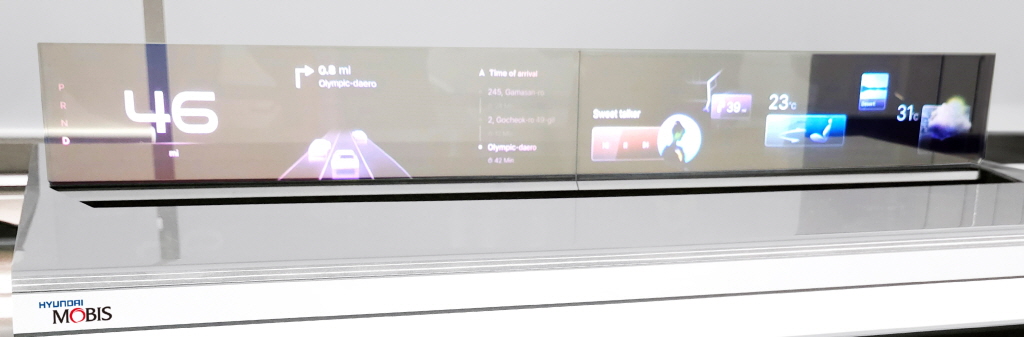
▲Hyundai Mobis transparent display (Photo source: Hyundai Mobis)
The higher the output, the better the charging speed and efficiency. If a 22kW ICCU is installed in an electric vehicle with the same specifications, the charging time is reduced by half compared to an 11kW ICCU.
It is also closely linked to V2G (Vehicle to Grid) technology, which uses electric vehicle batteries as a kind of large power supply source, so its utility is limitless.
Hyundai Mobis plans to lead the relevant market with this product, which surpasses the currently commonly used 11kW ICCU technology and raises it to the mass production level with a 22kW ICCU.
Hyundai Mobis plans to maximize new orders through aggressive sales activities that highlight the technological prowess and marketability of these core components.
Hyundai Mobis is accelerating its efforts to diversify its customer base and expand its order performance, recording $8.57 billion in global core component orders through the third quarter of this year, significantly exceeding its initial annual target of $5.36 billion.
The 'Innovative Display' series, which incorporates high value-added cutting-edge technologies, is also considered a representative product of this year's CES.bsp;
Cutting-edge display technologies will be showcased, including 'rollable displays' and 'swivel displays' for vehicles, 'QL displays' that implement OLED-level performance in LCD, and '3D displays'.
In particular, it is worth paying attention to the 'transparent display' for vehicles that incorporates next-generation display technology using holographic optical element technology, which is being unveiled for the first time this time.
By projecting clear images onto a transparent panel, it provides drivers with a wider sense of space and openness compared to regular displays.
It is also noteworthy that it can be applied to the windshield of a vehicle.
It has safety advantages as the driver can check various display information without having to move his/her gaze significantly, and as it is a display solution of a different type than existing ones, if mass-produced, it is expected to bring about many changes to future vehicle design.
Meanwhile, Hyundai Mobis will unveil for the first time a 'future mobility demonstration vehicle' that applies next-generation mobility technology at this year's CES.
While the exhibition so far has been primarily focused on visual displays of technology products and concept cars, this time, visitors can enjoy demonstrations by riding in vehicles equipped with the e-corner system, which has captured the public's attention.
It is expected to attract attention as a differentiated event that will make people realize that the era of future mobility is fast approaching.
It is also closely linked to V2G (Vehicle to Grid) technology, which uses electric vehicle batteries as a kind of large power supply source, so its utility is limitless.
Hyundai Mobis plans to lead the relevant market with this product, which surpasses the currently commonly used 11kW ICCU technology and raises it to the mass production level with a 22kW ICCU.
Hyundai Mobis plans to maximize new orders through aggressive sales activities that highlight the technological prowess and marketability of these core components.
Hyundai Mobis is accelerating its efforts to diversify its customer base and expand its order performance, recording $8.57 billion in global core component orders through the third quarter of this year, significantly exceeding its initial annual target of $5.36 billion.
The 'Innovative Display' series, which incorporates high value-added cutting-edge technologies, is also considered a representative product of this year's CES.bsp;
Cutting-edge display technologies will be showcased, including 'rollable displays' and 'swivel displays' for vehicles, 'QL displays' that implement OLED-level performance in LCD, and '3D displays'.
In particular, it is worth paying attention to the 'transparent display' for vehicles that incorporates next-generation display technology using holographic optical element technology, which is being unveiled for the first time this time.
By projecting clear images onto a transparent panel, it provides drivers with a wider sense of space and openness compared to regular displays.
It is also noteworthy that it can be applied to the windshield of a vehicle.
It has safety advantages as the driver can check various display information without having to move his/her gaze significantly, and as it is a display solution of a different type than existing ones, if mass-produced, it is expected to bring about many changes to future vehicle design.
Meanwhile, Hyundai Mobis will unveil for the first time a 'future mobility demonstration vehicle' that applies next-generation mobility technology at this year's CES.
While the exhibition so far has been primarily focused on visual displays of technology products and concept cars, this time, visitors can enjoy demonstrations by riding in vehicles equipped with the e-corner system, which has captured the public's attention.
It is expected to attract attention as a differentiated event that will make people realize that the era of future mobility is fast approaching.
본 기사에 대한 정정·반론·추후보도 청구는 보도 청구 안내를, 그간 게재된 보도문은 정정·반론보도 모아보기를 참고해 주세요.

.png)