


The Ministry of Science and ICT stated, "The number of 5G locations nationwide doubled to 54 last year."
 Published2024.01.03 16:38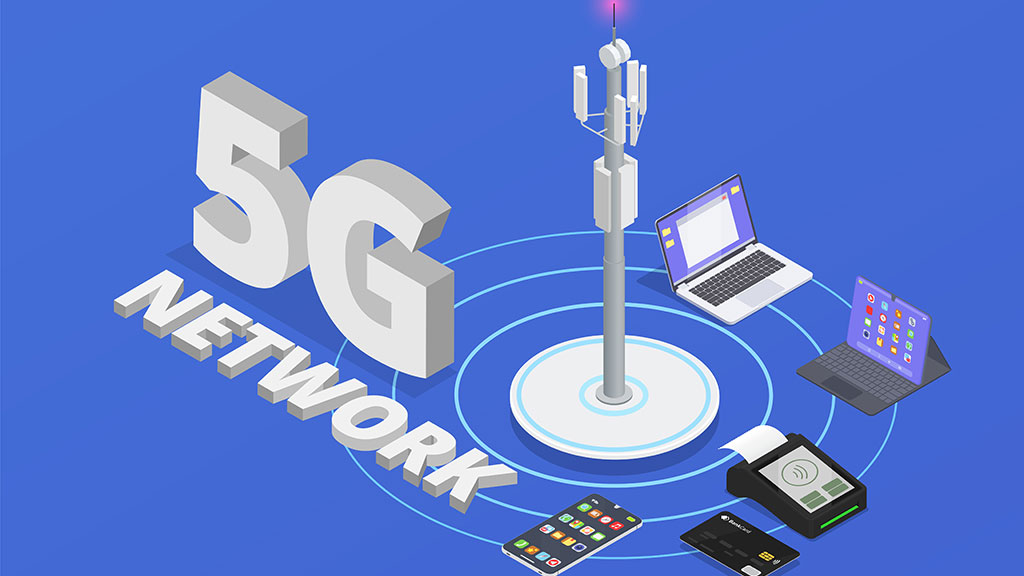
As of the end of 2023, 54 locations across 30 companies and institutions
Utilized in 14 fields including manufacturing, healthcare, logistics, and education.
Over the past year, the number of users of the 5G specialized network (Eum 5G) has doubled compared to the previous year.
The Ministry of Science and ICT announced on the 3rd that the use of 5G has more than doubled compared to the previous year, expanding to 54 locations across 30 companies and organizations nationwide as of the end of 2023.
"Eum5G (5G specialized network)" is a communications network that utilizes 5G frequencies in specific areas, allowing non-mobile carriers to implement their own networks. Its goal is to actively leverage the benefits of 5G mobile communications in specific areas, such as land and buildings.
In December 2021, Naver Cloud became the first domestic operator to receive a frequency allocation and launch the service. In 2022, 26 locations across nine sectors, including manufacturing, healthcare, and logistics, began using the service. By 2023, the service had expanded to 54 locations across 14 sectors, including automotive, shipbuilding, steel, and education, expanding its reach across all industries. Currently, there are 18 ‘frequency allocation’ companies and 12 ‘frequency designation’ companies.
According to industry experts, there will be 2,900 5G-specific networks worldwide by the end of 2023, and this is expected to grow at an average annual rate of 33% to reach 11,900 by 2028.
Meanwhile, Korea has also been streamlining the application process and submission requirements for 5G to promote its adoption. This includes streamlining the application process and removing restrictions on foreign ownership when registering as a fixed-line telecommunications business. Furthermore, a website has been established to provide comprehensive information, including the latest domestic and international deployment cases and the status of equipment and terminal supply. Furthermore, on-site pre-registration consulting services have been provided to address frequency application procedures and provide technical support.
The Ministry of Science and ICT presented references through 15 demonstration projects to ensure that 5G can be utilized in various fields. Last December, the domestic research team ETRI also achieved the success of completing the development of technology that increased the speed of 5G small cells to 3 Gbps.
Major examples of 5G services include: △Manufacturing: Increased productivity through stable and fast data processing compared to Wi-Fi, and major accident prevention services through real-time control △Logistics: Increased work efficiency through fast and safe data processing of personal digital assistants (PDAs) △Autonomous robots: A service in which AI autonomous robots deliver lunch boxes, drinks, mail, parcels, etc. to individuals in the office △Medical: Precision surgery services through 3D augmented reality (3D AR) and real-time non-face-to-face collaboration based on the results of patients’ computed tomography (CT)/magnetic resonance imaging (MRI) at hospitals △Defense: Multilateral collaborative combat based on realistic virtual reality (VR) using 28GHz, military training services such as mortar/anti-aircraft weapon operation and combat, etc.
In the future, as digital technologies such as artificial intelligence (AI), virtual models (digital twins), augmented reality (AR), extended reality (XR), and extended virtual worlds (metaverse) are linked with 5G to provide customized convergence services to demand companies, digital technology suppliers are also expected to grow in the market along with 5G.
The Ministry of Science and ICT plans to cooperate with 5G operators this year to actively utilize advanced 5G convergence services in large-scale logistics sites and energy sectors. In addition, we will work with relevant ministries and local governments to apply 5G to realistic content such as specialized training using extended reality (XR) and safety areas such as preventing major accidents in intelligent factories.
Hong Jin-bae, Director of the Network Policy Bureau at the Ministry of Science and ICT, said, “Ieum 5G is being successfully implemented by supporting the customized needs of users who want to implement various services in various industries,” and added, “We will continue to create successful cases that contribute to improving public convenience and revitalizing industries through various Ieum 5G services with large-capacity hyper-connectivity.”
Comments
Related news
Intensifies Search for New 5G Specialized Network Operators… Excluding the Three Major Mobile Carriers
The Ministry of Science and Technology Information and Communication announced a demonstration project on the 19th (Wednesday) to support the discovery and dissemination of 5G specialized network convergence services based on linkages between private companies for the national agenda of "5G Specialized Network (Eeum 5G) and Convergence Service Dissemination."
2023.04.20by 김예지 기자
Introduction of 5G steel automation and safety management
The Ministry of Science and ICT announced on the 11th that it has completed the procedures for frequency allocation and registration as a basic telecommunications business operator for POSCO DX in the 5G Leap (Eum) program. The requested frequency is 4.7GHz with a bandwidth of 100MHz, and the usage period is 2 years.
2023.09.12by 김예지 기자
SKT-Railroad Research Institute, Railway Communication 'Eum 5G-R' Development Begins
SKT announced on the 20th that it will proceed with a demonstration project to construct and operate a next-generation railway communication 5G-R communication test network in cooperation with the Korea Railroad Technology Research Institute.
2023.09.21by 김예지 기자
.jpg)
LG Electronics Introduces Eum 5G...Robot Control at Incheon Logistics Center
Eeum 5G is expanding into various industrial sectors. This time, Eeum 5G convergence services are being used for simultaneous control of dozens of robots in logistics facilities and for process and safety management in shipyards.
2023.10.05by 김예지 기자
28GHz, only possible with 5G? What's next for the fourth mobile carrier?
Mobile carriers will be able to provide subway Wi-Fi services utilizing 28GHz in subways through Eeum 5G (5G private networks). Meanwhile, the feasibility of utilizing the 28GHz band in commercial networks continues to show limited prospects.
2023.11.29by 김예지 기자











