



Morai Virtualizes Yeungnam University Campus as Digital Twin… Establishes Autonomous Driving Research Testbed
 Published2024.02.23 08:56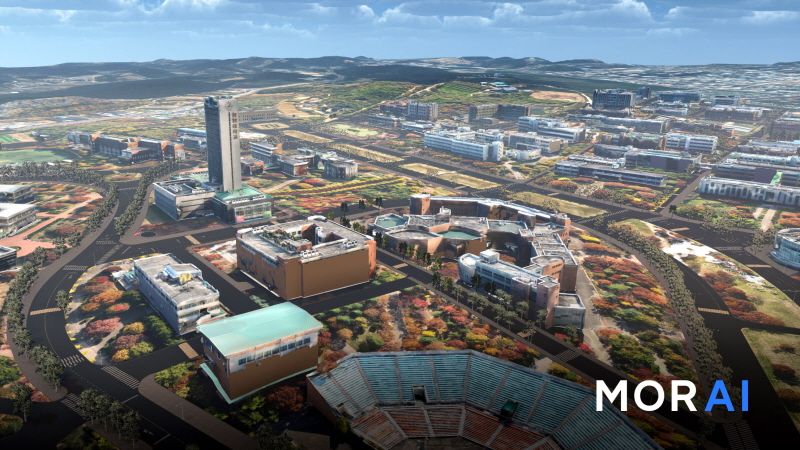
Morai Supports Future Vehicle Transformation Parts Business Group… Cooperation to Foster Autonomous Driving Talent in Daegu-Gyeongbuk Region
Yeungnam University Future Vehicle Convergence major students can test autonomous driving in Morai's virtual environment
Morai is collaborating with the RIS Daegu-Gyeongbuk Regional Innovation Platform Future Vehicle Conversion Parts Business Group to foster talent for future vehicle convergence majors in the Daegu-Gyeongbuk region, and Yeungnam University announced on the 23rd that it has strengthened the foundation for future mobility technology research by securing an autonomous driving test bed through the construction of this digital twin map.
The Future Vehicle Transition Parts Business Group, centered at Yeungnam University, carries out tasks such as fostering talent tailored to the future vehicle transition and supporting local settlement, developing innovative technologies for the transition, establishing a future vehicle ecosystem, and providing corporate support to lead innovation in the future vehicle transition parts industry, a key sector in the Daegu-Gyeongbuk region.
Morai supported the Local Government-University Cooperation-based Regional Innovation Project (RIS) of the Future Vehicle Transition Parts Business Group affiliated with the Daegu-Gyeongbuk Regional Innovation Platform and the Yeungnam University (B-1) Electric Vehicle Convergence Parts Track.
The RIS project involves local governments, universities, and regional innovation institutions establishing a regional innovation platform to formulate mid-to-long-term development plans tailored to industrial demand, selecting key sectors based on development goals, and universities linked to themIt is a project that supports the promotion of innovation in the local industry.
Morai constructed a digital twin map of the entire Yeungnam University campus (approximately 820,000 pyeong), focusing on the roads within the campus where vehicles can travel.
It precisely simulates the actual campus environment, enabling the testing of various scenarios that may occur under real road conditions.
With this, autonomous driving researchers and students at Yeungnam University can conduct various autonomous driving studies, such as verifying driving algorithms or system safety of autonomous vehicles, on a virtual Yeungnam University campus map.
Kwon Seong-jin, a professor in the Department of Future Automotive Engineering at Yeungnam University (and Deputy Director of the Future Vehicle Transformation Parts Business Group), stated, “Currently, Yeungnam University is operating educational courses in autonomous vehicles and autonomous driving artificial intelligence using Morai’s autonomous driving simulation software.” He added, “Through the construction of this digital twin, students will be able to conduct various verifications under conditions similar to reality. We expect this will not only enhance their understanding and application skills regarding autonomous driving technology but also serve as a foundation for them to grow into experts who will lead the future automotive industry.”
Jeong Ji-won, CEO of Morai, stated, “Through Morai’s autonomous driving simulation software, students and researchers at Yeungnam University can efficiently and cost-effectively conduct research on verifying the performance and safety of autonomous vehicles in a virtual environment, which is expected to contribute to the qualitative improvement of autonomous driving technology research.” He added, “Morai plans to continue supporting the development of local industries and the growth of the mobility industry through various collaboration programs.”
Meanwhile, Morai has established and operates a subsidiary in Daegu in addition to its headquarters in Seoul, and about 10 research and development personnel are working at the Daegu branch. It is focusing on future mobility businesses such as autonomous vehicles, robots, and UAM, while also strengthening its activities in the Daegu and Gyeongbuk regions.
Comments
Related news
HL Mando and HL Clemuv to Jointly Participate in CES 2024… Innovation Award Winners Share Spotlight
EV solution specialist HL Mando and autonomous driving specialist HL Klemove will unfold imagination for "Imagine Every Move," the theme of CES 2024, through everyday autonomous driving technology alongside CES Innovation Award-winning products.
2024.01.08by 성유창 기자
Moray and Telechips Sign MOU on ADAS and Autonomous Driving at CES 2024
Morais, an autonomous driving simulation specialist, and Telechips, a vehicle semiconductor design expert, announced on the 10th that they have signed an MOU at CES 2024 and will cooperate in the ADAS and autonomous driving fields.
2024.01.10by 성유창 기자
.jpg)
ETRI Wins Silver Prize at International Autonomous Driving Control Challenge
The Electronics and Telecommunications Research Institute (ETRI) won the silver award in the autonomous driving control benchmark competition at the 2023 IEEE Conference on Decision and Control (CDC), the most prestigious international academic conference in the field of control systems, held in Singapore at the end of last year.
2024.01.12by 배종인 기자
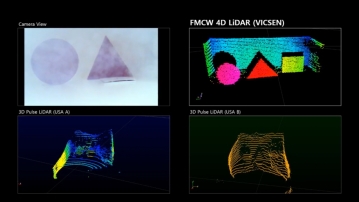
KEY 'Sensor' to Overcoming Autonomous Driving Limitations… Performance Enhancement and Technology Securing Are Required
As most autonomous vehicle accidents are determined to be caused by limited performance and errors in perception sensors, experts have raised the opinion that it is important to overcome critical situations by advancing sensors to enable perception error correction and adverse weather response capabilities, as well as by applying sensor fusion techniques.
2024.01.19by 성유창 기자
.jpg)
Hyundai Motors, Kia, KAIST Join Hands to Develop Next-Generation LiDAR
Hyundai Motor and Kia have established the 'Hyundai Motor Group-KAIST On-Chip LiDAR Joint Research Laboratory' at KAIST's main campus in Daejeon to develop LiDAR sensors for advanced autonomous vehicles in collaboration with KAIST.
2024.02.21by 배종인 기자











