


LG Uplus, AWS, and Samsung Electronics to Automatically Adjust 5G Equipment Capacity Using AI
 Published2024.02.27 17:00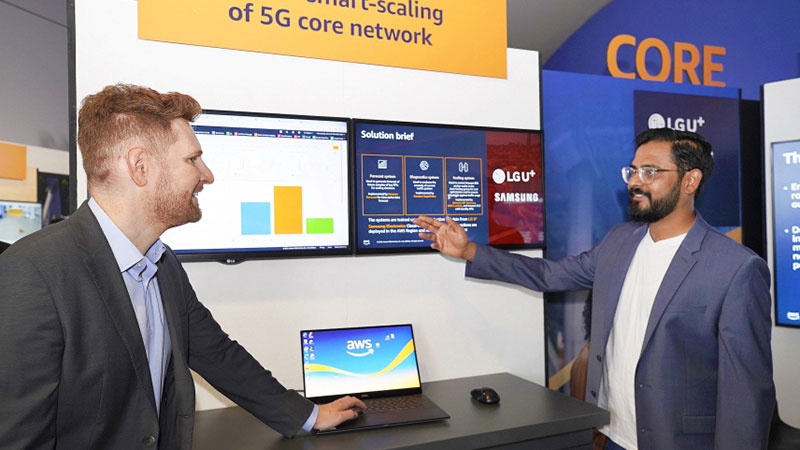
Three companies will collaborate at MWC 2024 to demonstrate AI automation technology for 5G equipment.
AWS AI Operational Automation Technology Applied to Samsung Electronics' Cloud Core
LG Uplus, AWS, and Samsung Electronics are jointly developing AI-based automation technology to control 5G equipment capacity, providing optimal quality and stable service.
LG Uplus announced on the 27th that it has decided to collaborate with Amazon Web Services (AWS) and Samsung Electronics to develop an automation function that optimizes the timing of 5G equipment expansion using AI at the Mobile World Congress 2024 (MWC 2024) held in Barcelona, Spain.
The technology the three companies have agreed to collaborate on is an automation technology designed to prepare for increased data usage. This technology allows users to leverage Samsung Electronics' cloud-native core software, built on the AWS cloud, to use AI to predict the optimal timing for equipment expansion and automatically scale up equipment to ensure seamless service. For example, in cases of traffic surges, such as during the New Year's countdown, AWS's AI can increase the capacity of 5G equipment from 10GB to 20GB, ensuring uninterrupted service.
The three companies demonstrated this technology at the AWS booth inside the Fira Barcelona exhibition hall, where MWC 2024 will be held. Samsung Electronics' "5G UPF (User Plane Function)" used in this demonstration is a cloud-native device that utilizes container technology. It performs network functions that process the user plane in the 5G core network. AWS's AI and machine learning technologies allow it to predict sudden traffic increases and efficiently increase equipment capacity without inconveniencing customers.
Previously, LG Uplus signed a business agreement with AWS in 2022 to develop network cloud technology and has been researching ways to build network equipment on the AWS cloud. In addition, Samsung Electronics has completed a verification of a backup network configuration that enables stable network operation even in the event of a telecommunications disaster such as an earthquake or fire by deploying its cloud-native 5G UPF equipment on AWS.
With this demonstration as an opportunity, the three companies pledged to continue joint research on AI and machine learning-based cloud equipment automation technology in the future.
Lee Sang-heon, head of NW Advanced Development at LG Uplus, said, “Through this collaboration, we expect to be able to provide optimal quality and stable services by applying AWS’s AI-based operational automation technology to Samsung Electronics’ cloud native core.” He added, “Going forward, we will strengthen our cooperation with technology-leading companies such as AWS and Samsung Electronics to secure competitiveness in next-generation network technology that utilizes AI and the cloud to innovate customer experiences.”
Ham Ki-ho, CEO of AWS Korea, said, “As the use of cloud technology in telecommunications services increases, the new evolution of 5G services is becoming increasingly visible,” and “We expect that LG Uplus will be able to achieve innovation, efficiency, and automation of its telecommunications network by utilizing machine learning and data analysis services from AWS, the world’s most comprehensive and widely adopted cloud.”
“We are delighted to be developing AI-based smart and efficient network operation automation technology in collaboration with LG Uplus and AWS based on Samsung Electronics’ cloud native core technology,” said Yoon Bo-young, Senior Vice President and Head of Call Software Development Group at Samsung Electronics’ Network Business. “Samsung Electronics will continue to collaborate with industry-leading companies to lead the next-generation network technology innovation that will make the communications environment more flexible.”
Comments
Related news
Korean Fabless Companies Accelerate Demand Recruitment... LGD & Innotek Hold Startup Technology Exchange Meeting
A discovery event for fabless startups to identify demand companies was held to activate the domestic system semiconductor ecosystem.
2024.02.07by 권신혁 기자
LG Chem, GM Sign 25 Trillion Won Cathode Material Supply Contract for 500,000 Tons
LG Chem announced a cathode material supply contract with GM on the 7th at LG Twin Tower in Yeouido, stating that through this contract, LG Chem will supply cathode material to GM with a minimum scale of 24.75 trillion won through 2035.
2024.02.08by 성유창 기자
LG Uplus-EricssonLG, 5G Network SW Platform Verification
LG Uplus announced on the 15th that it has completed verification of next-generation software platform technology in collaboration with Ericsson LG, a telecommunications equipment manufacturer, and will lead the creation of a 5G ecosystem by leveraging this technology.
2024.02.16by 김예지 기자
.jpg)
SKT and KT to showcase AI innovation technology at MWC2024
SKT and KT will showcase future technologies based on AI innovation at 'MWC 2024 (Mobile World Congress 2024)' opening on the 26th in Barcelona, Spain. LG Uplus will participate by organizing an observer group to explore AI trends.
2024.02.19by 김예지 기자
LG Uplus-Nokia, 6G Cloud Technology Verification… “Supporting Uninterrupted Network Operation”
LG Uplus announced on the 23rd that it successfully verified 6G cloud technology to enhance the survivability of virtualized base station equipment in preparation for 6G, in collaboration with Nokia, a global telecommunications equipment manufacturer.
2024.02.23by 김예지 기자











