


IBM: "The era of hybrid computing, where CPUs, GPUs, and QPUs coexist, is coming."
 Published2024.06.26 16:58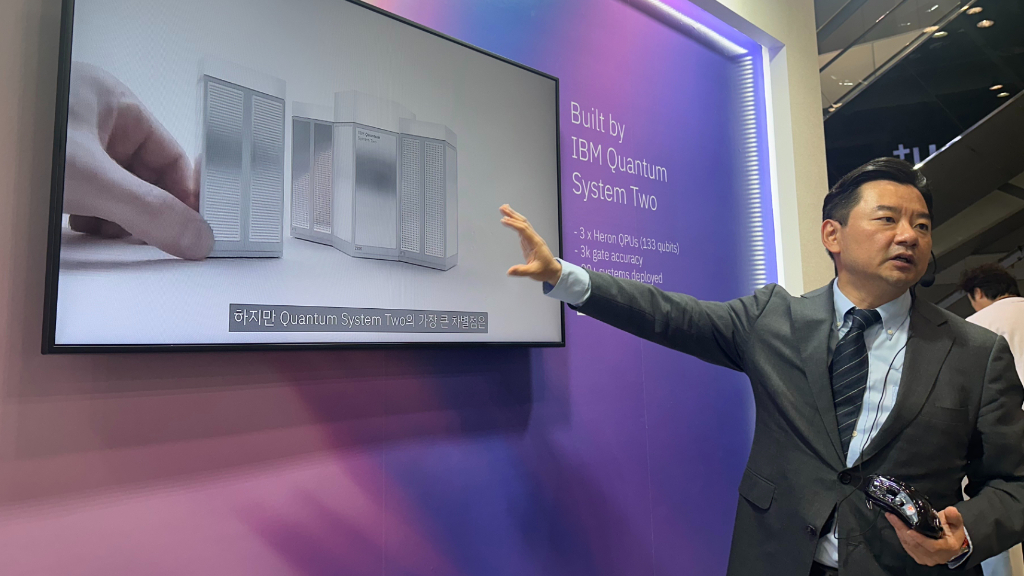
Quantum Korea 2024 to be held in Seoul… Quantum computing and quantum cryptography technologies to be showcased
South Korea to Invest 3 Trillion Won by 2035...Aiming to Achieve a Bilateral Economy
IBM Unveils Quantum Roadmap, Unveiling Heron Chip, Claiming Five Times More Performance Than Previous Generation
Development and distribution of the quantum development software platform 'Qiskit'
IBM has unveiled a roadmap for developing large-scale quantum hardware and software to solve problems difficult for conventional computers. Next-generation computing is expected to see the coexistence of traditional and quantum computing, with each achieving synergy in its respective specialized areas.
"Quantum Korea 2024," co-hosted by the Ministry of Science and ICT and the Quantum Korea 2024 Organizing Committee, was held on Tuesday, the 25th, at KINTEX Exhibition Hall 2 in Ilsan. South Korea has adopted quantum as one of its 12 national strategic technologies, established national quantum governance by enacting the Quantum Technology Industry Act in October of last year, and announced the "Quantum Initiative" in April of this year. This initiative is expected to be implemented in November of this year.
Kim Yeon, director of the Quantum Science and Technology Industry Division at the Ministry of Science and ICT, explained, “The key axes of the domestic quantum industry are securing quantum core technology, quantum engineering, and quantum service development. The government plans to expand infrastructure investment by up to 3 trillion won by 2035 and focus on fostering talent and R&D hubs.” Furthermore, the plan is to expand the industry based on global cooperation, establish quantum unicorn companies, and achieve a quantum economy by 2035.
Recently, the quantum field has been developing computing technology that utilizes the high speed of quantum and applies the irregularity of quantum to security.
IBM has unveiled its quantum roadmap and introduced a number of software technologies, including quantum computers. Since 2016, IBM has built over 60 quantum computing systems in its research labs and data centers through quantum research. Furthermore, it was the first company in the world to open quantum computers to the public via the cloud.
IBM Executive Vice President Pyo Chang-hee said, “Using the 127-qubit IBM Quantum ‘Eagle’ processor, which will be released in 2023, we have demonstrated that quantum systems can go beyond classical quantum mechanics simulations and solve problems in chemistry, physics, and materials at a scale that is difficult to calculate with conventional computers.”
For example, it can rapidly resolve global distribution challenges, responding in real time to changes in financial markets or, for oil companies, addressing countless variables like weather and schedules. It's like the CPU and GPU, the engines of artificial intelligence (AI) that learn and infer data, boasting performance far superior to that of supercomputers. Domestically, it's expected to be utilized in autonomous driving, new materials development, the battery industry, and simulation.
However, IBM did not believe that quantum computing, or QPUs (quantum processing units), could replace GPUs or CPUs. An IBM booth representative explained, “Quantum computing and traditional computers are being developed in a hybrid way that highlights each other’s strengths,” and “Next-generation computing will create synergy effects in areas where each computing performance is specialized.”
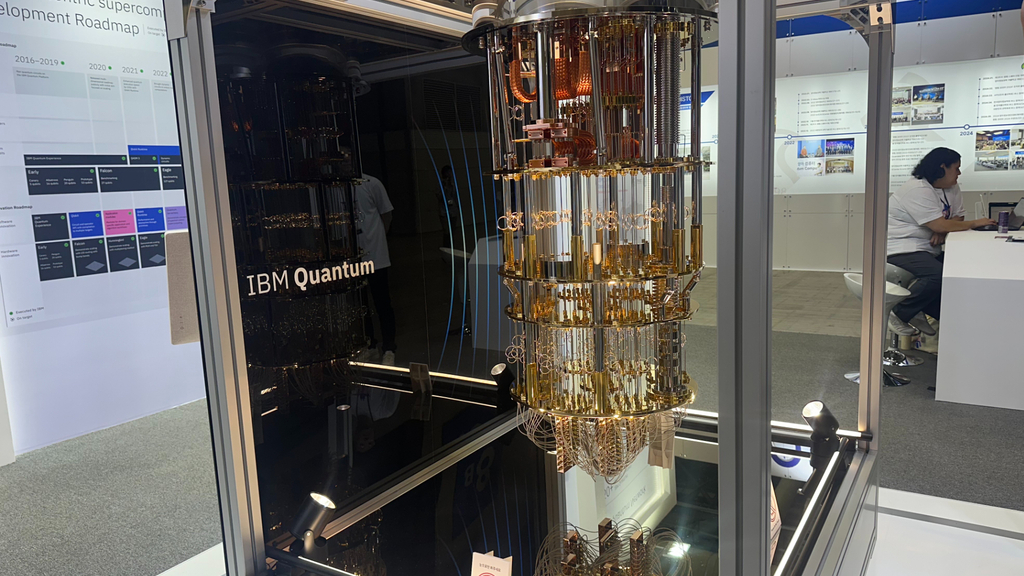
At its booth that day, IBM displayed its "Quantum System 1" equipment, scheduled for installation at Yonsei University's International Campus in the second half of this year. The equipment features a system where cans cover the outer walls in stages to maintain an extremely low temperature of -237 degrees Celsius.
In particular, the IBM Quantum "Heron" processor, released in December 2023, boasts five times the error sensitivity and higher performance of the Eagle processor, based on an architecture developed over four years. Three of these processors will be installed in IBM's first modular quantum computer, the "Quantum System 2," which is located at the Watson Research Center in New York.
IBM said, “While we focused on increasing the number of qubits until last year, we are now focusing on improving speed and performance, and are researching ways to increase integration between chips and reduce noise by arranging the chips themselves in a parallel structure.”
IBM has announced that it will extend its quantum development roadmap to 2033, building on the architecture of its Heron chip, and aims to improve the quality of quantum computing through improved gate operation. “As the scale, quality, and speed of IBM systems continue to improve, we will be able to run larger circuits,” said IBM Managing Director Pyo Chang-hee. “We are aiming for 50,000, 100,000, and even 100 million gates.”
Meanwhile, IBM also emphasizes software development tools that help developers build and run quantum circuits. Qiskit, announced in 2023, is an open-source quantum programming software that has been adopted by 600,000 users worldwide. Managing Director Pyo explained, "Recently, we've also developed a solution that integrates generative AI to automatically generate code for computations based on LLM (Large Language Model)."
IBM also said, "We've established a global quantum network, with 250 member governments, organizations, and universities using IBM products. We're also leading the way in quantum education, announcing plans to provide quantum education to 40,000 students in Korea, the U.S., and Japan by December 2023." IBM's 39 Quantum Innovation Centers (QICs) serve as hubs, conducting research and education based on global collaboration.
Comments
Related news

IBM-Korea Quantum Computing, Watson X and Quantum Computer Domestic Introduction Join Hands
Through IBM's collaboration with KQC announced on the 30th, customers in the ecosystem built by KQC will be able to utilize IBM's full-stack AI solution, including 'watsonx,' an AI and data platform for learning, tuning, and deploying advanced enterprise AI models and software.
2024.01.30by 김예지 기자
SKT Establishes Quantum Alliance with 7 Leading Quantum Companies
SKT announced on the 7th that it has established a Memorandum of Understanding (MoU) with companies possessing core technologies and components in the quantum field for the establishment of a "Quantum Alliance" (tentative name) and future cooperation. The "Quantum Alliance" comprises a total of 7 companies as member organizations, including SKT, SOS Lab, XGate, Woorilro, KCS, Nokia, and IDQ Korea.
2024.03.07by 김예지 기자
.jpg)
ETRI develops mass production technology for quantum dot lasers for optical communications
The Electronics and Telecommunications Research Institute (ETRI) has developed technology to enable domestic mass production of quantum dot lasers for the first time using a metal-organic chemical vapor deposition (MOCVD) system, which previously could only be used for research purposes.
2024.05.08by 배종인 기자
[Serial Planning - Communication is the History of Communication ④] 21st Century Communications that are Getting Faster and More Connected
[Editor's Note] The history of telecommunications is a history of humanity's endless efforts to connect with one another. Since prehistoric times, communication has served as a means of dialogue and agreement for humans as social creatures. In Korea, electrical telecommunications were first introduced in 1888 during the Joseon Dynasty, and after liberation, the rapid development of telecommunications business and technology in the 1980s ushered in the information age. Now, in the era of 5G and 6G, we are looking toward next-generation telecommunications such as satellite communication and quantum communication. With advances in cutting-edge technologies including artificial intelligence (AI), robotics, cloud computing, and UAM, telecommunications are becoming increasingly important and are expected to develop endlessly. Telecommunications is the most fundamental technology that spans across virtually all fields while also being a critical one. Through this planning series, we will cover various aspects related to telecommunications, from its history to minor events, technologies, and trends.
2024.06.14by 김예지 기자
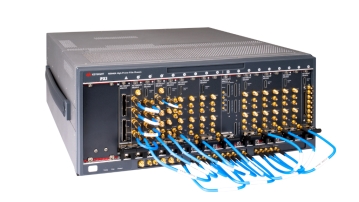
Keysight Unveils Quantum Chip Design Simulation
Keysight Technologies announced that it will demonstrate market-leading design, simulation, and test solutions that accelerate quantum computing, quantum sensing, and communication testing at 'Quantum Korea 2024,' which will be held from the 25th to the 27th at KINTEX in Ilsan.
2024.06.20by 김예지 기자











