


Expanding the designation of autonomous vehicle pilot zones on highways, autonomous cargo transport is set to begin in earnest.
 Published2024.07.09 16:32
City/province consultations starting on the 10th → Ministry of Land, Infrastructure and Transport designates wide-area routes such as highways
First autonomous vehicle cargo transport permit standards established, expected to boost autonomous cargo transport
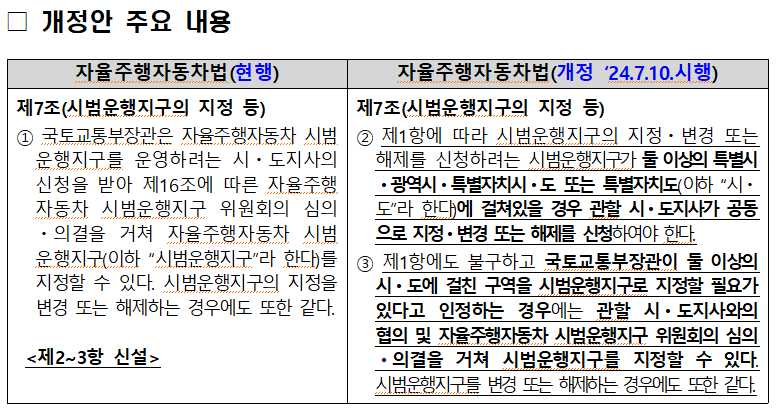
▲Key points of the revised pilot operation zone designation plan (Source: Ministry of Land, Infrastructure and Transport)
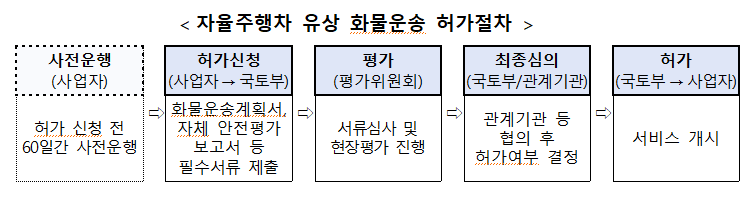
▲Procedures for permitting paid freight transport using autonomous vehicles (Source: Ministry of Land, Infrastructure and Transport)
Comments
Related news
.jpg)
Hexagon, “Reducing Development Period through Automotive Design AI and Machine Learning”
Hexagon Manufacturing Intelligence, a global leader in the digital reality solutions field combining sensors, software, and autonomous technologies, participated in the 2024 Spring Conference of the Korean Society of Automotive Engineers held at Sonokam Geoje on the 20th and conducted a seminar with Hyundai Motor Company on the theme of "Virtual Development of Future Mobility Driving Performance Using Artificial Intelligence (AI) and Machine Learning (ML)."
2024.06.21by 배종인 기자

China and Japan Emphasize Open Ecosystems in SDV Industry
China and Japan are emphasizing the establishment of open ecosystems in the SDV sector, which is a key area of the future automotive industry, and are moving forward to strengthen their competitiveness in the global market.
2024.06.24by 성유창 기자
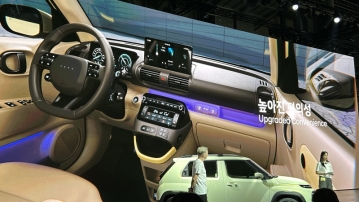
[Busan Mobility Show] Hyundai Motors Announces ‘Compact’ Electric Car Casper Electric and Hydrogen Society Blueprint
Hyundai Motor has presented its future mobility blueprint toward a sustainable future by demonstrating its electrification vision through the Casper Electric, a small electric vehicle that will lead the popularization of electric vehicles, while also expressing its commitment to transitioning to a hydrogen ecosystem through its hydrogen value chain business brand 'HTWO'.
2024.06.28by 성유창 기자
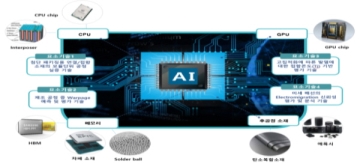
70 billion won invested in seven new projects, including the AI semiconductor supply chain.
The Ministry of Trade, Industry and Energy (Minister Ahn Deok-geun) is announcing a call for proposals for seven new projects under the 2024 Core Materials, Parts and Equipment (K-Materials) Key Strategic Technology Technical Support Infrastructure Development Program. The call for proposals covers the following fields: △demonstration and infrastructure development for strengthening semiconductor AI semiconductor supply chains △infrastructure development for demonstration of high-performance coatings/films for OLED displays △reliability infrastructure development for localization of high-power power conversion devices for future vehicles △demonstration infrastructure development for strengthening next-generation communication component supply chains in electrical and electronics △evaluation infrastructure development for control modules for autonomous collaborative manufacturing processes in machinery △demonstration infrastructure development for high-toughness and hydrogen-embrittlement-resistant metal materials for hydrogen industry in metals △infrastructure development supporting commercialization of eco-friendly bio-based materials in basic chemicals, etc.
2024.07.01by 배종인 기자
.jpg)
Mouser Connects EV/HEV Technology to the Future
Mouser Electronics, a leading New Product Introduction (NPI) company implementing innovation, provides information on the latest developments and advances, as well as challenges in electric vehicle (EV) and hybrid electric vehicle (HEV) technologies.
2024.07.05by 배종인 기자











