
인피니언, 2025년 차량용 반도체 시장 1위 유지…MCU 점유율 36%
 기사입력2026.04.14 09:56
글로벌 시장 744억불…유럽·중국·한국 1위 북미·일본 2위
2026년 4월 발표된 시장 집계에 따르면 2025년 글로벌 차량용 반도체 시장 규모는 744억달러로 전년 699억달러보다 증가했다. 인피니언은 점유율 12.8%로 1위를 기록했다. 회사 기준으로는 2020년 이후 6년 연속 선두다.
지역별로는 유럽과 중국, 한국에서 1위를 유지했고 북미와 일본에서는 2위를 차지했다. 세계 최대 차량용 반도체 시장으로 꼽히는 중국에서 선두를 지킨 점도 전체 실적에 반영됐다.
자동차용 마이크로컨트롤러 시장에서는 점유율 36.0%를 기록했다. 이는 전년보다 3.9%포인트 오른 수치다. 마이크로컨트롤러는 전기구동계와 첨단운전자보조시스템, 소프트웨어 정의 차량의 전장 제어에 쓰이는 부품이다.
인피니언은 차량용 반도체 시장 선두를 유지하는 동시에 핵심 제어 반도체 분야에서도 점유율을 확대했다. 전동화와 차량 소프트웨어 전환이 이어지는 시장에서 주력 부문 경쟁력을 다시 확인한 셈이다.
댓글
관련 뉴스
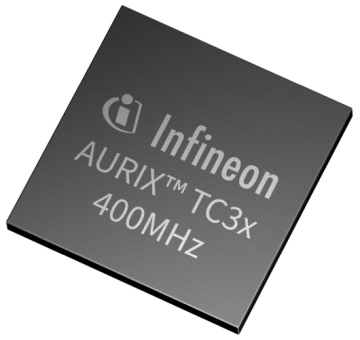
Infineon adds a 400MHz performance rating to the AURIX TC3x, reducing the burden of platform changes for ECU upgrades.
Infineon has added a 400MHz performance tier to its AURIX TC3x microcontroller (MCU) family for automotive applications. The company stated that it has designed the product to enable performance scaling without costly platform migration in powertrain, chassis, and zone/domain control applications where software complexity and real-time processing demands are increasing. The 400MHz device increases CPU frequency by up to one-third compared to existing TC3x products, and targets advanced control algorithms and expanded diagnostic functions in engine management systems (EMS), electronic stability control (ESC), ADAS/domain controllers, and similar applications. Initial production of the first product is scheduled to begin in 2026.
2026.03.05by 배종인 기자
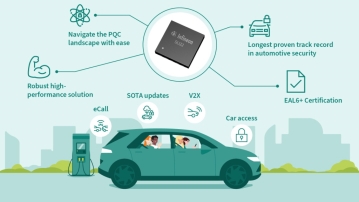
Infineon Strengthens Future Mobility Security with Quantum-Resistant Cryptography
As vehicle electrical system security becomes increasingly important, Infineon Technologies has unveiled the TEGRION™ SLI22, manufactured using a 28-nanometer process, and presented security technologies to prepare for advancing cyber threats and the quantum computing era. The SLI22, based on Infineon's Integrity Guard 32 architecture, has enhanced system integrity and data protection capabilities. Additionally, by applying the new ETSI MFF3 package, it significantly reduces installation footprint compared to existing packages, enabling flexible design even in vehicle electrical environments with severe space constraints.
2026.03.09by 배종인 기자

Infineon aims to achieve 23.2% MCU market share by 2025, expanding into the automotive and robotics markets.
Infineon recorded a 23.2% market share in the global microcontroller (MCU) market in 2025. This represents an increase of 1.8 percentage points from 21.4% in the previous year. What is notable is that this result was achieved while the overall market declined by 0.3%. The company is expanding its software-defined vehicle (SDV) response capabilities based on the integration of its automotive Ethernet business, and is also promoting expanded MCU application in the physical AI field, including humanoid robots. At the same time, the company is proceeding with designs that address security requirements such as ISO/SAE 21434, EU CRA, and PQC.
2026.03.11by 배종인 기자
[Deep Dive] MCU Sheds Its "Control" Shell and Embraces "Intelligence": A Major Transition to an Edge AI Platform
Today, the biggest topic facing embedded systems designers is undoubtedly 'AI'. However, many edge devices surrounding us—refrigerators, door locks, industrial sensors, and so on—still remain in a structure where it is difficult for them to make independent decisions without the help of the massive cloud infrastructure. Behind the power that cloud AI provides, three clear limitations exist: 'latency', 'communication costs', and 'privacy'. Against this backdrop, microcontrollers (MCUs) are rapidly evolving beyond simple processors into 'edge AI platforms' that directly interpret and make decisions on data in the field. Infineon, a leader in the global semiconductor market, is presenting a milestone for this massive change through 'PSoC™ Edge', a next-generation MCU architecture. Through an interview with Lee Jin-yong, manager in charge of edge AI solutions at Infineon, we examined the technical essence of edge AI and the practical challenges that field engineers face.
2026.03.12by 명세환 기자
[Special Report] Robot Design Overcomes 'Physical SOC' Limitations: Dabo Executive Vice President Yong-gyu Cho Reveals Infineon's Robotics Systems Philosophy
Jo Yong-gyou, Executive Director at DABO, emphasized a design philosophy centered on system-level approaches rather than individual components through a robotics webinar co-hosted with Infineon Technologies. Executive Director Jo diagnosed that "humanoids must simultaneously control dozens of joint motors, making system-level approaches essential." The core solution, the P4C3 MCU, is mounted on each joint in an ultra-compact form factor to perform high-speed computation and precision control. CoolGaN™, a next-generation power semiconductor, reduces losses by up to 60% compared to conventional silicon MOSFETs. This enables a 40% reduction in motor driver size and eliminates the need for heat sinks, dramatically reducing the robot's weight and volume. Executive Director Jo defined Infineon's SOC (System on Chip) concept as "a design philosophy that organically integrates an optimal semiconductor ecosystem rather than a single chip," and emphasized that developers can shorten POC and time-to-market through validated reference designs. Additionally, he presented a strategy that combines integrated sensor solutions such as radar and ToF with quantum-resistant security technology to simultaneously secure both the robot's cognitive capabilities and safety.
2026.03.12by 명세환 기자