


Infac and Vicor Implement 48V Zone Architecture with DC-DC Converter
 Published2026.09.14 12:03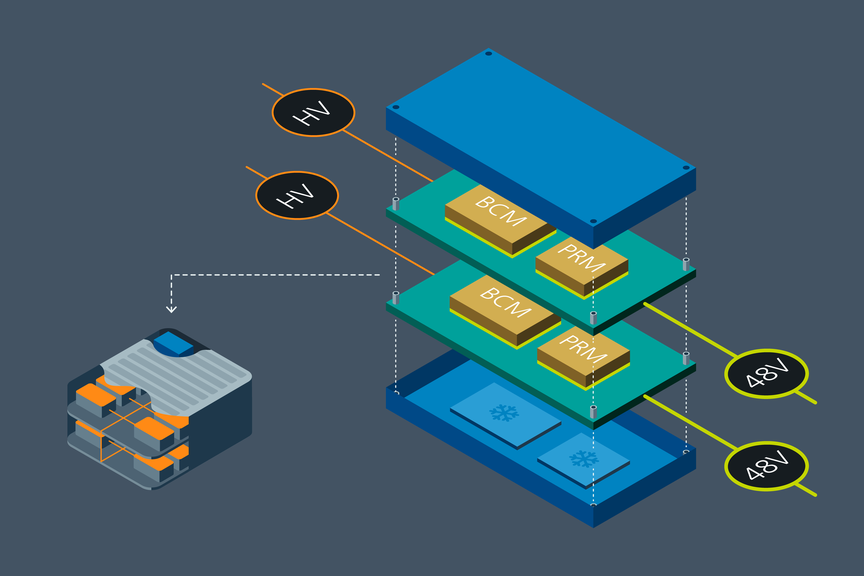
Using Vicor's 800V-to-48V isolated regulation DC-DC converter, the structure lowers voltage directly from the battery pack and distributes Safety Extra Low Voltage (SELV) throughout the vehicle.
It differentiates itself from the conventional "silver-box" design by utilizing the battery pack as a centralized power hub rather than dispersing DC-DC conversion stages to independent subsystems scattered throughout the vehicle.
Infac's system dimensions are 215 × 45 × 82mm (width/depth/height), with a volume of 793cm³ and weight of approximately 1.5kg, designed to avoid encroaching on battery cell space.
The company explained that the combination of Vicor's BCM6135 DC-DC converter and PRM3735 regulator met these space constraints.
By utilizing the existing liquid cooling system in the battery pack, the external separate cooling device was eliminated.
Infac stated that this design responds to the ongoing transition to 48V zone power architecture across the automotive industry.

Comments
Related news

Vicor Power Solutions Makes the Fastest Electric Motorcycle
The Baico DCM4623 DC-DC converter is being used as a component to power the 12V electronic control units, lighting systems, instrument clusters, and sensors in Lightning Motorcycles' electric motorcycles.
2023.09.06by 배종인 기자
Bycor Solves Automotive Electrification Challenges with Power Modules with Highest Efficiency and Power Density
Vicor, a leading innovator in high-performance power module solutions, presented across five sessions at WCX™, North America's largest automotive technology event, showcasing how its power modules with best-in-class efficiency and power density can address automotive electrification challenges.
2024.05.07by 배종인 기자
Bycor Launches DCM3717 and DCM3735 DC-DC Power Module Family
Power supply network (PDN) products centered on 48V are increasingly emerging as the industry shifts from 12V to 48V architecture to maximize efficiency.
2025.03.27by 명세환 기자
.jpg)
Byco opens the door to mid-level vehicle applications with ultra-compact active suspension power module
Vicor, a provider of innovative high-density power modules, is supplying its fixed-ratio DC-DC converter module (BCM6135), which converts 800V high voltage to 48V, as a key component for compact active suspension systems. This is expected to enable active suspension functionality, previously limited to premium vehicles, to be applied to mid-range vehicles as well, thereby contributing to significant improvements in driving safety and ride comfort.
2025.06.09by 배종인 기자

Bycor to Demonstrate High-Performance Modular Power Solutions at 2025 Power Electronics Conference
Viko, a leading company in the innovative high-performance power module field, plans to demonstrate efficient modular power solutions that realize innovative design across a wide range of industrial technologies at the 2025 Power Electronics Conference to be held at Pyeongchang Alpensia Convention Center from July 7th to 10th.
2025.06.23by 배종인 기자











