



Nota, Multimodal AI GPU Memory Reduced by 47%
 Published2026.10.01 09:10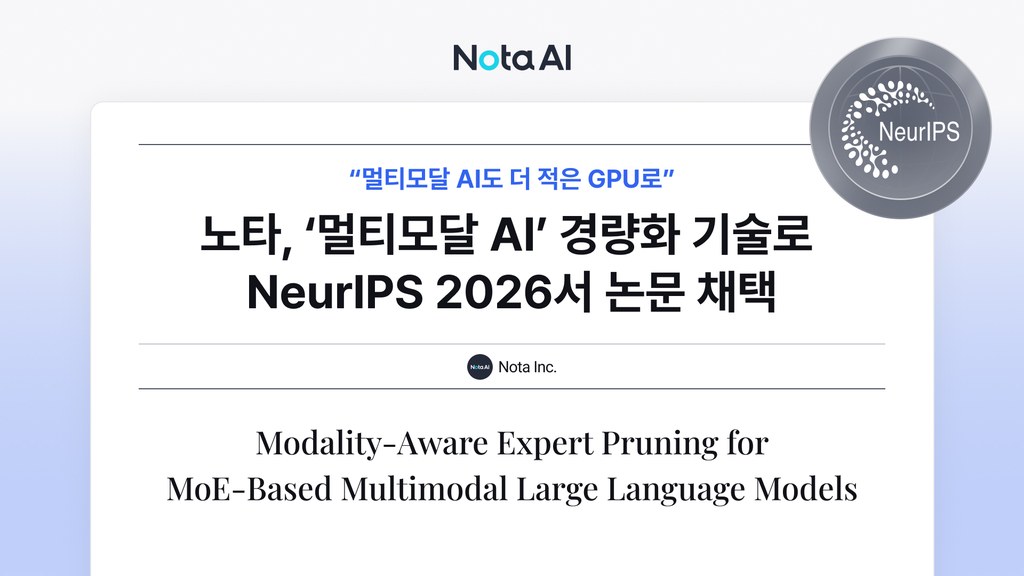
The accepted paper is titled 'Modality-Aware Expert Pruning for MoE-Based Multimodal Large Language Models'.
Nota separately evaluated expert importance for text and images respectively, using text-based importance criteria for selecting experts to retain and image-based importance criteria for selecting removal targets.
Instead of removing an equal number of experts at each layer, the company applied a method that prioritizes preserving experts in important layers by comparing the entire model.
GPU memory usage decreased from 58GB to 31GB, approximately 47% reduction, making it operable with a single GPU of 40GB memory.
The company explained that users need only set the removal ratio, and lightweight optimization can be completed with a single compression without additional training.
The company has previously applied expert pruning to super-large models such as 'Kimi K3' and 'Sola Open 2', and this year has had its research achievements recognized at major AI conferences including ICLR, EMNLP, and ICML, in addition to NeurIPS.

Comments
Related news

Nota, Upstage Consortium Advances to Third Round of Independent Foundation Model
Nota, an AI model optimization and lightweight company, has advanced to the third round of the government's independent AI Foundation Model (DokPaMo) initiative as a member of the Upstage Consortium. Through optimization of Upstage's 'Solar Open 2', Nota enabled a model requiring 8 H100 GPUs to run on 2 units, reducing memory usage by 76.5%, and achieved 80,000 cumulative downloads on Hugging Face. The goal is to enhance industrial applicability of the nation's representative AI models through integration of domestic AI software and hardware ecosystems.
2026.08.20by 배종인 기자
Nota, 2 MoE Quantization Papers Accepted at EMNLP 2026
AI model lightweight company Nota has secured acceptance of 2 papers on large language model optimization at EMNLP 2026. The company demonstrated that through MoE quantization technology, the number of GPUs required to run Qwen 3.8 Max can be significantly reduced from 24 to 4. The technology is drawing attention as a key optimization technique for improving data center AI infrastructure operation efficiency.
2026.08.25by 배종인 기자

Nota Joins SKT Consortium's 'AI for All' Following 'Sovereign Korean AI Foundation Model' Project
Nota, an AI model optimization company, has joined the 'AI for All' consortium led by SKT. Through its proprietary platform 'Netspresso,' the company provides technology that maintains performance while reducing computational load and memory usage of AI models. It supports efficient operation across diverse environments from data centers to edge devices, and handles full-cycle optimization from the development phase of national AI projects to service operations.
2026.09.01by 배종인 기자

NOTA Selected as Lead Organization for K-On-Device Humanoid National Strategic Project
NOTA has been selected as the lead organization in the humanoid sector for the Ministry of Trade, Industry and Energy's national strategic project 'K-On-Device AI Semiconductor Technology Development Project'. In collaboration with LG Electronics and Mobilint, NOTA will lighten the vision language action model (VLA) and convert it to match the domestic NPU architecture, enabling real-time on-device inference within robots. Through optimization techniques including token compression, quantization, and pruning, the company will reduce cloud dependency and minimize latency while securing real-time autonomous control performance.
2026.09.08by 배종인 기자

Nota and Intel Launch Video Surveillance Package Product… Combining B70 GPU
Nota and Intel have jointly launched a package product that combines Intel's GPU 'Arc Pro B70' with Nota's video surveillance solution 'NVA'. With a single GPU processing 32 video channels simultaneously and achieving analysis performance of 540 frames per second, it lowers the entry barriers for adoption in fields such as intelligent transportation systems, industrial safety, and selective surveillance. NVA, which combines computer vision and vision language models, is an AI solution that analyzes objects, actions, and situations in video in real-time and automatically generates reports.
2026.09.17by 배종인 기자











