



The healthcare market is on the rise, from fitness to disease treatment.
 Published2015.10.16 19:29
The Korea Electronics Show (KES) attracted attention with its 'healthcare' specialized zone where the general public could experience the experience.
The healthcare specialist section showcased everything from wearable devices to professional medical devices, demonstrating the rapid expansion of the related market. Among these, mobile health (mHealth) devices that connect to mobile devices dominated the market. According to SensiAn, the mHealth wellness / sports & fitness device market exceeded $ 2.4 billion in 2014 and is expected to exceed $ 3.8 billion in 2020 . Here, we introduce two fitness products, one medical device, and two medical devices from the notable ' mHealth' category.
'Z-BIKE', exercise and health management all in one
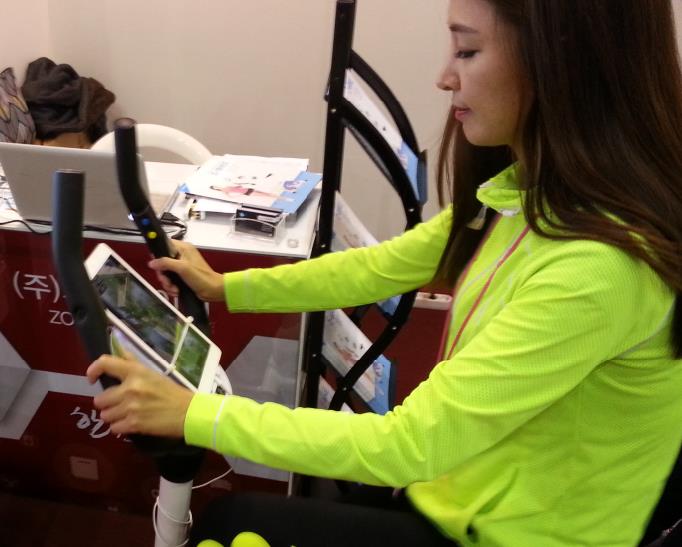
If you're tired of the tedious indoor cycling routine, there's the Z-BIKE. Developed by Geo IT, the Z-BIKE connects to smart devices and features a proprietary app and 10 cycling programs for a fun workout. Unlike traditional indoor bikes, the Z-BIKE features a gyro sensor and handlebar controls, allowing you to adjust direction. Pedal load adjustments are also automatically applied based on the content mode, eliminating the need to manually adjust intensity. Plans to expand content through IPTV integration in the future ensure it appeals to everyone from children to the elderly, even those who find exercise tiresome.
'Whitmeter' improves data reliability through clinical validation.
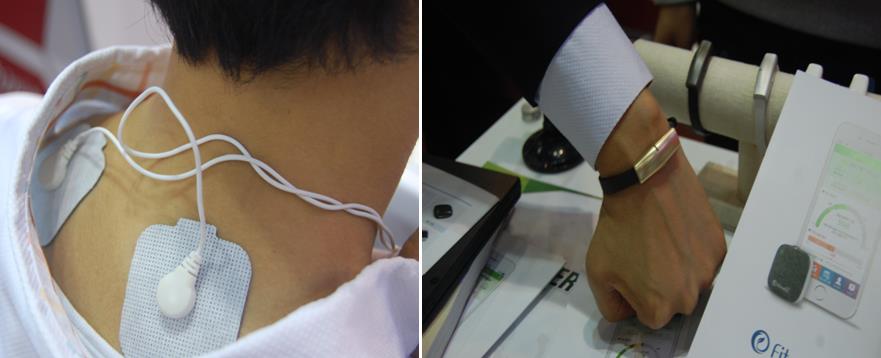
Fit.Life's "Fitmeter," a fitness device, is compact enough to fit comfortably in the palm of your hand and weighs only 13.7g. It can be carried in a pocket or worn as an armband, allowing users to track their exercise levels via a mobile app. According to a company representative, "Unlike other wearable devices, we've clinically verified the data to enhance its reliability." The "Fitmeter" analyzes activity calories burned, continuous exercise, and activity intensity, and its unique feature is its ability to measure exercise intensity using a 3-axis acceleration sensor.
The video below is a self-developed program that demonstrates intensity measurement. You can see the intensity being measured and the points increasing accordingly. A wearable device on display in the center of the booth caught the eye, and when the reporter asked about it, a representative said, "We plan to release a wearable device by the end of this year and launch it at the Consumer Electronics Show (CES) in Las Vegas."
A mobile low-frequency therapy device was also introduced. While not a specialized device, "Dr. Music," a medical device, analyzes music waveforms to generate low-frequency sounds. It can be connected to smart devices, radios, and game players to create low-frequency sounds from music, movies, and game sound effects. The device's simple design and compact size make it easy to carry and use anywhere. Conventional low-frequency therapy can limit movement and develop resistance to a single low-frequency rhythm, but this device addresses this resistance with a variety of music waveforms. This device also won the Gold Award at the 2014 Geneva International Exhibition of Inventions.
The u-health market is in full swing under government leadership.
In the professional medical device sector, Healcerion (HC) unveiled a wireless compact ultrasound device. Most compact ultrasound devices released by foreign companies rely on wired connections. In contrast, HC's product features a dedicated communication network. It wirelessly links ultrasound images to a proprietary app, allowing data analysis, capture, and transmission. This makes it useful in emergencies and during house calls. A company representative stated that in the future, dedicated ultrasound devices for use on fetuses and companion dogs with small internal organs will also be released.
Although its penetration rate is low in Korea, the "electronic stethoscope," which is expected to lead the future u-health market, is on display. The "Yabes Stethoscope," manufactured using domestic technology, has established an industrial base, primarily overseas. Kim Jong-su, CEO of GS Technology, said , " Currently, 130,000 people use telemedicine in the US, and the global telemedicine market is worth over 570 trillion won ." “Currently, the Yabes stethoscope can only be connected via cable , but we plan to make it Bluetooth-based and mobile-compatible around December ,” he said, expressing his expectations, saying, “Although the technology for electronic stethoscopes was introduced 10 years ago, it seems that the limitations of remote treatment can be overcome with the development of IoT by linking medical data with smart devices.”
Current medical law allows for D2D (Doctor-to-Doctor) communication, but not D2P (Doctor-to-Patient). Even in the United States, the largest telemedicine market, its application is limited to pediatrics and psychiatry. However, the use of electronic stethoscopes, which allow users to send their own data to doctors, is expected to expand its reach to internal medicine. Recognizing this potential, the "Yabes Stethoscope" has been supplied to five government ministries since May of this year.
on Vimeo .
Comments
Related news

Maxim Integrated Unveils Next-Generation Healthcare Wearable Technology
2014.12.04by 명세환 기자
Discovered wearable display technology worn like clothes
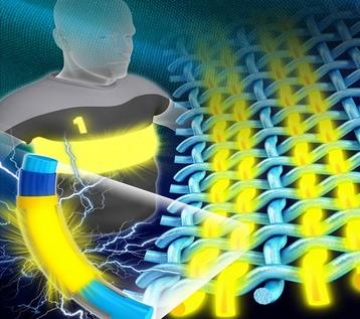
This technology is a foundational technology that enables fabrication of organic light-emitting displays directly on fibers themselves. The achievement was recognized and published in the online edition dated July 14 of 'Advanced Electronic Materials,' an international academic journal in the field of nanoelectronics. Conventional wearable displays have been attached on top of clothing to realize aesthetic design, but this approach has limitations in that they are rigid and inflexible, making real-world application difficult, and it is challenging to maintain the inherent characteristics of textiles.
2015.08.05by 명세환 기자

ESP32 Development Environment Selection and GPS Application Implementation
The ESP32 is a microcontroller that integrates Wi-Fi, Bluetooth, 12-bit ADC, capacitive touch, PWM, DAC, and UART in a single SoC. However, the abundance of features does not by itself solve the designer's problems. The real challenges lie in selecting the appropriate development environment, determining which pins can be used and which must be avoided, and converting raw data from modules into usable information. This document addresses ESP32 peripheral constraints (ADC2 and Wi-Fi coexistence limitation, UART1 occupancy, ADC non-linear regions), the trade-offs between Arduino IDE and ESP-IDF, and the process from connecting NEO-6M/NEO-M8N GPS modules to UART2, parsing NMEA sentences, and visualizing routes in Google Earth, all organized based on documented references.
2026.10.12by 편집부

MIPI CSI-2, DSI-2, C-PHY, D-PHY Test Solution Technical White Paper
The MIPI interface adopts a burst mode that transitions between low-power (LP) and high-speed (HS) states for low-power consumption, and in return, strict timing rules are imposed on state transitions. Additionally, the high-speed section operates as a packet-based protocol with headers, ECC, and CRC, so verification engineers must handle waveforms and protocols simultaneously. Traditional configurations combining general-purpose oscilloscopes and AWGs reveal limitations in setup complexity, measurement uncertainty, and lack of reproducibility when faced with these requirements. This white paper, based on webinar materials, organizes the structure of this problem and describes how the SV5C-DPTXCPTX generator for receiver testing and SV5C-DPRXCPRX analyzer for transmitter testing integrate state transition testing, stressed eye testing, and protocol analysis into a single bench, along with their application boundaries.
2026.10.12by 편집부











