



Focusing investment on the robot industry: 'Safety Robots, Care Robots, and IoRT'
 Published2015.11.03 13:55
With the advent of IoT and the revolutionary development of artificial intelligence, interest in robots is expanding across the board.
At the RoboWorld seminar held at KINTEX on the 28th, PD Park Hyun-seop (KEIT) stated, “According to IFR source ‘2013’, there are approximately 400 types of robots under development and commercialization, and the global robot market size is $14.8 million in total,” adding, “Of this, manufacturing robots account for $9.7 million, or about 64%, followed by professional services at 24% and personal services at 12%.”
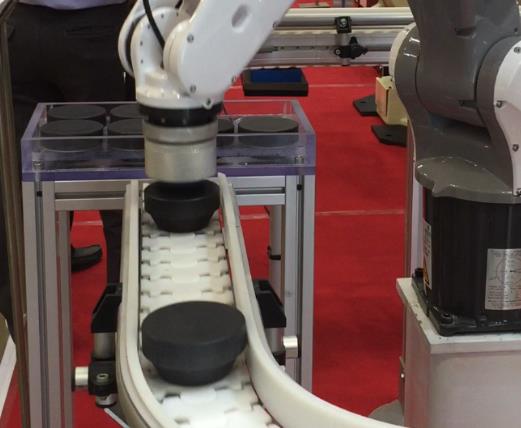 Robots equipped with weak AI accelerate commercialization
PD Park Hyun-seop, who gave a presentation at the 'Intelligent Robot' outlook seminar of the Future Growth Engine Open Talk Relay, introduced the current status of initiatives and major policies in the robotics sector.
Intelligent robots are a general term for machines that perceive the external environment, assess the situation on their own, and operate autonomously. It encompasses manufacturing, education, medical, and defense sectors, with a focus on disaster response and healthcare that reflect megatrends such as population aging and increasing demand for safety.
However, robots equipped with specialized AI are currently being commercialized. Common technologies for these robots include intelligence, components, and platforms, while product categories include manufacturing, personal services (such as life support and education), and professional services (such as agriculture, livestock, fisheries, construction, transportation, and maritime affairs), medical services, and national defense and security.
The robot market, which began with the emergence of surgical robots in the 1990s, became popularized with the release of cleaning robots, and the concept of robots expanded with the introduction of rehabilitation robots in the early 2000s and autonomous vehicle systems in 2010. In 2015, through the DARPA Challenge, numerous rescue robots and fast running robots modeled after the quadrupedal locomotion of animals are being developed one after another.
The U.S. attempts to bring manufacturing back to the U.S. with robots, while Japan decides to double its manufacturing robot technology.
Accordingly, governments around the world are accelerating business expansion through policies. Europe, which has currently prepared an investment of approximately 3 to 5 trillion won, has a vision to form an ecosystem through R&D of manufacturing robots and, based on this, expand its influence across various industrial sectors.
The United States recognizes the importance of job creation due to income polarization and the decline of the middle class caused by the IT and financial sectors. As labor costs in Southeast Asian countries rise, the plan is to utilize robotic technology to bring manufacturing back to the country. The Obama administration announced that it would make an annual investment of 50 billion dollars.
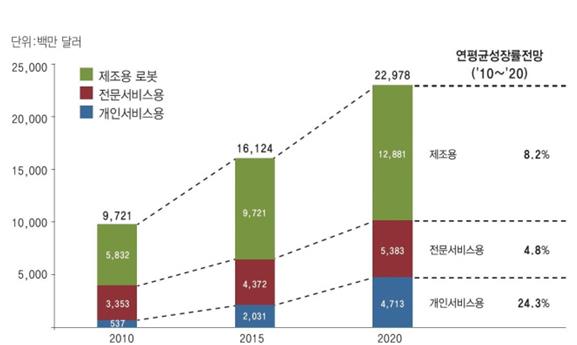
▷ Global Robot Market Outlook (2020) (Unit: Million USD)
Source: IFR. Currently, manufacturing robots account for more than 50%, but the proportion of professional and personal services is also expected to increase by 2020.
Japan, a leader in robot technology, has decided to double its manufacturing robot technology by 2020 and has announced its ambition to host a 'Robot Olympics' to succeed the U.S. DARPA Robotics Challenge (DRC). In addition, robot technology is being invested in R&D for medical assistive devices such as mobility aids, bathing assistance, and movement assistance, as well as in the construction of bridges, tunnels, rivers, and dams to build infrastructure.
In China, interest in robots is on the rise as production costs in China and the United States have become equal starting this year due to rising labor costs resulting from economic development.
Google is the world's top robot company, and IT companies are rushing to invest in robots.
In particular, Producer Park Hyun-seop emphasized that "giant IT companies investing in robotics firms should be viewed as a kind of signal." Amazon is already utilizing robotic technology for its logistics systems, and Google has become the world's leading robotics company through the acquisition of eight robotics firms. Apple is accelerating the development of robot technology by investing in e-factories in China, and SoftBank, which announced 'Pepper', targeted the market with a price in the 2 million won range.
This phenomenon stems from the four recent hot topics: IoT, Industry 4.0, drones, and autonomous vehicles. Producer Park stated, “In the IoT market, robots will become a gateway, and the quality of the robots themselves will improve through the use of inexpensive hardware.” He also predicted that drones, which can be described as "Everywhere," will first evolve into agriculture, aviation, surveillance, and research based on a 1 trillion won market, while "delivery" will be the last to be commercialized. This is because the risks associated with flying in urban areas must be considered.
Domestic investment in the robot industry is centered on national and social issues, technological development, and robot intelligence.
The government's 2016 R&D investment direction is broadly divided into three categories: national and social issues, technological development, and robot intelligence. Regarding national and social issues, the core objective is to realize a safe society capable of countering the increasing scale of natural and man-made disasters through the development of safety robots. In addition, with the entry into an aging society, nursing and care robots are emerging, and we plan to invest in manufacturing robots to strengthen the manufacturing sector.
In terms of technological development, software platforms (IoRT) that enable deep learning and innovate robot prices and robot intelligence through IoT, cloud, and big data are targets for investment.
Finally, investments in robot intelligence will focus on key components for standardization, advocating the vision of Co-Robot (human-robot coexistence).
Areas to watch in the future include muscle augmentation and dual-arm robots for manufacturing robots, while investments are expected in specialized robotic technologies for the construction, transportation, and marine sectors, such as wind power management and gas pipeline inspection. In the medical field, where applications are expected to be most widespread, there are bone surgery robots and lower limb rehabilitation robots, and in the intelligence sector, outdoor driving and recognition technologies for autonomous vehicles have been included.
Comments
Related news
The second most dreamed-of technology for engineers as children was robots, so what was number one?
A total of 118 engineers who participated in the survey responded to questions about which technologies they had imagined in their childhood that have actually been implemented, as well as which technologies are expected to be commercialized fastest or what factors present obstacles to commercialization.
2015.08.18by 명세환 기자
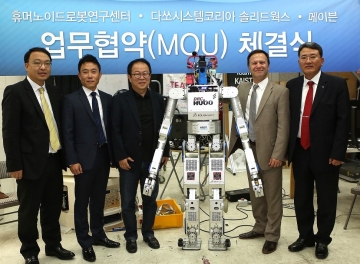
KAIST accelerates development of humanoid robots.
On the morning of the 7th, Dassault Systèmes announced at the Humanoid Robot Research Center at KAIST in Daejeon that it will provide technical support necessary for future robot development. KAIST received a donation of SOLIDWORKS, its 3D design solution. "Through SOLIDWORKS, we are able to check the design process in 3D in real time, and we aim to develop high-performance humanoid robots," it stated.
2015.10.08by 명세환 기자
Nvidia invests $5 billion in Intel
NVIDIA and Intel, leaders in global AI computing technology, are now forging ahead in providing cutting-edge solutions through NVLink-based architecture integration. NVIDIA and Intel have officially announced a strategic partnership and stated that they will jointly develop customized data center and personal computing products to accelerate diverse applications and workloads ranging from hyperscale to enterprise and consumer markets, thereby laying the foundation for the next generation computing era.
2025.09.22by 배종인 기자
.jpg)
Applied Materials Launches Environmental Protection Campaign to Mark World Cleanup Day
Applied Materials Korea (CEO Park Kwang-seon) is carrying out environmental cleanup activities with employees and their families around the Dongtan Sinricheon area on the occasion of World Cleanup Day, evolving into a company that engages with the local community beyond technological innovation.
2025.09.22by 명세환 기자











