


Silicon Labs Launches Thread-Upgradable Home Solution
 Published2015.11.17 19:21
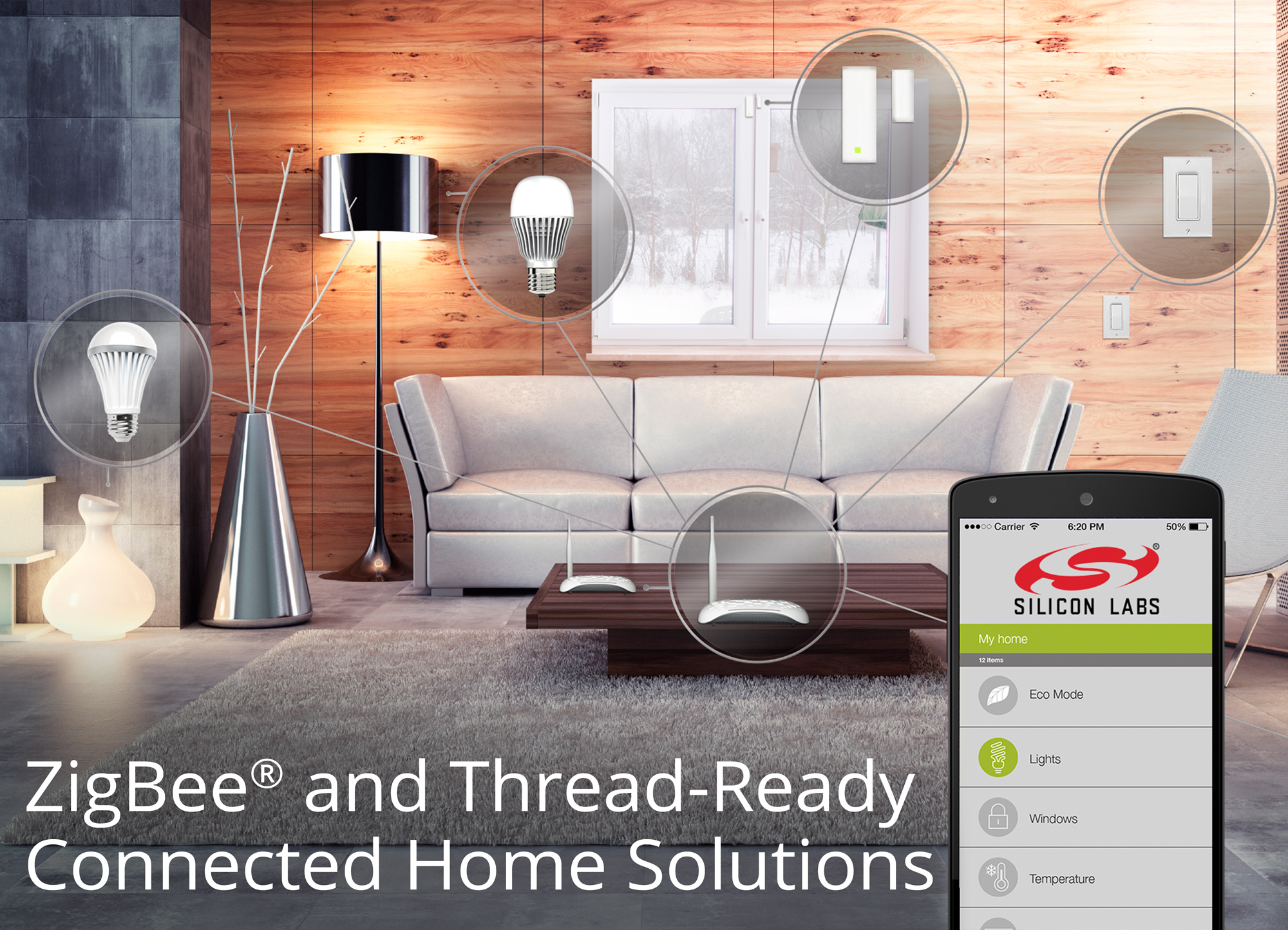
Silicon Labs announced a reference design that accelerates development timelines by streamlining the product development process for ZigBee®-based home automation, connected lighting, and smart gateways.
Silicon Labs’ IoT solution , the first product in the turnkey series, includes hardware, firmware, and software tools necessary for developers to create a variety of functionally connected home products with interoperability and scalability, based on Silicon Labs’ ZigBee “Golden Unit” home automation (HA 1.2) software stack and ZigBee system-on-chip (SoC) mesh networking technology.
Silicon Labs has designed a cost-effective reference design that reduces complexity by connecting Zigbee devices, such as lighting, dimmer switches, and door/window contact sensors, to connected home networks. This simple design means that consumers who regularly purchase “DIY” connected home products from U.S. home building materials and interior retailers like Home Depot and Lowes can use it very easily.
Silicon Labs' Zigbee connected lighting reference design provides not only a wireless lighting board but also a plug-in demo board suitable for rapid demonstration and testing. Through the Golden Unit Zigbee stack, LED lights can reliably connect, interoperate, and disconnect from mesh networks, as well as possess scalability allowing anywhere from a few to hundreds of light nodes to be connected to the same network. Connected lights support dimming, as well as white, color temperature, and RGB color adjustment.
Silicon Labs' Zigbee-based home automation reference design includes a capacitive touch dimmable light switch and small form factor door and window contact sensors. The light switch provides color, tone adjustment, and dimming control functions, which conventional switches cannot perform. Unlike conventional switches, these wireless, battery-powered switches can be easily installed anywhere in the home without moving components.
User gesture detection implemented using Silicon Labs' EFM8 capacitive sensing MCU
The switch design was implemented using Silicon Labs' EFM8 capacitive sensing MCU, which can detect different user gestures (touch, hold, swipe). The contact sensor reference design provides all the tools necessary to implement a wireless, battery-powered sensor that monitors the status (open or closed) of doors and windows, which is useful for automatically controlling lighting.
Silicon Labs provides developers with two Zigbee gateway options to complete a reference design. The first is a plug-and-play USB virtual gateway that runs on all PC development platforms in Windows, OS X, and Linux environments, and the second option is a 'ready-to-use' Wi-Fi and Ethernet gateway reference design based on an embedded Linux computer system.
With two gateway options, developers can control and monitor Zigbee HA 1.2 compliant end nodes via Wi-Fi from devices running a web browser, such as smartphones or tablets. Using an intuitive web-based user interface, developers can easily set up rules between Zigbee devices, including lights, dimmer light switches, and contact sensors.
Comments
Related news
Intel Unveils Next-Generation 'Core Ultra Series 3' and vPro Platform for Enterprise PCs
Intel has officially unveiled the "Intel Core Ultra Series 3" for next-generation enterprise PCs and the latest vPro platform, addressing a wide range of demands from enterprise notebooks to high-performance workstations.
2026.03.26by 배종인 기자
ROHM Launches ESD Protection Diode Compatible with High-Speed Interfaces of 10Gbps or Higher
Semiconductor specialist ROHM has developed the 'RESDxVx series' of ESD (electrostatic discharge) protection diodes capable of responding to next-generation high-speed data communication environments exceeding 10Gbps, simultaneously enhancing both signal quality maintenance required in high-speed interfaces and IC protection performance.
2026.03.26by 배종인 기자
ST Launches 75V Drive IC Targeting 48V Industrial Motor Driving
ST Microelectronics has unveiled the 'STSPIN9P' series of 75V motor drive ICs tailored for 48V-class industrial drive system design. The new product family is characterized by half-bridge and full-bridge configurations that enable design scalability according to motor type and output conditions. Power supply circuits, protection functions, and current sensing circuits are integrated on-chip to simplify system configuration, and the devices are designed to support applications up to 500W maximum. The company plans to provide reference designs and demo boards to support development and evaluation in industrial automation, robotics, pumps, fans, lighting, and textile machinery.
2026.03.26by 배종인 기자

Nordic supports security updates for the entire lifecycle of IoT devices at a single fixed cost
Nordic Semiconductor, a global leader in low-power wireless connectivity solutions, has unveiled a single fixed-cost licensing model that delivers FOTA (Firmware Over-the-Air) and device management capabilities throughout the device lifecycle via nRF Cloud, and introduced a new firmware update solution to prepare for the enforcement of the European Union's Cyber Resilience Act (CRA).
2026.03.26by 배종인 기자

Practical Training in Low-Noise, Low-Power Circuit Design All in One Place… Training Fee Support
The "2026 Advanced Engineer Practical Masterclass" to strengthen competencies in high-sensitivity analog circuit and sensor-based system design will be held on April 16 at the e4ds Conference Center in Gasan-dong, Seoul. This program will be conducted as an offline paid hands-on training session, not online, and is targeted at engineers seeking on-site intensive learning. Texas Instruments will provide educational support for this training, allowing participation at 150,000 won, a 100,000 won discount from the original price of 250,000 won.
2026.03.26by 배종인 기자











