


ams' Boost NFC adopted in STM32
 Published2015.11.29 23:34
ams, a specialist in high-performance sensors and analog ICs, announced that STMicroelectronics has adopted ams's proven BoostedNFC technology for integrated system development boards in the entry-level STM32 family of microcontrollers.
Boost NFC technology supports the implementation of reliable NFC coupling in space-constrained devices. The new NFC expansion board announced by ST connects to Nucleo STM32 mainboards and presents an integrated design blueprint for realizing NFC functionality in applications such as IoT nodes performing NFC functions in configuration environments and networks, as well as in wearable devices that require secure data transmission for contactless payment, ticketing, or access control functions.
This expansion board comes with an integrated NFC firmware set supported by ST’s extensive family of ARM® Cortex®-M-based STM32 microcontrollers. The NFC board complements other expansion boards that implement fingerprint recognition, Bluetooth connectivity, M2M communication, and displays, enabling rapid prototyping for end products featuring integrated NFC.
ST's NFC expansion board is based on ams's AS39230 boosted NFC analog front-end and ST's own ST54E system package (integrating the ST21NFCC controller and ST33G1M2 secure element). Depending on application requirements, this board can be connected with various antenna sizes, ranging from a reader/writer function supporting 400mm² to a miniature SMD antenna for card emulation only.
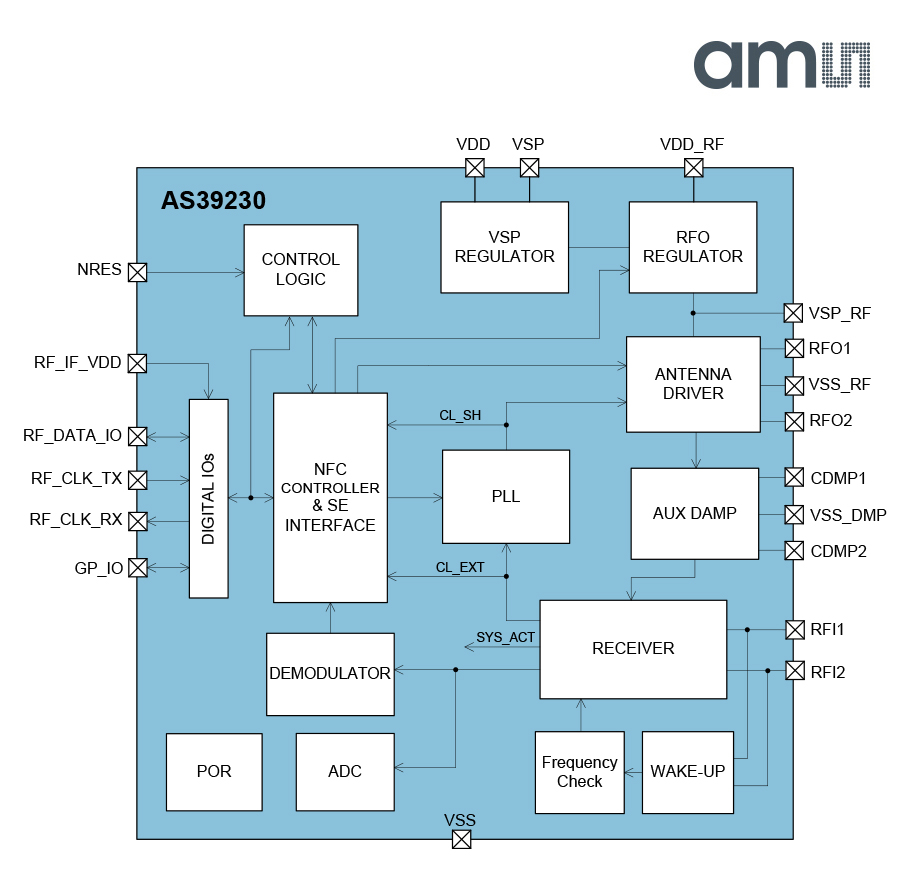
The circuitry implemented on the new board delivers excellent NFC performance under conditions where RF signals are rejected, such as when operating near or inside metal surfaces or when transmitting through very small antennas. For example, designers of IoT nodes and wearable devices must finish devices with metal finishes or accommodate small external closures inside antennas. The new expansion board provides designers with a pre-built NFC implementation design that enables fast and reliable coupling with all standard NFC readers, such as smartphones, contactless payment terminals, transmission system entry barriers, and access control card readers.
The design implemented as an expansion board is also suitable for use in applications requiring global certification, including the Common Criteria (CC), EMVCo, GlobalPlatform, Visa, Mastercard, Amex, and the People's Bank of China (PBoC). Through this, OEMs using STM32 MCUs can easily realize new designs for wearable devices, such as wrists or smartwatches, to perform access control functions, such as making product payments with contactless payment terminals, emulating smart cards like subway ticket cards, or entering hotel rooms without a key.
Active load modulation technique has a 10 times wider operating range compared to passive load modulation technique
The excellent RF performance of the NFC expansion board is made possible by the active load modulation technique that boosts NFC signals implemented in the AS39230. This method has a 10 times wider operating range compared to the passive load modulation technique used in smart cards. At the same time, because the AS39230-based system consumes a low average current of 15µA in listening mode, it consumes significantly less power from the battery compared to existing NFC solutions.
Laurent Degauque , Marketing Director of STMicroelectronics’ Security Microcontrollers business unit, said, “The RF performance of the security-enhanced NFC expansion board is excellent, and it is very easy for STM32 MCU users to implement because the number of components included on the board is very small. Since ST’s integrated firmware set is supported for NFC applications, this board offers the fastest and most reliable way to implement successful new NFC designs.”
“Other NFC development systems cannot achieve reliable, perfect operation with antennas as small as 100 mm² , or the metal casing of the finished product itself cannot be used as an antenna. The AS39230, mounted on the NFC expansion board, enables reliable operation even with a small antenna and supports the metal casing of the finished product itself to function as an antenna.” "Because antennas have many constraints on space or performance, these characteristics are the best selection criteria for product designers when choosing products in the market," he said.

Comments
Related news
ams Launches Next-Generation NFC Interface Tag IC
2015.05.21by 명세환 기자

What is ams' IC used in a small wearable scanner?
ams announced that Technology Solutions Limited (TSL), a British company, has integrated ams's highly integrated, low-power reader IC (product name: AS3993) into its new wearable-type RFID scanner product 1153. Technology Solutions stated, "The requirements for efficient read performance with very low power consumption were a clear justification for our adoption of ams's AS3993."
2015.10.07by 명세환 기자

ams acquires image sensor company CMOSIS
ams, a specialist in high-performance analog ICs and sensors, announced that it has concluded an agreement to acquire 100% of the shares of CMOSIS, a specialist in advanced area and line-scan CMOS image sensors for high-performance imaging applications, in an all-cash transaction.
2015.11.24by 명세환 기자

Intel Unveils Next-Generation 'Core Ultra Series 3' and vPro Platform for Enterprise PCs
Intel has officially unveiled the "Intel Core Ultra Series 3" for next-generation enterprise PCs and the latest vPro platform, addressing a wide range of demands from enterprise notebooks to high-performance workstations.
2026.03.26by 배종인 기자

ROHM Launches ESD Protection Diode Compatible with High-Speed Interfaces of 10Gbps or Higher
Semiconductor specialist ROHM has developed the 'RESDxVx series' of ESD (electrostatic discharge) protection diodes capable of responding to next-generation high-speed data communication environments exceeding 10Gbps, simultaneously enhancing both signal quality maintenance required in high-speed interfaces and IC protection performance.
2026.03.26by 배종인 기자











