


Silicon Labs Unveils Heart Rate Monitoring Optical Sensor Solution
 Published2016.01.07 11:30
Reduces the cost and complexity of wrist-based heart rate measurement
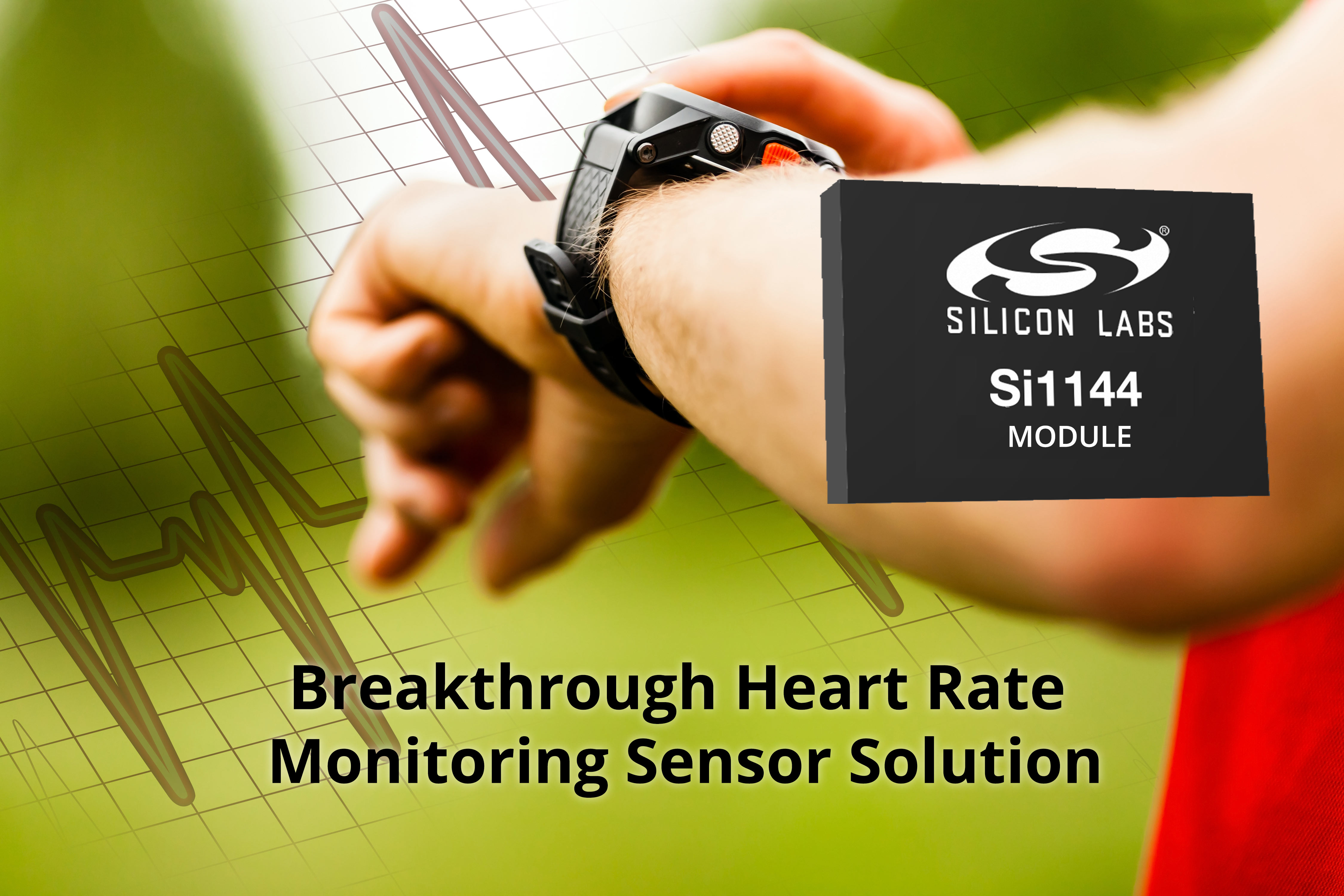
Silicon Labs announced the release of an optical HRM sensor solution designed to reduce cost and complexity in wrist-based heart rate monitoring (HRM) applications. Silicon Labs stated that the solution includes a low-power optical sensor module and an energy-friendly EFM32™ Gecko microcontroller (MCU) running advanced HRM algorithms. The small-footprint Si1144 sensor module features an optical sensor, a green light-emitting diode (LED), an LED driver for up to two external LEDs, an analog-to-digital converter (AD converter), control logic, and an I2C digital interface.
According to market forecasts by Silicon Labs, 100 million HRM-enabled devices will be sold by 2018, and most of these will be wrist-measuring wearables. Silicon Labs' Si1144 HRM solution targets the rapidly growing market for a wide range of wearable devices, including activity tracking fitness bands, pedometers, and smartwatches, as well as application markets where HRM functionality is added to fitness center equipment, bathroom scales, and activity monitoring devices for the elderly.
Heart rate monitoring is one of the most popular biometric sensing technologies available to everyone, from passionate athlete-level users seeking to improve their exercise records to the general public pursuing a healthier and more active lifestyle. Accurate HRM enables precise calorie calculations, making it easier to manage your diet for weight management.
In traditional methods, heart rate measurement has been limited to using chest straps connected to external devices, such as specialized fitness watches or smartphones. These types of HRM solutions have drawbacks, including being cumbersome and uncomfortable to wear, and the difficulty of monitoring via smartphone while running or cycling.
Wrist-based HRM technology has transformed biometric monitoring methods by providing a more convenient and comfortable way to measure heart rate with precision comparable to chest-strap-based products. Amidst many HRM solutions, measurement results vary significantly depending on the specific unit, and not only are they expensive, but they also consume a lot of power, shortening battery life. In addition, complex noise effects caused by movement are a major headache in the design of wrist-measuring HRMs.
Daniel Cooley, Vice President of the IoT Products Business Unit at Silicon Labs, said, “An additional benefit of Silicon Labs’ HRM solution is its industry-leading power consumption and very small footprint, making the Si1144 module an excellent choice for power-sensitive and space-constrained wearable devices.”
Comments
Related news
Silicon Labs Launches Controller to Shorten Development Time for Capacitive Sensing Applications
Silicon Labs announced the launch of TouchXpress™, a family of fixed-function controller products that provides the fastest and easiest method for adding low-power capacitive touch interfaces to embedded designs. Silicon Labs' robust CPT007B and CPT112S TouchXpress controllers require no time-consuming firmware development process, and offer a simple turn-key solution that enables the addition of elegantly designed touch-based user interfaces to a wide range of products including home appliances, white goods, consumer electronics, lighting controls, medical equipment, and measurement/control panels.
2015.12.10by 명세환 기자

ESP32 Development Environment Selection and GPS Application Implementation
The ESP32 is a microcontroller that integrates Wi-Fi, Bluetooth, 12-bit ADC, capacitive touch, PWM, DAC, and UART in a single SoC. However, the abundance of features does not by itself solve the designer's problems. The real challenges lie in selecting the appropriate development environment, determining which pins can be used and which must be avoided, and converting raw data from modules into usable information. This document addresses ESP32 peripheral constraints (ADC2 and Wi-Fi coexistence limitation, UART1 occupancy, ADC non-linear regions), the trade-offs between Arduino IDE and ESP-IDF, and the process from connecting NEO-6M/NEO-M8N GPS modules to UART2, parsing NMEA sentences, and visualizing routes in Google Earth, all organized based on documented references.
2026.10.12by 편집부
MIPI CSI-2, DSI-2, C-PHY, D-PHY Test Solution Technical White Paper
The MIPI interface adopts a burst mode that transitions between low-power (LP) and high-speed (HS) states for low-power consumption, and in return, strict timing rules are imposed on state transitions. Additionally, the high-speed section operates as a packet-based protocol with headers, ECC, and CRC, so verification engineers must handle waveforms and protocols simultaneously. Traditional configurations combining general-purpose oscilloscopes and AWGs reveal limitations in setup complexity, measurement uncertainty, and lack of reproducibility when faced with these requirements. This white paper, based on webinar materials, organizes the structure of this problem and describes how the SV5C-DPTXCPTX generator for receiver testing and SV5C-DPRXCPRX analyzer for transmitter testing integrate state transition testing, stressed eye testing, and protocol analysis into a single bench, along with their application boundaries.
2026.10.12by 편집부

NVIDIA to Invest $1 Billion in U.S. Science Over Next Five Years
NVIDIA has announced plans to invest $1 billion over the next five years to strengthen U.S. scientific and technological competitiveness. The company will enhance cutting-edge artificial intelligence research and development capabilities in key areas including quantum computing, healthcare, and energy security, while expanding support for higher education research institutions and cloud service providers. NVIDIA is participating as a major industry partner in the White House Office of Science and Technology Policy's Genesis Mission, and is promoting supercomputer construction in collaboration with national laboratories including Argonne and Los Alamos.
2026.10.12by 배종인 기자

Advanced Capacitive Sensing Technology for Moisture-Resistant Touch and Digital Level Sensing
Capacitive sensing is replacing mechanical buttons and contact-type water level sensors by virtue of its non-contact and movable-part-free characteristics. However, water and frequently changing ground conditions directly disturb its measurement principle. Based on Microchip webinar materials, this white paper describes the principles, configuration, and performance basis of Digital Level Sensing (DLS), which reports water level regardless of ground conditions, and Impulse Touch Sensing (ITS), which eliminates the effect of water at the moment of signal acquisition. Furthermore, it specifies application boundaries that designers should be aware of, including recommended mechanical stack-up below 5mm, inapplicability to metal containers, and the necessity of validation for media other than water.
2026.10.12by 편집부











