



Maxim Announces Power Management Chip for IoT and Wearables
 Published2016.01.07 11:37
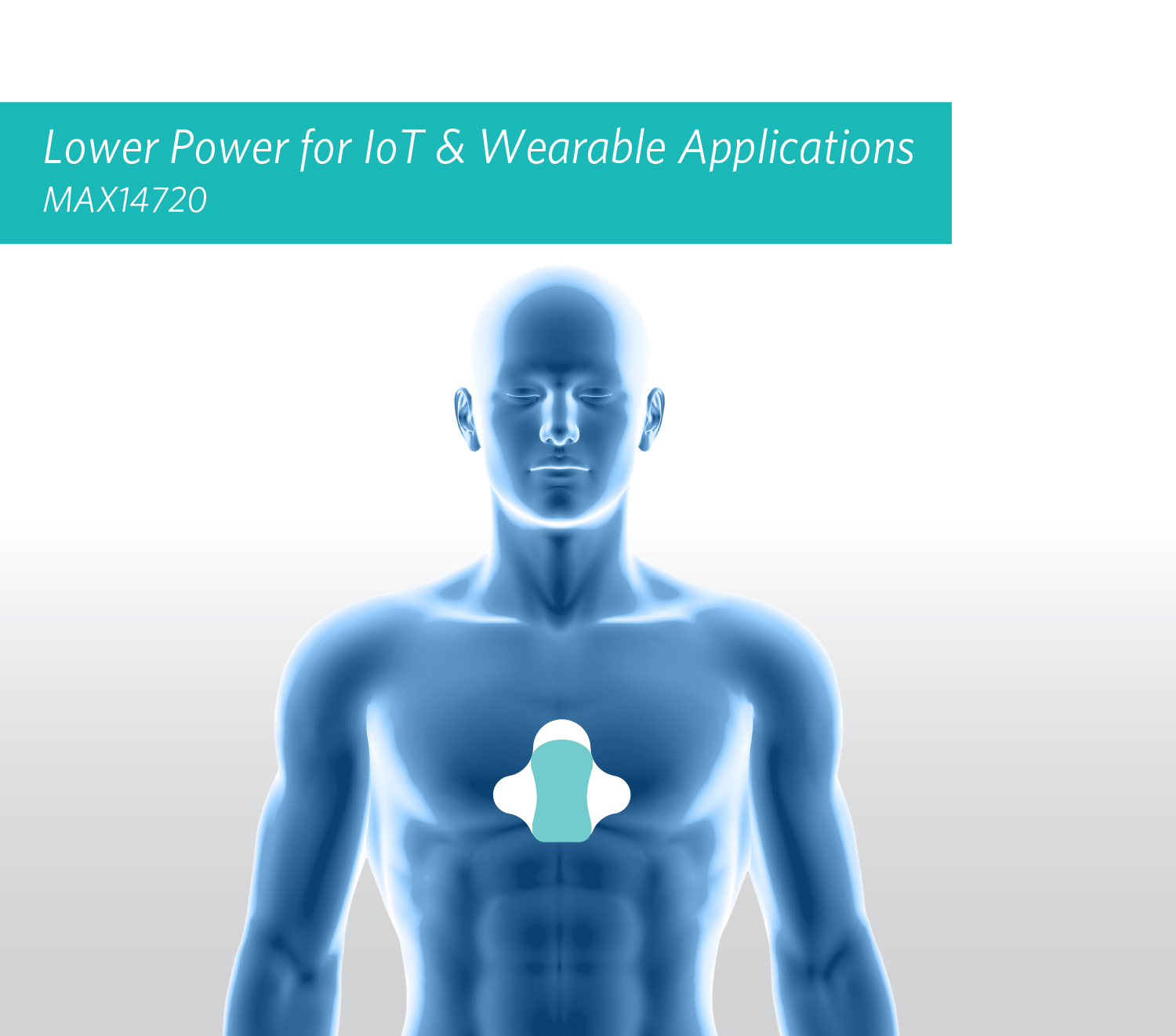 Maxim Integrated announced the 'MAX14720', a power management chip (PMIC) that optimizes power and battery life in the fields of medical and fitness wearables and the Internet of Things (IoT).
Improving battery life and achieving low power consumption are key considerations in the development of wearable and IoT products. The MAX14720 is a power management chip optimized for non-rechargeable batteries, such as coin and alkaline batteries, where size and energy efficiency are critical.
The electronic battery seal extends battery life by effectively disconnecting the battery connection before initial power supply. The MAX14720 reduces the number of components and enables a much smaller form factor design by integrating the functionality of five devices: a power switch, a linear regulator, a buck regulator, a buck-boost regulator, and monitoring.
While most battery power management chips operate at 3 volts (V), the MAX14720 operates at a low voltage of 1.8V and works with primary batteries. Maxim's proprietary low standby current technology significantly extends the runtime of wearable systems. The electronic battery seal extends storage life and enables a fully sealed housing. The MAX14720 reduces component costs and space with high-value features such as push-button input monitoring, power-up sequencing, and voltage rail monitoring.
"Maxim Senior Business Manager Frank Dowling said, 'Maxim has established a strong position in the rechargeable wearable market and is effectively leveraging the expertise and proprietary technology gained in rechargeable wearables in the non-rechargeable wearable market as well.'"
Angela McIntyre, Research Director, and Michael Reitz, Senior Research Analyst at market research firm Gartner, stated, “The wearable fitness and health market is projected to reach $14.4 billion in 2020 with the sale of approximately 190 million devices,” adding, “System design for wearables will become more simplified by utilizing display drivers, optoelectronics, USB charging interfaces, small NOR memory, and power management chips, along with basic microcontroller (MCU)-based processing, Bluetooth and Wi-Fi communication, accelerometers, and gyroscopes.”
The MAX14720 is available in a 25-bump, 0.4mm pitch, 2.26mm x 2.14mm wafer-level package (WLP) and operates in a range of -40°C to +85°C.
Comments
Related news
.jpg)

Maxim Integrated Leads the Sports Wearable SoC Market
Maxim Integrated Products Korea (Representative Kim Hyun-sik) announced its participation in the 'International System-on-Chip Design Conference (ISOCC) 2015' to be held in Gyeongju, Gyeongbuk from November 2nd to 5th. The ISOCC 2015 event is co-sponsored by the Circuits and Systems Society (IEEE-CAS) of the Institute of Electrical and Electronics Engineers.
2015.11.02by 신윤오 기자
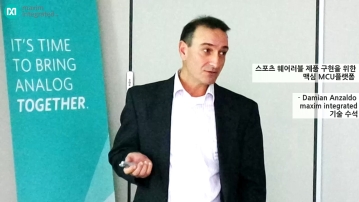
Why should engineers choose the Maxim Wellness Platform? It offers design flexibility, low power, and robust security for sports wearables!
Maxim's 'Wellness Platform' consists of hardware and software that enables healthcare technology to be flexibly applied to wearable applications through solutions, thereby optimizing the characteristics of wearable products. The solutions included in the Wellness Platform provide industry-leading technology in power and battery management, digital processing, high-density integrated sensors, and ultra-low-power communication, while emphasizing robust security features as key advantages.
2015.12.24by 명세환 기자
ESP32 Development Environment Selection and GPS Application Implementation
The ESP32 is a microcontroller that integrates Wi-Fi, Bluetooth, 12-bit ADC, capacitive touch, PWM, DAC, and UART in a single SoC. However, the abundance of features does not by itself solve the designer's problems. The real challenges lie in selecting the appropriate development environment, determining which pins can be used and which must be avoided, and converting raw data from modules into usable information. This document addresses ESP32 peripheral constraints (ADC2 and Wi-Fi coexistence limitation, UART1 occupancy, ADC non-linear regions), the trade-offs between Arduino IDE and ESP-IDF, and the process from connecting NEO-6M/NEO-M8N GPS modules to UART2, parsing NMEA sentences, and visualizing routes in Google Earth, all organized based on documented references.
2026.10.12by 편집부
MIPI CSI-2, DSI-2, C-PHY, D-PHY Test Solution Technical White Paper
The MIPI interface adopts a burst mode that transitions between low-power (LP) and high-speed (HS) states for low-power consumption, and in return, strict timing rules are imposed on state transitions. Additionally, the high-speed section operates as a packet-based protocol with headers, ECC, and CRC, so verification engineers must handle waveforms and protocols simultaneously. Traditional configurations combining general-purpose oscilloscopes and AWGs reveal limitations in setup complexity, measurement uncertainty, and lack of reproducibility when faced with these requirements. This white paper, based on webinar materials, organizes the structure of this problem and describes how the SV5C-DPTXCPTX generator for receiver testing and SV5C-DPRXCPRX analyzer for transmitter testing integrate state transition testing, stressed eye testing, and protocol analysis into a single bench, along with their application boundaries.
2026.10.12by 편집부











