


What are the 3 challenges 3D printing must overcome to become a high-value-added industry, not an illusion?
 Published2016.01.12 11:03
Since 2012, 3D printing has garnered attention as a major industry poised to lead the Third Industrial Revolution. The expectation was that DIY production and consumption methods utilizing 3D printing would replace mass production. However, the reality of high profits has yet to materialize. While traditional hearing aids and dental products were once prominent, the industry is currently only making its mark in the 3D CAD education market and in the production of figures and accessories. Furthermore, there are concerns being raised that despite major Korean conglomerates recognizing this promising technology early on and possessing 3D printers, the reality is that they have failed to produce any tangible results.
In fact, the limitations of 3D printing productivity have been consistently pointed out not only in Korea but also overseas. Terry Gou, Chairman of Foxconn, who has made various attempts since the early days of 3D printing technology, even argued that "3D printing is a gimmick."
With opinions still divided on the extent to which 3D printing technology can be applied, what challenges must be overcome for 3D printing to advance toward the Third Industrial Revolution? Accordingly, LG Economic Research Institute published a report on prerequisites for the widespread adoption of 3D printing.
The report stated that 3D printing is likely to be used in a limited way for the production of personalized products or products with complex designs, rather than leading the third industrial revolution and completely replacing traditional manufacturing methods, and pointed out three problems that need to be overcome: ① securing material diversity and price competitiveness , ② reducing quality control costs, and ③ enhancing customer value through securing optimal designs .
3D printer performance improvement
Print quality 'falls lower than expected in actual use'
According to a survey of manufacturers conducted by PwC, the reasons manufacturers are struggling to utilize 3D printing are mostly related to the performance of the 3D printer, such as print quality (47.2%), price (31.5%), material mixing (22.2%), and printing speed (19.4%).
In addition, when Boston Consulting Group (BCG) compared the product manufacturing speeds of injection molding and 3D printing, the difference was even greater. When producing plastic products by injection molding, about 26,000 products were produced per day, whereas only 111 products were produced by 3D printers during the same period.
① Securing Material Diversity and Price Competitiveness
The widespread adoption of metal 3D printers is necessary, and printing speeds must be increased.
 Currently, most 3D printers produce products using a single material, which imposes many limitations on the production of finished products. Therefore, 3D printer manufacturers are releasing 3D printers capable of printing using a mixture of materials such as rubber and plastic. According to the report, at CES 2015, the venture company VOXEL8 showcased a 3D printer capable of printing electronic circuits using a combination of conductive metal and plastic materials.
It was also stated that because the price of materials used in 3D printing is still higher than that of mass production methods, 3D printing is being utilized only in limited ways, mainly for the exterior parts of products or in the advanced machinery industry, focusing on plastics and general metals.
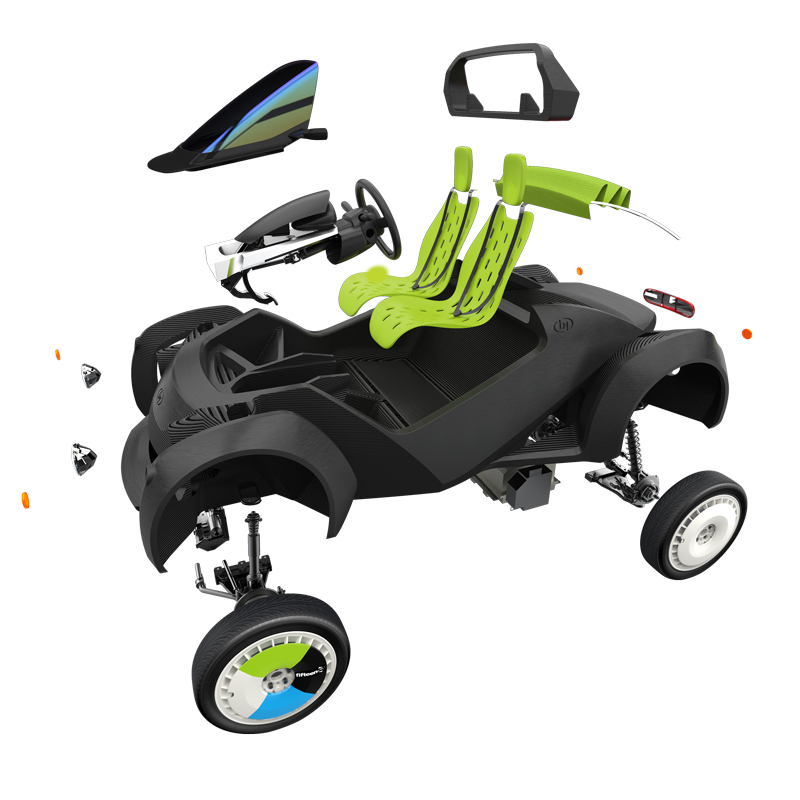
▶ 'Local Motors', which produces cars using 3D printing
The printing speed of 3D printers is also one of the obstacles to improving productivity, and 3D printer manufacturers, aware of this, are making significant efforts to improve 3D printer performance. The report predicted that by around 2020, the output speed of 3D printing is expected to improve tenfold and precision fivefold, while the price is expected to drop by half.
② Reduction of quality control costs
New production methods, data secured through numerous experiments
The biggest problem with the widespread adoption of metal 3D printing, which offers high productivity and profitability, is that quality control of printed parts is difficult.
The report stated that in order to guarantee product quality, identifying the variables that affect the quality of products printed with a 3D printer can predict the physical property results of the produced products. However, it was stated that since 3D printing is a new manufacturing method, there is no choice but to obtain data through numerous experiments within the company because sufficient data has not yet been accumulated. It was also conveyed that GE is currently improving the 3D printing methods, materials, performance, and quality control standards required for the products it intends to produce through this process.
③ Enhancing customer value through securing diverse and specialized designs
Holding a contest to secure designs
Shoe Insole Company 'Soles' Collaborates with Biomechanical Engineers and Doctors
Products printed with 3D printers have no structural design constraints. Therefore, the process of securing as many ideas as possible and finding the most suitable design for each situation becomes important.
Sols, a company featured in the report that manufactures personalized shoe insoles, analyzes variables affecting impact based on foot movement to determine the curvature and degree of cushioning of the insole to minimize shock. Since variable information naturally varies from person to person, this process must be implemented using software algorithms capable of proposing optimal product designs based on customer data. Sols is collaborating with experts, including biomechanical engineers and doctors, and incorporating customer feedback to continuously improve this algorithm.

▲ 'Sols', which manufactures insoles using 3D printing based on individual body and lifestyle information
The future of 3D printing applications is just taking its first steps.
3D printing is evolving beyond prototyping into a technology for manufacturing commercial products. While it may not completely replace existing manufacturing methods, it will be utilized as a means of creating new value in the areas of small-batch, customized product production and the production of complex-designed products. The report states that although there are still issues to be resolved, a significant portion of them will be resolved in the long term, and predicts that the market size for 3D-printed products (final parts/products) will grow by 36% annually from $81 million in 2013 to $3.2 billion in 2025.
The curtain has just risen on the 3D printing era. As the limitations of 3D printing are overcome, the product sectors where 3D printing is advantageous will gradually expand. Accordingly, the report stated that companies will need to determine whether the products they are manufacturing have the potential to fall within the areas where 3D printing is beneficial.
Comments
Related news
After trying to make it myself with 3D printing, now consumers are designers
The Korea Electronics Show (KES) being held at KINTEX features continuous product introductions from various IT companies and industry outlook seminars. Among these, the 3D printing sector is providing separate 3D experience exhibitions and seminar spaces, thereby enhancing visitor understanding and participation.
2015.10.15by
Urgent Review of 3D Printing Market: “Educational FDM Market is Saturated”
The industrial sector that actually uses 3D printing extensively is mockup work for automotive parts. However, Korea's current educational equipment market using FDM-type printers is in a saturated state.
2015.11.10by
[International Issue] 3D-Printed Antimicrobial Products That Block Bacterial Formation at the Source, and More
According to ScienceDaily, materials scientist Andreas Hermann and orthodontist Yijin Ren and their colleagues have developed a 3D-printed substrate that kills bacteria upon contact.
2015.11.23by 박동욱 기자

ESP32 Development Environment Selection and GPS Application Implementation
The ESP32 is a microcontroller that integrates Wi-Fi, Bluetooth, 12-bit ADC, capacitive touch, PWM, DAC, and UART in a single SoC. However, the abundance of features does not by itself solve the designer's problems. The real challenges lie in selecting the appropriate development environment, determining which pins can be used and which must be avoided, and converting raw data from modules into usable information. This document addresses ESP32 peripheral constraints (ADC2 and Wi-Fi coexistence limitation, UART1 occupancy, ADC non-linear regions), the trade-offs between Arduino IDE and ESP-IDF, and the process from connecting NEO-6M/NEO-M8N GPS modules to UART2, parsing NMEA sentences, and visualizing routes in Google Earth, all organized based on documented references.
2026.10.12by 편집부

MIPI CSI-2, DSI-2, C-PHY, D-PHY Test Solution Technical White Paper
The MIPI interface adopts a burst mode that transitions between low-power (LP) and high-speed (HS) states for low-power consumption, and in return, strict timing rules are imposed on state transitions. Additionally, the high-speed section operates as a packet-based protocol with headers, ECC, and CRC, so verification engineers must handle waveforms and protocols simultaneously. Traditional configurations combining general-purpose oscilloscopes and AWGs reveal limitations in setup complexity, measurement uncertainty, and lack of reproducibility when faced with these requirements. This white paper, based on webinar materials, organizes the structure of this problem and describes how the SV5C-DPTXCPTX generator for receiver testing and SV5C-DPRXCPRX analyzer for transmitter testing integrate state transition testing, stressed eye testing, and protocol analysis into a single bench, along with their application boundaries.
2026.10.12by 편집부











