



ST Launches Digital Power Amplifier for Automotive Audio
 Published2016.01.15 17:41
Simplifying system design and reducing costs for car radio suppliers.
STMicroelectronics has launched its second-generation power amplifiers that simplify car radio system design and enable drivers and passengers to enjoy high-quality sound even in compact cars.
According to ST, the FDA801 and FDA801B, the second-generation products of its four-channel Class-D[2] amplifiers, use digital input to directly convert digital audio sources into high-quality, spacious sound. This digital input method is immune to GSM noise, improves sound quality, reduces component costs, and simplifies system design. ST launched the world's first digital-input Class-D automotive audio amplifier in 2012 and has now accelerated its efforts with the second-generation products with improved features. These products will also be pin compatible to allow for a variety of multi-channel configurations in the near future.
“Class-D amplifiers are revolutionizing car audio across the market, from audiophile systems in luxury vehicles to affordable, high-quality sound in compact cars,” said Alfio Russo, Group Vice President and General Manager, Automotive Products Group, STMicroelectronics. “ST is committed to continuous development, and we believe these new products will set even more advanced performance and efficiency benchmarks for the industry.”
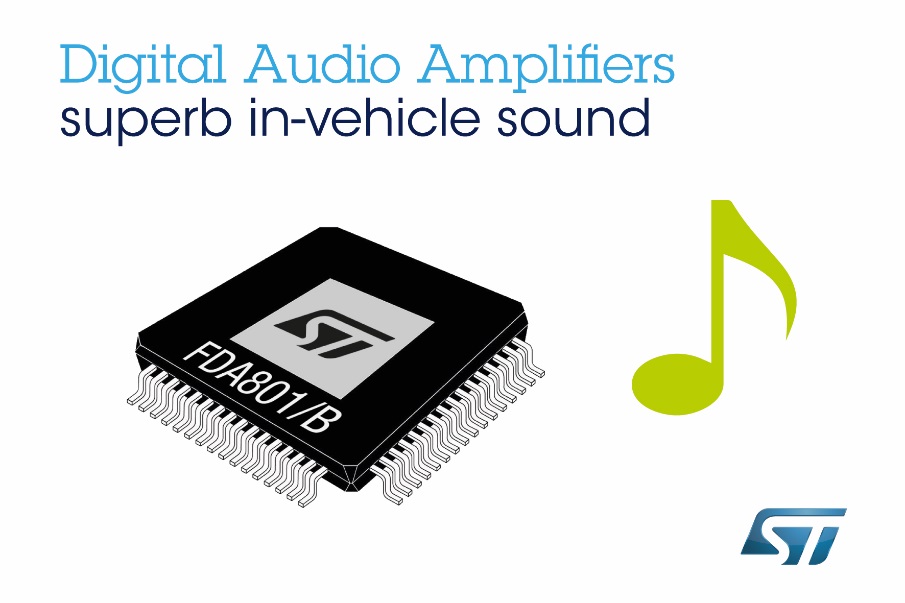
Through a digital impedance meter (Digital Impedance Meter, FDA801B)
Equipped with real-time speaker impedance measurement function
ST's new power amplifier delivers superior sound quality and improved energy efficiency. It also features a unique real-time speaker impedance measurement capability via the new Digital Impedance Meter (FDA801B), marking an unprecedented leap forward in automotive diagnostics.
This advancement was made possible by ST's advanced BCD9s process technology. This process minimizes interference between chip circuits, reduces standby power consumption, and prevents power transistor losses, boosting efficiency by over 93%.
FDA801/B helps improve vehicle fuel efficiency and extend the driving range of hybrid and battery-electric vehicles due to its low power loss. ST's new amplifier is compatible with fuel-saving start-stop technology and allows uninterrupted audio playback even when the vehicle's battery voltage drops to restart the engine.
The digital input and external feedback topology not only simplify circuit design but also improve frequency response regardless of load impedance and output filter design. This allows for the expansion of multiple variants based on a common platform without the need for detailed amplifier redesign. Unlike analog-input Class-D amplifiers, the FDA801/B's excellent noise immunity, low switching interference, and low power consumption, which allows for smaller heatsinks, make it suitable for use in head units as well as booster amplifiers.
Comments
Related news
Shipped 1 billion STM32 MCUs and over 500 million ST33 security MCUs
ST announced the shipment of 1 billion units of STM32, a general-purpose microcontroller based on ARM® Cortex® cores, and the achievement of 500 million units shipped for ST33, a secure microcontroller featuring the ARM SecureCore® SC300 processor.
2015.12.16by
[Planning] MCU Company ⑤ STMicroelectronics: "Highly integrated, low-power MCUs are perfect for IoT products, and we plan to expand into the low-end market in the future."
"Visiting MCU Companies" has this time sought out ST Microelectronics (hereinafter ST), renowned for its broad range of MCU offerings. ST possesses over 600 products that can be applied to diverse applications suited to the IoT era. Since the launch of STM32 in 2007, the company has currently moved into mass production of the STM32 F7 based on Cortex-M7. Additionally, ST plans to provide development environments free of charge to developers and hold training sessions. We meet with Manager Choi Kyung-hwa (photo), who oversees MCU operations at ST Korea, to hear about the secrets to competitiveness.
2016.01.11by 신윤오 기자
ST's High-Performance SoC Solution Adopted in Set-Top Boxes
STMicroelectronics announced that its high-performance SoC Cannes/Monaco product family has been adopted in the newly released Sky Q set-top box.
2016.01.13by 명세환 기자

Intel Unveils Next-Generation 'Core Ultra Series 3' and vPro Platform for Enterprise PCs
Intel has officially unveiled the "Intel Core Ultra Series 3" for next-generation enterprise PCs and the latest vPro platform, addressing a wide range of demands from enterprise notebooks to high-performance workstations.
2026.03.26by 배종인 기자

ROHM Launches ESD Protection Diode Compatible with High-Speed Interfaces of 10Gbps or Higher
Semiconductor specialist ROHM has developed the 'RESDxVx series' of ESD (electrostatic discharge) protection diodes capable of responding to next-generation high-speed data communication environments exceeding 10Gbps, simultaneously enhancing both signal quality maintenance required in high-speed interfaces and IC protection performance.
2026.03.26by 배종인 기자











