


Smart lighting meets IoT, growing rapidly in the home network market
 Published2016.01.18 14:19
The alternative is 'connected lighting' combined with existing IoT.
Will the IoT (Internet of Things) be the breakthrough for the LED industry facing a saturated market?
In the era of the Internet of Things, LEDs are expanding beyond their role as simple lighting and into 'connected lighting' that connects people, space, and the environment by combining with wireless communication technology.
This market, also known as smart lighting, is expected to grow at an average annual rate of 15.8% and reach a size of 56 billion dollars (approximately 57 trillion won) in 2020, according to a recent survey by market research firm Market and Market.
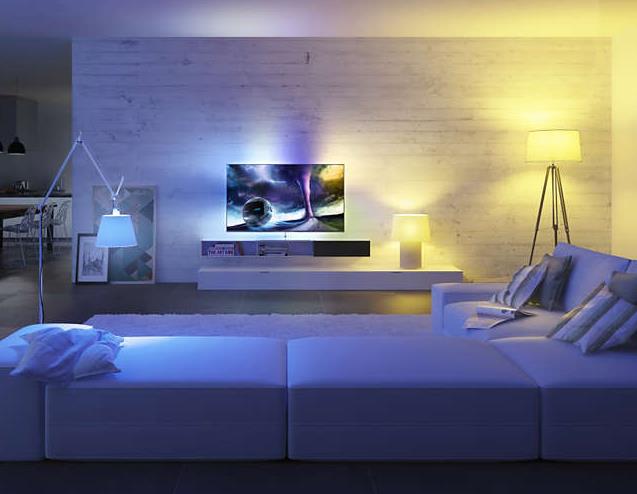
▲ 'Hue', the first home smart lighting launched by Philips in November last year.
LED lighting is a lighting product that uses LED packages, a type of diode, and is known to be 2 to 10 times more energy efficient than conventional lighting. However, they are about 10 times more expensive than existing lighting products, and the market research firm HIS forecasts that while fluorescent and incandescent lamps currently account for 96% of the market in 2014, this will fall to 61% by 2023.
This is because LED bulbs are expected to experience a significant price drop starting in 2019 due to oversupply due to their long lifespan of 22 years on average. In addition, supply is expected to significantly exceed demand as Chinese companies are making aggressive investments. As a result, shipments of LED lamps are expected to increase to double digits by 2020, which means that the LED lighting market will reach saturation.
Smart lighting is connected via wireless communication such as Wi-Fi, Zigbee, or Bluetooth, so you can freely control the brightness and color of the lighting as needed through an app. Especially in the case of buildings, since lighting accounts for close to 40% of total energy costs, applying a smart lighting system has the advantage of significantly reducing energy usage.
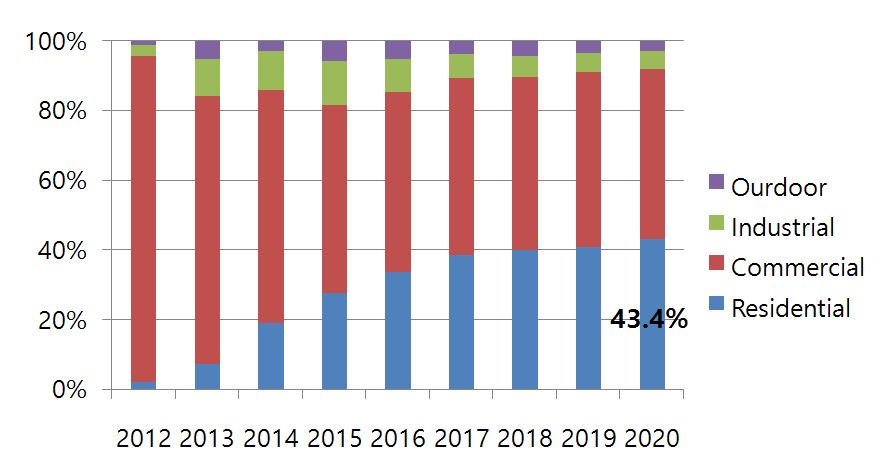
▲LED Smart Lighting Market Share Forecast by Application, SNE Research
'Smart lighting' that has a great energy saving effect
According to the HIS report, the energy required for lighting worldwide in 2014 was 3.5 trillion KWh (kilowatts). With the introduction of smart lighting in the future, this will be reduced to 3 trillion KWh by 2022, and it was also revealed that saving 500 billion KWh is an amount that can operate Disneyland in the United States for 1,216 years.
In addition, with the advent of the IoT era, smart lighting is expected to expand as a home network and its use in residential spaces will increase. According to research firm SNE Research, the proportion of residential smart lighting, which was 2.2% in 2012, is expected to rise to 48.7% in 2020, which is not much different from the proportion of industrial smart lighting, which is 43.4%.
LED Smart Lighting Market Share Forecast by Application, SNE Research
By 2020, the share of LED smart lighting in residential areas will grow to 48.7%.
Additionally, one report predicted that while the smart lighting industry is currently led by the European and North American markets, the Asia-Pacific market will also grow rapidly, growing 37.7% from 2013 to 2018.
The smart lighting market has been taking shape in Korea since Philips first released its home smart lighting, ‘Hue’, in November of last year. In March of this year, LG Electronics became the first domestic company to release a smart light bulb.
The government is also actively accepting the introduction of 'smart lighting'. First, it announced that it would replace all streetlights in the city with LED lights by 2018, and then expand the 'smart LED road lighting control system' to 50% of streetlights in the city by 2020. In addition, Seoul City also replaced the lighting in 243 subway stations with LED lights.
Comments
Related news
Infineon Provides Digital Platform for Managing Eco-friendly LED Technology
Infineon announced on October 21 that it will provide the dp digital power 2.0™ platform. dp digital power 2.0 is a digital platform for power supply that intelligently controls LED lighting systems to achieve maximum energy savings.
2015.10.22by
Simultaneous exchange of information and promotion through the world's largest LED forum
ForumLED Europe 2015, marking its 7th edition, is a B2B event forum covering LED technology and related applications, providing various opportunities such as business consultation to lighting and LED experts and end users centered in Europe.
2015.10.26by

Solar Science Enters IoT-Based LED Smart Lighting Business
LED lighting specialist SollaScience has entered the IoT smart lighting business, recently completing the supply and installation of LED smart lighting with IoT-based wireless power-saving technology at an underground passage of a highway toll gate.
2015.12.24by

LG U+ Selected as Preferred Negotiator for Wando County LED Security Lighting Improvement Project
LG Uplus announced that it has been selected as the preferred negotiation partner for the 'Wando-gun LED Security Lighting Improvement Project,' which has drawn considerable attention through commissioned bidding with a specialized agency. This 'Wando-gun LED Security Lighting Improvement Project' was promoted through a comprehensive consignment by Wando-gun to the Korea Photonics Industry Promotion Agency, a specialized institution.
2016.01.15by
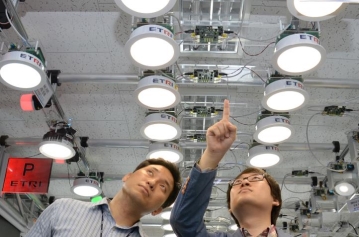
[Interview 1] "Is the next innovation in smartphones the camera? Then pay attention to LED communication technology"
LED communication technology is advancing rapidly alongside smart lighting. In 2011, under the leadership of Samsung Electronics and ETRI, standardization of visible light communication was achieved. In particular, LED-ID is a technology that enables transmission and reception of unique information through LED display-based screens and smart cameras. We met with Professor Young-min Jang from Kookmin University (photo), who is proceeding with standardization, to hear in detail about the progress of LED communication technology.
2016.01.18by











