


[Automotive Testing] 'Smart AB', a solution to prevent drowsy driving
 Published2016.01.28 16:20
Using infrared lighting, driver's gaze direction and head position angle
Quantification of values for eyelids, pupils, and the iris
At CES 2016, it clearly emerged as the main topic, surpassing conventional home appliances and mobile devices. This is because everything from the currently ongoing ADAS (Driver Assistance Systems) to the era of self-driving cars—once seen only in movies—has taken a step closer. However, the outlook is not entirely optimistic. This is because automobiles are deeply linked to human life, and accident rates must be reduced to a much lower probability than for humans. Consequently, as the number of advanced components increases, the importance of "functional safety" is also growing.
In response to these demands, the Automotive Testing exhibition was held at COEX from January 27 to 29. Over 120 participating companies showcased cutting-edge testing technologies used in automotive production processes and products that improve vehicle reliability, durability, safety, and quality across all procedures, from initial prototype analysis to line end inspection and quality assurance.
Among the many companies, KOSTECH exhibited 'Smart AB', a 3D remote eye tracking program that prevents drowsy driving. Kosteck explained, “As a manufacturer of eye tracking systems based on Swedish 3D measurement technology, we have implemented perfect real-time tracking technology for the eyes, eyelids, and head.”
This system measures using 2 to 8 cameras, and uses two or more video cameras and an IR-Flash (infrared light) to capture the subject's face. By analyzing the video, it is possible to quantify values such as the subject's gaze direction, head position angle, eyelids, pupils, and irises, and output them in real time.
Kostech’s Jeong Gu-yeong stated, “The automotive sector is progressing with anti-sleep technology that tracks drivers’ gaze toward the display to detect drowsiness and provides a signal or warning via vibration,” adding that “in addition to this, applications are being developed to analyze buyers’ gaze while looking at magazines or banners.”
Comments
Related news
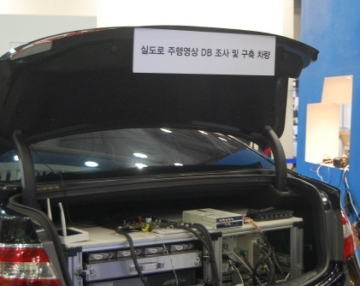
[Automoive Testing]NI is collecting autonomous vehicle data with DAQ devices
At CES 2016, it emerged as the clear topic of discussion, surpassing conventional home appliances and mobile devices. This is because we have moved one step closer to the era of autonomous vehicles that were once only seen in movies, starting with driver assistance systems (ADAS) which are currently in progress. However, there are not only optimistic outlooks. Since 'automobiles' are deeply related to human life, they must reduce accident rates at a probability far lower than that of people. Accordingly, as the number of advanced components increases, the importance of 'functional safety' is also growing.
2016.01.28by
[Automotive Testing] Measure Automotive Thermal Durability with FLIR's Thermal Imaging Cameras!
Among these, thermal measurement is one of the essential parts required for automotive inspection. Since automotive components need thermal durability to withstand high temperatures, a thermal imaging camera capable of observing this is effective. Accordingly, FLIR, which has specialized in developing infrared cameras, participated in the 2016 Automotive Testing and exhibited infrared cameras necessary for automotive inspection.
2016.01.28by

[Automotive testing] MDS Expands Automotive Testing Solutions from Mobile Sector
MDS is a company that has been providing embedded-based solutions for over 20 years. Initially starting from mobile solutions, the company is now expanding into the automotive and aerospace sectors. At this 2016 Automotive Testing exhibition, MDS is conducting displays divided into three specialized zones (ZONE) for each testing category.
2016.01.28by
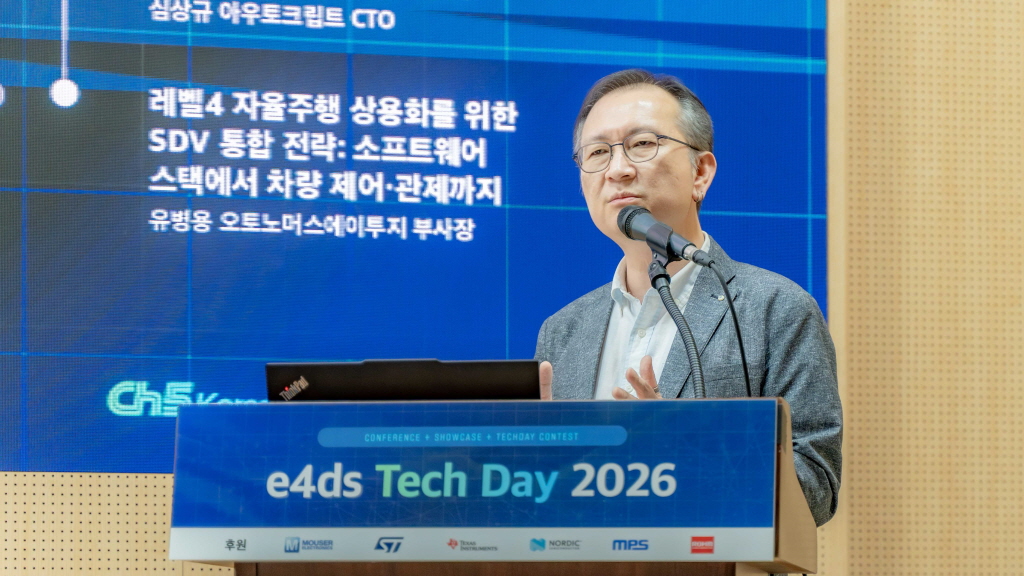
[e4ds Tech Day 2026 ⑨] Sim Sang-gyu, Autocrypt CTO: "In the Physical AI Era, Automotive Security Must Extend Beyond the Vehicle"
At e4ds Tech Day 2026, Sim Sang-gyu, CTO of Autocrypt, explained automotive cybersecurity strategies in the era of Physical AI and SDV (Software-Defined Vehicle). Automobiles are evolving as part of an ecosystem connected to AI, cloud, chargers, IoT, and robots, and he emphasized that the scope of security must expand beyond the vehicle interior to the entire connected environment. In particular, AI model tampering, adversarial attacks, OTA updates, and EV charger hacking were identified as major threats. He explained that response measures require zero trust, AI model integrity protection, intrusion detection, Security by Design and Default, and full lifecycle security management, and that proactive security system establishment beyond regulatory compliance is critical for securing future mobility competitiveness.
2026.10.12by 배종인 기자

Practical HIL Construction Strategy for Automotive and Off-Highway Controller Validation
As vehicle E/E architecture transitions to zonal structures and shifts to software-defined vehicles (SDV), the number of controllers (ECUs) requiring validation and software complexity are surging dramatically. Meanwhile, real vehicle testing cannot provide repeated verification under identical conditions and entails lead time and safety concerns. This white paper explains the principles of HIL (Hardware-in-the-Loop) validation and the structure of the NI platform composed of PXI, SLSC, and VeriStand, and through two actual implementation cases—Camera Record & Replay HIL for In-Cabin Monitoring Controller (ICMU) and Forklift Controller (VCU) HILS—describes how controller-level regression testing becomes possible. Additionally, it explicitly states application boundaries and limitations, such as lack of A2B support.
2026.10.12by 편집부











