



[Interview 2] "Is the camera the next innovation in smartphones? If so, pay attention to LED communication technology."
 Published2016.01.29 09:20
LED, expanding its role beyond 'lighting' to include the fields of art and communications.
LED-ID, transmission and reception function through light-shaped patterns
When you think of LED, what comes to mind? Bright, colorful lights in all their glory. And that's understandable, as Seoul Square, located across from Seoul Station, transforms the building into a nightly spectacle of light. This is because countless LED lights attached to the building's exterior create moving media art. This is one form of media art known as "LED façade."
When LEDs first appeared, they garnered attention for their vibrant brightness. However, their price difference—more than ten times that of conventional incandescent and fluorescent lamps—prevented widespread adoption. However, thanks to their long average lifespan of 22 years, LED shipments are outpacing demand, leading to strong projections for price declines. Market research firm IHS forecasts that LEDs will account for 39% of the market by 2023.
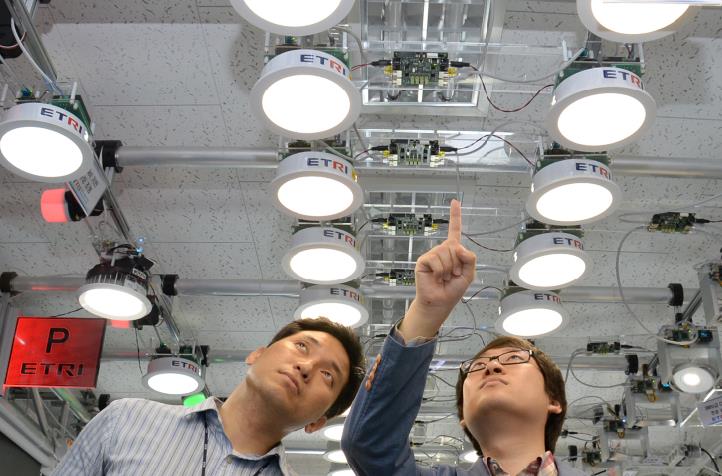
▲ETRI (Electronics and Telecommunications Research Institute) announced in May of last year that it had successfully developed visible light communication (VLC) networking technology that enables information transmission through the light of LED lights.
Now, in the IoT era, LEDs connected through communication have evolved into ‘smart lighting.’ It can control the brightness and color of light depending on the presence of people or the atmosphere of the interior, and is also effective in reducing the energy efficiency of large buildings.
Along with smart lighting, LED communication technology is also advancing rapidly. In 2011, Samsung Electronics and ETRI led the way in standardizing visible light communication. LED-ID, in particular, is a technology that enables unique information to be transmitted and received between LED display-based screens and smart cameras. We met with Professor Jang Young-min (pictured) of Kookmin University, who is currently working on standardization, and heard in detail about the progress of LED communication technology.
===========================================================
The previous article, "Is the Next Smartphone Innovation Camera? If so, Pay Attention to LED Communication Technology" (Part 1), was published on January 18th.
- Which companies are you currently interested in?
Intel, Panasonic, and China Telecom are known to be interested.
-What is the status of your research and development?
Our current rival is Intel. We are developing both rolling shutter (CMOS) and global shutter (CCD) sensors simultaneously, while Intel focuses on global shutter (CCD).
Rolling shutter can increase the frame speed by capturing by scanning the screen left and right or up and down, but distortion can occur because the exposure timing is different for each scan line position of the sensor, and global shutter does not cause distortion by capturing the entire thing at once, but it has the characteristic of not being able to increase the frame speed because all pixels must be read after exposing all pixels.
Most standard cameras use rolling shutter (CMOS) sensors. While CMOS sensors are widely used in general-purpose applications, such as affordable webcams, global shutter (CCD) sensors are used in high-end cameras due to their high sensitivity and high cost. Intel is interested in the high-end cameras used in automobiles. We are developing it so that it can be applied not only to general cameras but also to global cameras.
Cameras are designed to capture 30 frames per second, resulting in a single image. This means you can capture 30 frames per second. However, frame rates vary across devices. They aren't always 1/30th of a second. Webcams can capture 20 frames per second, while others can even reach 31 frames per second. Our proposal is to adapt the camera to fit all smart device cameras.
Short-range communication can be utilized in the IoT era.
Expanding to lighthouses and autonomous vehicles
- Web cameras are also widely used in IoT devices.
Yes. Web cameras also receive data and enable communication. They don't just capture video; they receive it, capture, and extract data. They can record, and even receive additional information. This allows them to receive much more than just what's visible to the naked eye.
- How far can this technology be applied in the future?
Visible light communication using LEDs can be utilized in intelligent transportation systems (ITS), such as vehicle-to-vehicle communication and the transmission of traffic safety information between vehicles and traffic lights (intelligent streetlights). It is also expected to provide high-speed sensor services that can replace radio-frequency identification (RFID) tags for communication between lighthouses and ships. With the recent proliferation of monitors equipped with LED backlights (BLU), they can be applied to video object communication (VOC) and optical PAN (optical PAN), which allow users to receive special information within the video. Lighthouses rotate and emit light, transmitting information through LEDs like Morse code. For example, the Haeundae lighthouse rotates every nine seconds, and its primary message is "This is the lighthouse." Using LED communication, it can convey information such as Haeundae's location, weather, and wave height.
We are preparing the next version of automotive radar that can advance technology to even autonomous vehicles.
Until now, we've been able to receive data, use that information, and measure distances. With this technology, we can actually detect distant objects. While conventional radar can detect camera positions even at long distances, this technology receives data, allowing for precise location determination.
Additionally, cameras, instead of human eyes, can receive data. When a vehicle takes action, such as braking, that information is transmitted to the backlight, alerting the cars behind it to the potential actions. The brake lights can also provide additional information, such as "braking," "traffic is blocked," or "slow down."
- Security and technological safety are important for automobiles, but what about LEDs?
It is not yet very safe. Research is underway to increase the distance and improve the reliability of the data.
What we are studying is that two of the five contributions are for long-distance use.
The convergence of the IoT era and next-generation LED communications

- What role can LED communication play in the IoT era?
Because anything that emits light and has a pattern can be used, it could create synergy with displays and cameras, key components of IoT. Things previously only visible through video can now be communicated through data transmission. Currently, a parking lot digital signage project is under development, supported by schools.
When entering the parking lot, the system displays the number of seats on the first floor and the number of seats on the second floor, but doesn't provide exact locations. Even if it does, humans have to see and remember them. Using LED communication, sensors in the parking lot can detect and transmit when space 10 on the first floor is empty. This allows the system to display "Welcome Kookmin University" on digital signage, which then receives parking space data via cameras. Furthermore, through automatic navigation and automated navigation, the system can even park autonomously.
Of course, you can do it with other communications such as Wi-Fi, but the resolution is long at 5m. However, since the interior is densely equipped with LED lights, it is possible to identify parking spaces with high accuracy.
- Is it only possible indoors with lighting?
No. Cameras are used on drones not only for surveillance purposes but also to prevent collisions based on actual location. By flashing LED lights on these cameras, they can obtain precise location data and avoid collisions.
Since 2001, Professor Jang has served as an international standards expert at the Korea Information and Communications Technology Association, promoting academic commercialization by introducing 4G mobile communication standard technologies to Korea. He has also served as Director of the LED Convergence Center, Steering Committee Chair of the Multiscreen Service Forum, and Chair of the IEEE 802.17.7 OWC TG, contributing to the ecosystem of lighting, LED component, and service companies.
- What are the limitations that these technologies must overcome?
Next-generation wireless communication must have a minimum range of 100 meters. Currently, we're at 40 meters. We must strive to develop more reliable technology.
While close-range applications like digital signage (10-20 meters) are acceptable, long-range applications like lighthouses require distances of up to 1-2 kilometers. Therefore, a new communication technique was proposed. To send an image lens over a long distance, the light must be directed. This requires integration with optical components to focus and project light like a laser. There are still many areas left to research.
Creative research develops through convergence with other fields over time.
We need to create a research environment that allows for continuous research even if it doesn't generate immediate profits.
- As someone who is starting from the standardization stage, I think your ambitions are quite different.
In 2010, I received a project from the Korea Institute of Industrial Technology Evaluation and Planning (KEIT). The project involved research aimed at technological development through innovation projects with university professors, which ultimately led to standardization. We created a new study group and nurtured it from the ground up. While I'm not sure what the market will look like, I believe our technology will be competitive and be reflected in the market.
- You've been working hard for a long time since 2010. What were the difficulties?
When I first announced my intention to research this field, I remember the professors around me chiding me, saying, "Why are you working so hard when there's no prospect?" A few months ago, there was a discussion about why Korea doesn't produce a Nobel Prize, but those professors don't develop for the Nobel Prize. They propose new fields that others haven't explored and continue their research. This is because they often combine research with other fields and discover unexpected new discoveries. I hope Korea, too, will create an environment where creative research can continue without significant investment, rather than simply supporting trendy, profit-driven research.
"We must pioneer new fields that others are not exploring, and continuous research must be supported accordingly. People often talk about the reasons why our country doesn't receive a Nobel Prize, but the truth is that Nobel laureates don't conduct research for the Nobel Prize.
Comments
Related news

Solar Science Enters IoT-Based LED Smart Lighting Business
LED lighting specialist SollaScience has entered the IoT smart lighting business, recently completing the supply and installation of LED smart lighting with IoT-based wireless power-saving technology at an underground passage of a highway toll gate.
2015.12.24by
[Interview 1] "Is the next innovation in smartphones the camera? Then pay attention to LED communication technology"
LED communication technology is advancing rapidly alongside smart lighting. In 2011, under the leadership of Samsung Electronics and ETRI, standardization of visible light communication was achieved. In particular, LED-ID is a technology that enables transmission and reception of unique information through LED display-based screens and smart cameras. We met with Professor Young-min Jang from Kookmin University (photo), who is proceeding with standardization, to hear in detail about the progress of LED communication technology.
2016.01.18by
Korea Instrument, KOLAS Accredited Calibration Agency First to Simultaneously Acquire ISO/IEC 27,001·27,701
Korea Instrument has become the first among KOLAS accredited calibration agencies to simultaneously acquire ISO/IEC 27,001 and ISO/IEC 27,701 certifications. Through its proprietary platforms CWIZ Enterprise and CWIZ Partners, the company has embedded information security and personal data protection requirements across all business processes including customer information, equipment data, and calibration reports, with plans to continuously advance its management system through regular audits and security inspections.
2026.10.12by 배종인 기자
TeamViewer One, IT Incident Automation Workflow and Resolution Center Enhanced
TeamViewer has added IT incident automation capabilities and an advanced Resolution Center to its integrated digital workplace management platform 'TeamViewer ONE'. Recurrent service disruptions, configuration errors, and capacity shortages are automatically handled according to preset policies, and device status verification through script deployment can be managed in a unified interface, significantly reducing repetitive tasks for IT teams.
2026.10.12by 배종인 기자
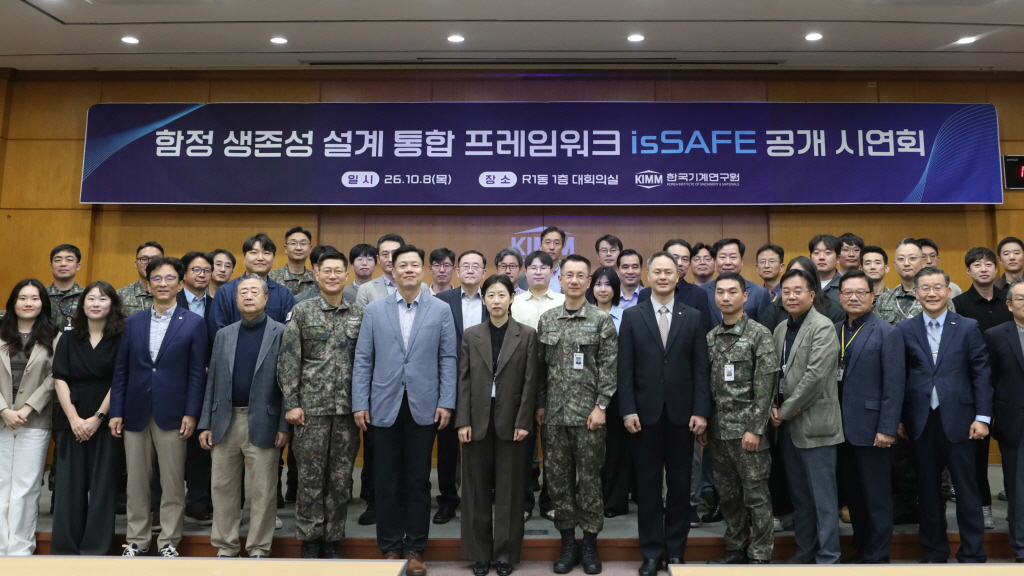
KAERI Develops Domestically-Produced SW 'isSAFE' for Integrated Warship Survivability Analysis
The Korea Institute of Machinery and Materials has developed domestically-produced software 'isSAFE' that comprehensively analyzes warship survivability. This design framework integrates the entire process—from warship modeling to hit scenario generation, vulnerability analysis, and results analysis—into a single platform, establishing an independent technology foundation in the defense technology sector that had previously relied on foreign software.
2026.10.08by 배종인 기자











