


Automotive Industry Adopts GSMA Embedded SIM Standard for 'Connected Car' Market
 Published2016.02.11 16:41
General Motors, Jaguar Land Rover, Renault-Nissan, Scania, Volvo Cars, etc. support standards for connected cars
Currently, 22 providers offer commercial solutions.
The Global Mobile Communications Association (GSMA) announced today that leading companies in the automotive and transportation industries have decided to support the GSMA Embedded SIM standard to accelerate the growth of the connected car market. Global brands supporting the interoperability standard include General Motors, Jaguar Land Rover, Renault Nissan, Scania, and Volvo Cars, and the standard enables automakers to remotely provide internet connectivity to vehicles in conjunction with a telecommunications carrier of their choice.
It also supports the provision of various in-vehicle services, including infotainment, real-time navigation, insurance and roadside assistance, as well as telematics and remote diagnostics. Applying this standard helps to quickly connect vehicles with local operators regardless of the vehicle's place of production.
Alex Sinclair, Chief Technology Officer at GSMA, explained, “The GSMA Embedded SIM standard was adopted by the industry shortly after commercial solutions were first introduced. The automotive sector is poised for tremendous growth, and global common standards will contribute to mobile operators providing reliable, secure, and scalable connectivity to vehicles regardless of location.” He explained, “This approach helps automakers provide all types of in-vehicle connectivity services through a single SIM,” adding, “When a vehicle is shipped, the SIM can be supplied along with a mobile carrier profile, and there is no need to exchange the SIM even when the contract expires.”
Gartner: One in Five Cars to Be Connected to Wireless Networks by 2020
The connected car market is signaling explosive growth. Gartner Research forecasts that by 2020, various forms of wireless network connectivity will be installed in 250 million vehicles in operation, or one in five cars. Additionally, Machina Research predicts that the total number of connections in the connected car market will grow at an average annual rate of 31%, rising from 182 million in 2015 to 693 million in 2020. Market analysis firm Berg Insight also forecasts that shipments of in-vehicle embedded telematics systems will increase from 1.9 million units in 2014 to 15 million units by 2020.
Mike Bell, Director of Global Connected Cars at Jaguar Land Rover, explained, “Jaguar Land Rover is making connectivity the core of its vehicles to provide a wide range of safety, security, convenience, and infotainment features for our customers.” He added, “With the GSMA Embedded SIM standard, Jaguar Land Rover can reduce manufacturing complexity and adapt to changing regulatory frameworks, while improving customer solutions to provide next-generation connectivity services throughout the lifespan of Jaguar Land Rover vehicles by collaborating with leading mobile operators based in specific countries or regions.”
Fredrik Callenryd, Senior Vice President of Business Planning at Scania CV AB, pointed out, “The GSMA Embedded SIM standard solves many fundamental problems inherent in automotive manufacturing,” adding, “In particular, by resolving issues of localization and lifecycle management within the market, it enables the delivery of more efficient and robust global products.”
Alexandre Corjon, Global Vice President of Electrical and Systems Engineering at the Renault-Nissan Alliance, stated, “The Renault-Nissan Alliance is innovating global industrial technologies for customers in mainstream and mass production markets.” He expressed his expectations, saying, “Support for the GSMA Embedded SIM standard will help us continue to innovate by strengthening reliable and stable solutions, while also enabling us to provide more flexible and agile solutions.” He added, “This will allow us to provide customers with ease of use and high-quality service, which are key goals of Renault-Nissan.”
To date, 22 mobile operators worldwide have commercially launched solutions based on the GSMA embedded SIM standard. AIS, América Móvil, KPN, MTN, Rogers Wireless, Swisscom, Taiwan Mobile, Telenor, TIM, and members of the Bridge Alliance and the Global M2M Association are scheduled to launch new commercial solutions. Adopting interoperability standards can help reduce fragmentation and enable the industry to leverage the benefits of the Internet of Things (IoT). According to Makina Research, the effective IoT market is estimated to reach $1.1 trillion by 2020. Bell Canada, Deutsche Telekom, Etisalat, Indosat, NTT DOCOMO, Orange, Tele2, Telefónica Brasil, Telefónica Group, TeliaSonera, and Vodafone have already launched commercial solutions.
Comments
Related news


'Green Light' for Leading International Standards for Web-based Smart Cars
Domestic researchers have taken the lead in international standards in the field of connected vehicles linked to the Internet. ETRI (Electronics and Telecommunications Research Institute, President Kim Heung-nam) announced that its research team has been selected as an Editor at the World Wide Web Consortium (W3C), an international standardization body for Web technology, and has begun full-scale development on two standard recommendation proposals. Being selected as an Editor at an international standardization conference means taking the first step toward establishing international standards for the related technology.
2015.07.20by 명세환 기자
The first automotive-specific Ethernet transceiver and switch that flexibly addresses smart car networking needs.
NXP Semiconductors (NASDAQ:NXPI), a technology leader in the Secure Connected Car segment and a global frontrunner in In-Vehicle Networking, has announced a complete portfolio of "true automotive-grade" Ethernet products that meet the stringent requirements of the automotive industry. Ethernet enables high data bandwidth, communication speed, weight reduction, and cost efficiency required for next-generation vehicles. This is expected to provide foundational networking technology for autonomous and connected vehicles.
2015.07.21by 신윤오 기자
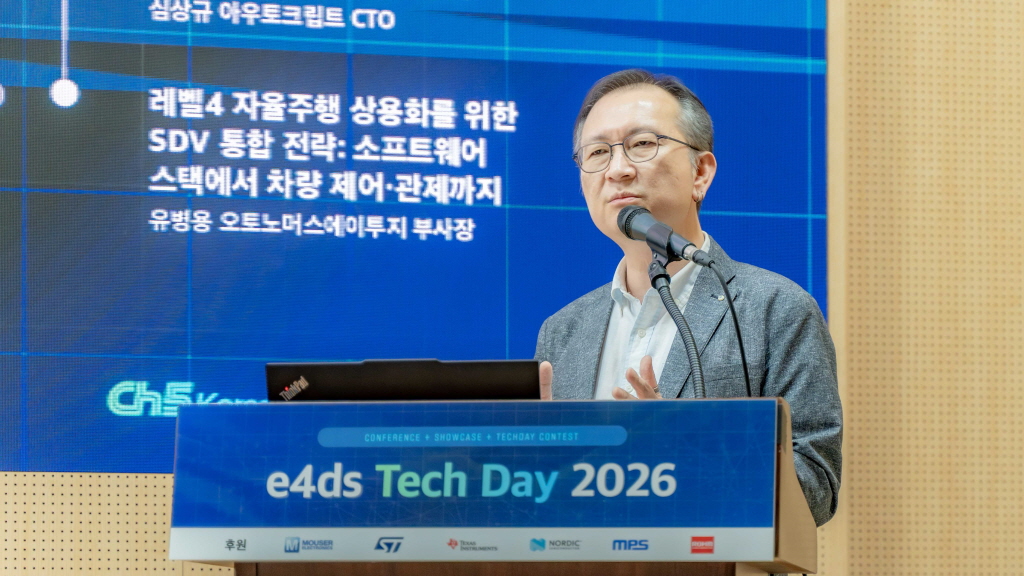
[e4ds Tech Day 2026 ⑨] Sim Sang-gyu, Autocrypt CTO: "In the Physical AI Era, Automotive Security Must Extend Beyond the Vehicle"
At e4ds Tech Day 2026, Sim Sang-gyu, CTO of Autocrypt, explained automotive cybersecurity strategies in the era of Physical AI and SDV (Software-Defined Vehicle). Automobiles are evolving as part of an ecosystem connected to AI, cloud, chargers, IoT, and robots, and he emphasized that the scope of security must expand beyond the vehicle interior to the entire connected environment. In particular, AI model tampering, adversarial attacks, OTA updates, and EV charger hacking were identified as major threats. He explained that response measures require zero trust, AI model integrity protection, intrusion detection, Security by Design and Default, and full lifecycle security management, and that proactive security system establishment beyond regulatory compliance is critical for securing future mobility competitiveness.
2026.10.12by 배종인 기자











