


Domestic Rehabilitation Robot Market Expands to 40%, Will It Be a New Opportunity for SMEs?
 Published2016.02.22 16:17
The rehabilitation robot market, which consists of professional service robots with lower technological entry barriers and increased personal health management, is expected to grow continuously with the entry of small and medium-sized enterprises.
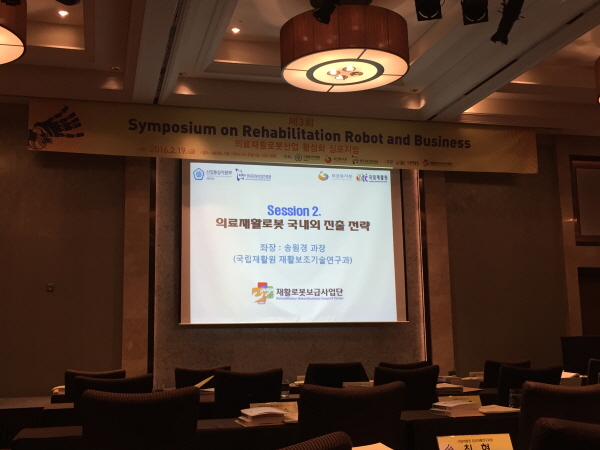
The National Rehabilitation Center held a symposium on Rehabilitation Robot and Business on the 19th at the Sheraton Seoul D Cube City Hotel to share information necessary for the commercialization of medical rehabilitation robots and the achievements of the rehabilitation robot distribution project.
At the event, following the first session on "Support Systems for the Commercialization of Medical Rehabilitation Robots," presentations were given in the second session on "Strategies for Domestic and International Expansion of Medical Rehabilitation Robots." In the final third session, themed "Sharing Achievements of Rehabilitation Robot Distribution Projects," achievements in the utilization of rehabilitation robots were introduced.
A rehabilitation robot is a robot used in the process of improving and maintaining a person with a disability to an optimal physical, sensory, intellectual, psychological, and social level.
In addition to rehabilitation robots, medical robots are divided into three fields: treatment and surgical robots, rehabilitation robots, and medical service robots (care, hospital guidance, and remote diagnosis). The current global medical robot market is estimated at approximately $1.7 billion, with surgical robots accounting for 45%, hospital and pharmacy automation 22%, and rehabilitation robots following at around 20%.
Domestic medical market for rehabilitation robots grows to 40%
The rehabilitation robot market, with its low technological barriers, offers high potential for small and medium-sized enterprises to target.
The domestic market is approximately 19.4 billion won based on the production and import unit price in 2014. Compared to the global market, the domestic market is dominated by only two segments: surgical and rehabilitation aids. Surgical aids account for 11.8 billion won (61%), while rehabilitation aids account for 7.6 billion won (39%).
While rehabilitation robots accounted for 10% in 2010, this figure rose to 40% in 2014. In particular, while global conglomerates dominate the market for high-value-added, high-tech surgical robots, it appears that small and medium-sized enterprises are leading the market for rehabilitation robots, which represent a segment of the low-cost market.
In response, Dr. Kim Gye-ri, an engineering Ph.D. at the Korea Institute of Science and Technology, explained, “Rehabilitation robots are gaining attention as interest in personal health management increases. Furthermore, from a corporate perspective, surgical robots have high entry barriers and require significant research and development costs and time, making it advantageous for small and medium-sized enterprises to enter the market.”
To overcome boredom from repetitive training
Providing effective treatment through patient ability assessment and various content
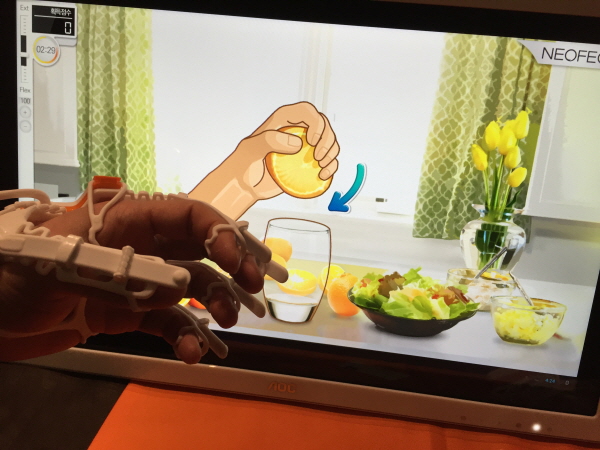
During the symposium, robots from the rehabilitation robot distribution project from 2012 to 2015 were also exhibited. Among them, NEOFECT’s Rapael Smart Glove, a robot selected for the 2014 Rehabilitation Robot Distribution Project, is a wearable biofeedback training device for hand rehabilitation that provides visual data of the training process, helping patients perform rehabilitation training without boredom. In particular, it plays an important role in enhancing brain plasticity for patients with central nervous system disorders through goal-oriented repetitive training.
After wearing a lightweight medical device weighing 132g made of elastomer material, the joint range of motion evaluation, measured through three channels of acceleration, angular velocity, and magnetic field sensors, analyzes the movement of the patient's hands and fingers.
The measured values utilize a 'Learning Schedule Algorithm' to provide customized training with difficulty levels adjusted according to the patient's ability. After training, systematic rehabilitation management is possible through results and reports, enabling efficient rehabilitation treatment.
According to a Neofect official, "We are currently using this product in about 20 hospitals, and above all, hospital staff are seeking it out more because it allows patients to undergo rehabilitation training without getting bored."
During a presentation on medical device business strategy case studies and success models, Lee Jin-soo, Team Leader of the Medical Device Industry Support Team at the Korea Health Industry Development Institute, stated, “Strategies for SMEs in the rehabilitation robot sector must involve expanding the market through entry into emerging markets via inter-company technology partnerships and government cooperation. Furthermore, OEM and ODM strategies are necessary to overcome technological disadvantages compared to global companies and to expand distribution networks.”
Comments
Related news
Focusing investment on the robot industry: 'Safety Robots, Care Robots, and IoRT'
At the RoboWorld seminar held at KINTEX on the 28th, Park Hyun-seop, PD at KEIT, stated, "Based on the 2013 data from the IFR, there are approximately 400 types of developed and commercialized robots, with the global robot market size reaching a total of 14.8 million dollars." He added, "Of this, manufacturing robots account for 9.7 million dollars, comprising approximately 64 percent, followed by professional services at 24 percent, and personal service robots at 12 percent."
2015.11.03by
Universal Robots Partners with Korean Distributors to Target the Market
Universal Robots announced that it has selected ㈜TES (True Engineering Solutions Co., Ltd.), Korea's first vacuum robot developer for the semiconductor and display industries, and ㈜A&G Technology (A&G Technology Co., Ltd.), which manufactures quality testing equipment for completed vehicle, engine, and transmission production lines in the automotive industry, as additional official distributors for Universal Robots in Korea. With this appointment, Universal Robots is now partnering with a total of three domestic distributors, including existing distributor Vision Semiconductor Co., Ltd., to pursue the Korean market.
2015.11.26by 명세환 기자
ESP32 Development Environment Selection and GPS Application Implementation
The ESP32 is a microcontroller that integrates Wi-Fi, Bluetooth, 12-bit ADC, capacitive touch, PWM, DAC, and UART in a single SoC. However, the abundance of features does not by itself solve the designer's problems. The real challenges lie in selecting the appropriate development environment, determining which pins can be used and which must be avoided, and converting raw data from modules into usable information. This document addresses ESP32 peripheral constraints (ADC2 and Wi-Fi coexistence limitation, UART1 occupancy, ADC non-linear regions), the trade-offs between Arduino IDE and ESP-IDF, and the process from connecting NEO-6M/NEO-M8N GPS modules to UART2, parsing NMEA sentences, and visualizing routes in Google Earth, all organized based on documented references.
2026.10.12by 편집부

MIPI CSI-2, DSI-2, C-PHY, D-PHY Test Solution Technical White Paper
The MIPI interface adopts a burst mode that transitions between low-power (LP) and high-speed (HS) states for low-power consumption, and in return, strict timing rules are imposed on state transitions. Additionally, the high-speed section operates as a packet-based protocol with headers, ECC, and CRC, so verification engineers must handle waveforms and protocols simultaneously. Traditional configurations combining general-purpose oscilloscopes and AWGs reveal limitations in setup complexity, measurement uncertainty, and lack of reproducibility when faced with these requirements. This white paper, based on webinar materials, organizes the structure of this problem and describes how the SV5C-DPTXCPTX generator for receiver testing and SV5C-DPRXCPRX analyzer for transmitter testing integrate state transition testing, stressed eye testing, and protocol analysis into a single bench, along with their application boundaries.
2026.10.12by 편집부
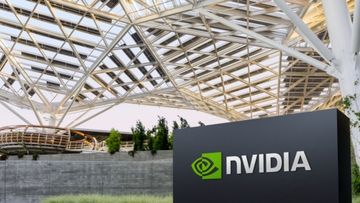
NVIDIA to Invest $1 Billion in U.S. Science Over Next Five Years
NVIDIA has announced plans to invest $1 billion over the next five years to strengthen U.S. scientific and technological competitiveness. The company will enhance cutting-edge artificial intelligence research and development capabilities in key areas including quantum computing, healthcare, and energy security, while expanding support for higher education research institutions and cloud service providers. NVIDIA is participating as a major industry partner in the White House Office of Science and Technology Policy's Genesis Mission, and is promoting supercomputer construction in collaboration with national laboratories including Argonne and Los Alamos.
2026.10.12by 배종인 기자











