


White LED, implemented with a single chip without using phosphors
 Published2016.02.25 19:20
High unit cost due to combination of multi-colored LED chips
A research team at KAIST has developed a white LED manufacturing technology. This technology, which does not use phosphors, is expected to contribute to the advancement of next-generation lighting and display technologies.
Currently, most white LEDs utilize a blue LED with a yellow phosphor, or combine multiple colored LED chips. However, this method of combining multiple colored LED chips in parallel has the disadvantage of higher unit costs. Furthermore, the yellow phosphor is a rare earth element, leading to a high dependence on imports and limitations such as low color rendering and discoloration.
Accordingly, a research team led by Professor Cho Yong-hoon of the Department of Physics at KAIST has devised a method for producing a white LED using a single semiconductor chip, without the use of phosphors. They designed a microcomposite structure that resembles a pyramid with a concentrically cut-off top.
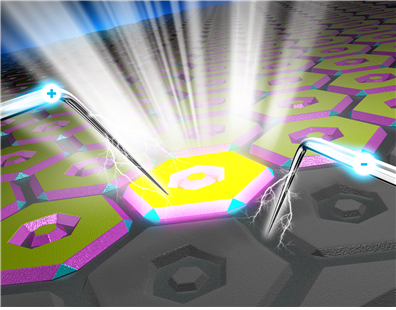
Schematic diagram of a micro-sized truncated pyramid-shaped composite structure that emits white light by current injection without using a phosphor.
(Image: Provided by KAIST)
Through the change of three-dimensional structure area control
White LED demonstration with a single chip
This microscopic three-dimensional structure forms quantum wells with different conditions on each face, allowing each face to emit light of a different color. Ultimately, this allows for the mixing of various colors within a single structure, eliminating the need to combine multiple LED colors. By controlling the time and conditions for creating a three-dimensional structure and changing the area of each crystal plane, LEDs with various mixed colors can be produced.
The research team demonstrated a phosphor-free white LED using a single LED chip by adjusting the area of each crystal plane. Furthermore, the color remained virtually unchanged even when the current applied to the LED was varied. This represents an early stage of phosphor-free white LEDs and is significant in that it suggests a direction for future phosphor-free white light sources.
Professor Cho said, "If efficiency is improved through future 3D semiconductor process development, it could be used as a single-chip white light source that is inexpensive and offers excellent color reproducibility without the need for phosphors." Meanwhile, this research was published online on the 12th in the journal "Light: Science & Applications," published by Nature, and its importance was recognized, leading to its selection as the cover paper for the print edition.
Comments
Related news

Solar Science Enters IoT-Based LED Smart Lighting Business
LED lighting specialist SollaScience has entered the IoT smart lighting business, recently completing the supply and installation of LED smart lighting with IoT-based wireless power-saving technology at an underground passage of a highway toll gate.
2015.12.24by

LG U+ Selected as Preferred Negotiator for Wando County LED Security Lighting Improvement Project
LG Uplus announced that it has been selected as the preferred negotiation partner for the 'Wando-gun LED Security Lighting Improvement Project,' which has drawn considerable attention through commissioned bidding with a specialized agency. This 'Wando-gun LED Security Lighting Improvement Project' was promoted through a comprehensive consignment by Wando-gun to the Korea Photonics Industry Promotion Agency, a specialized institution.
2016.01.15by
Samsung Electronics Launches LED Modules for Industrial Lighting
Samsung Electronics has launched 'inFlux,' a high luminous flux LED module optimized for industrial lighting, and is beginning its full-scale initiative to capture the LED module market. Luminous flux refers to the total amount of light emitted from a light source.
2016.02.02by

Intel Unveils Next-Generation 'Core Ultra Series 3' and vPro Platform for Enterprise PCs
Intel has officially unveiled the "Intel Core Ultra Series 3" for next-generation enterprise PCs and the latest vPro platform, addressing a wide range of demands from enterprise notebooks to high-performance workstations.
2026.03.26by 배종인 기자

ROHM Launches ESD Protection Diode Compatible with High-Speed Interfaces of 10Gbps or Higher
Semiconductor specialist ROHM has developed the 'RESDxVx series' of ESD (electrostatic discharge) protection diodes capable of responding to next-generation high-speed data communication environments exceeding 10Gbps, simultaneously enhancing both signal quality maintenance required in high-speed interfaces and IC protection performance.
2026.03.26by 배종인 기자











