



Mentor Graphics Launches Emulation for Comprehensive System Design Verification
 Published2016.02.25 14:26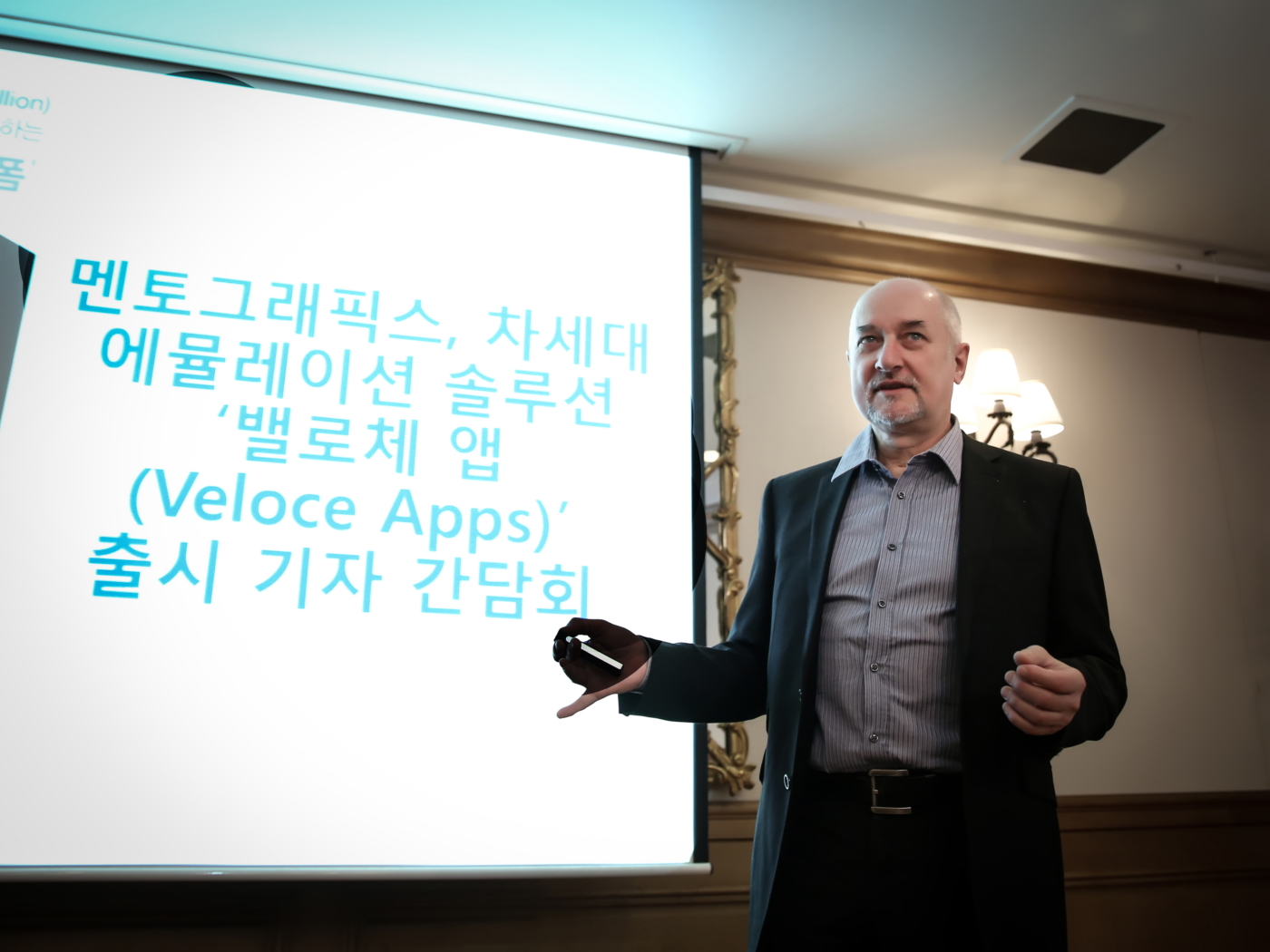
'Veloce App', through a series of hardware and software integration verifications
Perform low-power verification, power estimation, and performance characteristic analysis.
SoC and system designs are becoming increasingly complex. With multiple processors, protocol interfaces, and extensive software, what solution is appropriate for verifying all this complexity?
On February 22nd, a Mentor Graphics press conference was held at the Ritz-Carlton Hotel in Yeoksam-dong, Seoul. The presentation was led by Gabriele Pulini (pictured), Product Marketing Manager for the Emulation Department at Mantor Graphics.
“The emulation market is growing bigger than the simulation market,” he explained. “The ‘Veloce App’ released by Mantographics can solve important verification problems in system design.”
Users of emulation solutions have traditionally relied on in-circuit emulation (ICE) environments for comprehensive verification, leaving them vulnerable to ICE model debugging issues. Mentor Graphics' Veloce Deterministic ICE solution enables users to capture and analyze waveforms and root cause information at any point during verification through unique waveform streaming technology within the ICE environment.
The Veloce app consists of Mantographics' emulation solutions, including 'Veloce Deterministic ICE', 'Veloce DFT', and 'Veloce FastPath'.
Veloce Deterministic ICE overcomes the unpredictability of in-circuit emulation (ICE) environments by adding visibility and repeatability for debugging, and provides access to other "virtual-based" use models. Veloce DFT accelerates Design for Test (DFT) verification time to minimize the risk of catastrophic failures before tapeout, and significantly reduces runtime during design verification after DFT insertion. Veloce FastPath optimizes emulation performance by enabling faster model execution when verifying large, multi-clock SoC designs.
 Improved verification processing speed performance compared to hardware-centric strategies
This allows software to address design risks much more quickly than hardware-centric strategies when running on hardware with adequate performance and a scalable operating system.
Additionally, the Veloce OS operating system allows for easy integration of usage models that increase the return on investment for the emulator. Its plug-and-play operation accommodates flat and hierarchical designs, and its reduced memory requirements for compilation through flow improves performance.
"These latest innovations are increasing our customers' overall verification throughput performance," said Eric Selosse, Vice President and General Manager of Mentor's Emulation Business Unit. "Focusing on software applications for specific SoC and system-level problems will drive the future of emulation."
(Mentor Graphics press conference, courtesy of Mentor Graphics)
Comments
Related news

Mentor Graphics Supplies 'Capital' Electrical System Tools to GM Vehicle Development Project
Mentor Korea (www.mentorkr.com, CEO Yang Young-in) announced that Mentor® Capital®, an electrical systems and wire harness domain design verification solution, will be utilized in General Motors' (GM) vehicle development project as an electrical systems design tool.
2016.02.16by 신윤오 기자

Intel Unveils Next-Generation 'Core Ultra Series 3' and vPro Platform for Enterprise PCs
Intel has officially unveiled the "Intel Core Ultra Series 3" for next-generation enterprise PCs and the latest vPro platform, addressing a wide range of demands from enterprise notebooks to high-performance workstations.
2026.03.26by 배종인 기자

ROHM Launches ESD Protection Diode Compatible with High-Speed Interfaces of 10Gbps or Higher
Semiconductor specialist ROHM has developed the 'RESDxVx series' of ESD (electrostatic discharge) protection diodes capable of responding to next-generation high-speed data communication environments exceeding 10Gbps, simultaneously enhancing both signal quality maintenance required in high-speed interfaces and IC protection performance.
2026.03.26by 배종인 기자
ST Launches 75V Drive IC Targeting 48V Industrial Motor Driving
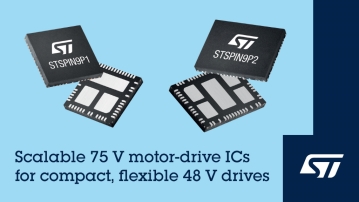
ST Microelectronics has unveiled the 'STSPIN9P' series of 75V motor drive ICs tailored for 48V-class industrial drive system design. The new product family is characterized by half-bridge and full-bridge configurations that enable design scalability according to motor type and output conditions. Power supply circuits, protection functions, and current sensing circuits are integrated on-chip to simplify system configuration, and the devices are designed to support applications up to 500W maximum. The company plans to provide reference designs and demo boards to support development and evaluation in industrial automation, robotics, pumps, fans, lighting, and textile machinery.
2026.03.26by 배종인 기자
Nordic supports security updates for the entire lifecycle of IoT devices at a single fixed cost
Nordic Semiconductor, a global leader in low-power wireless connectivity solutions, has unveiled a single fixed-cost licensing model that delivers FOTA (Firmware Over-the-Air) and device management capabilities throughout the device lifecycle via nRF Cloud, and introduced a new firmware update solution to prepare for the enforcement of the European Union's Cyber Resilience Act (CRA).
2026.03.26by 배종인 기자











